
Your needs, this model
Does it fit your priorities?
Does the TS-433eU-US meet a four-native-bay minimum, and which drive categories does QNAP list?
QNAP's U.S. hardware selector lists four native 3.5-inch SATA positions, 3.5-inch SATA hard drives and 2.5-inch SATA SSDs. It does not list 2.5-inch SATA HDDs as a selector category. The current exact-family compatibility response names 205 3.5-inch HDD and 55 SSD entries with returned model, capacity, interface and firmware fields; some HDD strings are wildcards, and one exact model appears with two firmware entries. Check the complete intended drive code and firmware. The lack of a separate 2.5-inch HDD category proves neither support nor incompatibility for an individual drive. Four is the supported physical bay count; a five-native-bay minimum excludes it.
Explore this need in the finder →Does either built-in Ethernet port meet a 2.5-Gbps single-port floor, or do the two ports add together?
Each of the two built-in ports is individually rated at 2.5GbE, so one meets a 2.5-Gbps single-port threshold. The two jacks are not one 5-Gbps link, and port trunking/SMB Multichannel does not guarantee that speed to one client. The switch or router, peer, cabling, disk set, configuration and workload shape real transfers.
Explore this need in the finder →Can two selected drives form a QTS RAID 1 mirror while leaving other native positions, and is that a backup?
Yes. The model's four-bay QTS software row lists RAID 1, and QNAP's QTS guide defines that mode as two disks with an identical copy on each and tolerance of one disk failure. The owner selects and verifies two compatible drives, installs them and creates the pool; the manual lists no data drives or prepared array in the package. Two native positions remain physically unassigned at first, but another pool or later expansion depends on the chosen setup. A mirror is not a separate backup; keep an independent restorable copy.
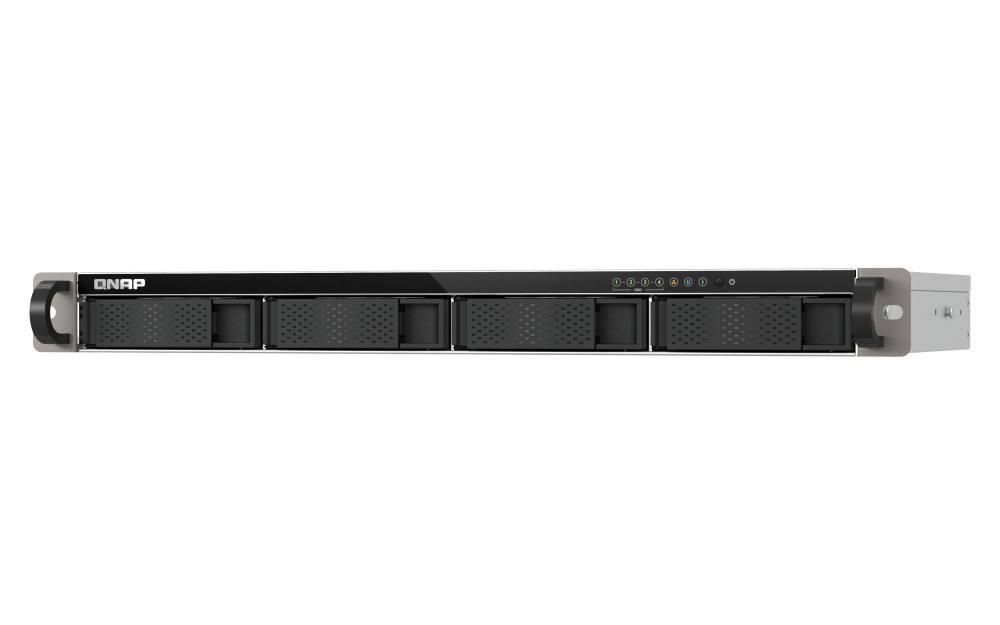
Explore this need in the finder →The TS-433eU-US is a compact, four-bay QNAP NAS whose defining combination is a 1U short-depth rack chassis and two individual 2.5GbE ports. This review evaluates the exact U.S. Store identity against QNAP's current model page, hardware selector and English-U.S. user guide. It is a document-based assessment, not a hands-on test: no independent throughput, setup, noise, power or reliability results are claimed.
Who should consider this short-depth rack profile?
The strongest fit is someone who specifically wants four native SATA positions in a low-depth rack unit and can use a 2.5GbE link. QNAP lists the chassis at 1.7 × 16.93 × 11.51 inches (H × W × D), and identifies it as a 1U short-depth rackmount NAS. That nominal depth is useful when comparing chassis, but it is not a complete rack-fit measurement: rack posts, rails, door swing, power and network cables, ventilation and front service access all affect installation. A product-page dimension alone cannot settle those clearances.
Rail procurement needs extra care. QNAP's guide says rail kits are sold separately. Its earlier rail table lists RAIL-B02 and RAIL-S01 with different post-depth ranges, but a later section names only RAIL-B02; QNAP's product-page accessory list also marks RAIL-S01 as end-of-life. The current exact-family compatibility response names RAIL-B02 and RAIL-S01 too, but both list entries leave their descriptions blank, so they do not reconcile the manual conflict or establish a current package or fit. Ask QNAP or the seller to confirm the exact rail revision and measure the cabinet before ordering.
Drive compatibility is a separate check
The hardware selector identifies four hot-swappable 3.5-inch SATA bays and lists 3.5-inch SATA hard drives and 2.5-inch SATA SSDs as media categories. It does not list 2.5-inch SATA hard drives for this profile. QNAP's current exact-family compatibility response includes 205 named 3.5-inch HDD entries and 55 SSD entries with returned model, capacity, interface and firmware fields. An identical HDD model label, ST24000NM002H, appears with two different firmware entries, and other labels contain wildcards; check the complete drive code and firmware rather than assuming a whole family is approved. The response has no separate 2.5-inch HDD category, which proves neither support nor incompatibility for a particular 2.5-inch drive. A compatibility entry also does not mean the drive is included in the TS-433eU-US box. Verify the exact intended disk and seller package before ordering.
The English-U.S. guide's standard package table lists the NAS, a power cord, a Cat5e cable, drive screws, a handle kit and a quick guide; it does not list data drives or rack rails. The guide says the included Cat5e lead supports up to 2.5Gbps. The exact U.S. Store page establishes the TS-433eU-US SKU, not any retailer-added bundle, so check the final order contents rather than assuming disks, rails or other parts are included. The model page also describes a separate USB-connected TR-004U expansion path; that enclosure is an additional product and does not increase the TS-433eU's four native bays.
RAID 1 is a setup choice, not a prepared array
QNAP's software table lists RAID 1 for its four-bay QTS arrangement and EXT4 for internal drives. QNAP's general QTS guide defines RAID 1 as two disks with an identical copy on each, tolerating one member-disk failure while using half of their combined raw capacity. The owner still has to select compatible drives, install them, initialize QTS and create the pool. Nothing in the reviewed sources says that this U.S. SKU ships with drives or an initialized mirror. A two-drive mirror leaves two physical trays unassigned at the outset, though what to do with those positions later depends on the chosen storage plan.
That redundancy is narrower than backup. It does not protect against deletion, malware, theft, electrical damage or a failed pool, and a second network port is not a second copy of the data. Plan a separate, restorable backup outside the NAS. QNAP lists other four-bay layouts as well, but RAID 5, RAID 6 and RAID 10 use different drive counts and failure tradeoffs; do not treat their capacity or tolerance as interchangeable with a two-drive mirror.
Two 2.5GbE links do not make one 5GbE port
Each built-in Ethernet jack is rated at 2.5GbE, so the model clears a 2.5-Gbps minimum for one physical port. The pair can support networking configurations that QNAP describes, including port trunking or SMB Multichannel, but those labels are not a promise of one 5-Gbps connection to a client. A suitable switch or direct peer, client NIC, cabling, storage layout, protocol settings and workload all influence the complete path. Buyers needing one faster built-in interface should compare the separately reviewed TS-432XeU-4G-US, which has an individual 10GbE SFP+ port and therefore a different peer-and-cabling requirement. A 3-Gbps single-port floor excludes the TS-433eU-US.
Fixed memory shapes the workload decision
The U.S. selector lists 4 GB of onboard memory and says it is non-expandable. That is a real ceiling rather than a starting module to upgrade later. QNAP describes a built-in NPU for QuMagie image-recognition tasks and promotes container use, but neither feature establishes how a buyer's particular application mix will perform. Check current QTS app requirements, simultaneous users, indexing and backup workloads against the fixed memory before treating the unit as an all-purpose server. The four-core ARM Cortex-A55 specification identifies the processor class; it is not an independent speed test.
How it differs from similarly named QNAP models
The desktop TS-433-4G shares a four-bay, fixed-4-GB idea but is a tower with one 2.5GbE port and a separate 1GbE port. This eU version is a rack chassis and has two 2.5GbE links. The TS-432XeU is another short-depth rack model, but its reviewed U.S. configuration adds a 10GbE SFP+ port and uses a memory module that QNAP lists as expandable; it is not a drop-in synonym for TS-433eU. Compare exact suffixes, port types, memory profile and rack parts rather than choosing by the similar number alone.
Bottom line: the TS-433eU-US is a focused candidate when four SATA bays, 1U short depth and individual 2.5GbE links are the requirements. Its fixed 4 GB memory, the need to verify an exact drive/firmware entry and conflicting rail guidance are material checks, not minor footnotes. It is not the right match for a five-bay minimum or a request for a single built-in port faster than 2.5GbE. Confirm drives, rack hardware and the seller's exact box before purchase.
Key specifications
Key details at a glance
| Internal drive bays | 4 bays |
|---|---|
| Documented internal drive media | 3.5-inch SATA HDD / 2.5-inch SATA SSD |
| Built-in Ethernet ports | 2 built-in 2.5GbE Ethernet ports |
| Fastest individual Ethernet port | 2.5 Gbps |
| Installed system memory | 4 GB |
| Listed storage arrangements | JBOD / Single / RAID 0 / RAID 1 / RAID 5 / RAID 6 / RAID 10 |
| Internal file systems | EXT4 |
| USB 3.2 Gen 1 ports | 2 |
| Hardware warranty | 3 years |
| Data drives included in listed package | No |
| Processor | ARM Cortex-A55 |
| CPU cores | 4 |
Use the exact model’s instructions for operating limits, supplied equipment and version differences.
Sources for this review
Sources for this assessment
- QNAP U.S. Tower / SMB product grid — TS-433eU family card
- TS-433eU U.S. product page | QNAP
- Rendered TS-433eU U.S. hardware/software selector | QNAP
- TS-433eU User Guide | QNAP
- TS-433eU-US exact item | QNAP U.S. Official Store
- QNAP U.S. Official Store short-depth rackmount category — TS-433eU-US card
- TS-433eU exact-model drive compatibility route | QNAP
- QTS RAID type comparison | QNAP
- Getting started with NAS storage | QNAP
- Official QNAP TS-433eU image from the exact U.S. product page
- TS-433eU current compatibility list | QNAP

Check your setup before choosing a NAS
Use the finder to check bay count, the network link you need, and whether a documented two-drive redundant arrangement is essential.