
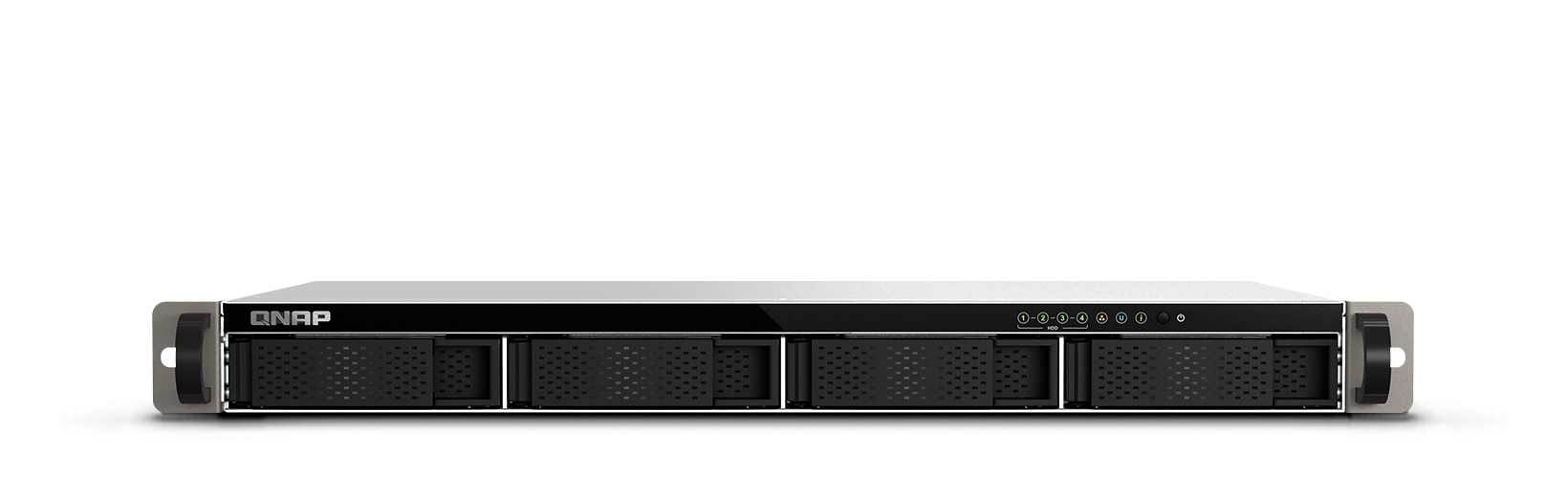
Your needs, this model
Does it fit your priorities?
What exactly counts as a drive bay on the TS-432XeU?
QNAP lists four native 3.5-inch SATA positions and names 3.5-inch SATA hard drives and 2.5-inch SATA solid-state drives as supported media categories. The table does not list 2.5-inch HDDs for this profile, and its broad categories do not approve a particular drive model, capacity or firmware. Check the exact disk on QNAP's current compatibility list before buying. The four positions meet a four-bay minimum; they do not meet a five-native-bay minimum.
Explore this need in the finder →Is the TS-432XeU's 10GbE port an RJ45 jack, and will it deliver 10Gbps transfers?
No on both points: QNAP lists one 10GbE SFP+ interface plus two separate 2.5GbE RJ45 ports. A single 10-Gbps SFP+ link meets a 10-Gbps individual-port floor without an add-in NIC, but it requires a compatible peer and the right supported DAC, transceiver or fiber route. Router or switch, client, cabling, storage, configuration and workload affect the actual path; no 10-Gbps file-transfer result is promised. A 10.5-Gbps single-port floor excludes this model.
Explore this need in the finder →Can two drives provide redundancy in a TS-432XeU, and is that a backup?
Yes to the first question: the U.S. four-bay QTS software row lists RAID 1 and EXT4, so a buyer-created two-drive mirror is a documented arrangement. Supply two exactly compatible drives, choose the QTS layout and create the pool; neither an installed drive pair nor a prepared array is documented as included. RAID 1 can help with one drive failure but is not an independent backup—keep another restorable copy elsewhere.
Explore this need in the finder →This is a source-based assessment of QNAP's TS-432XeU-4G hardware profile and its exact U.S. retail identity, TS-432XeU-4G-US. I have not owned, installed, measured or tested the appliance. Its strongest documented fit is a small office, branch or equipment cabinet that needs four internal SATA positions and one built-in 10GbE SFP+ link in a short-depth 1U chassis. That fit depends on verifying the rack hardware, disks and network path rather than treating a product page as a ready-to-run system.
Confirm the exact name and package
The U.S. manufacturer selector presents one TS-432XeU-4G profile; QNAP's U.S. Store page identifies the NAS configuration as TS-432XeU-4G-US. The U.S. Tower/SMB family card and a separately observed short-depth Store card resolve to this same model, not to two different NAS units. This assessment is for the small-e TS-432XeU, not QNAP's desktop TS-432X or the separately named TS-435XeU. Similar naming is not a reason to import another model's slot, processor or network details.
QNAP's standard package list names the NAS, one Ethernet cable, a power cord, screws, two hangers, two holders and a quick installation guide. The listed parts do not include data drives, an SFP+ transceiver or DAC, or sliding rack rails. That list is a useful starting point, not a guarantee about an individual reseller's bundle. Before checkout, confirm the exact TS-432XeU-4G-US item, what drives and mounting pieces are actually supplied, and whether any optional selection changes the configuration.
Four native bays, but check the precise drive
The U.S. hardware table lists four 3.5-inch SATA bays and names 3.5-inch SATA hard drives and 2.5-inch SATA solid-state drives as supported media categories. It does not name 2.5-inch hard drives in that model's drive-compatibility field. Even the listed categories do not approve every capacity, firmware revision or disk model. QNAP's model-filtered compatibility route was a generic shell without itemized approval rows when checked, so no specific drive can be called compatible on the evidence captured here. Check the full drive model and firmware against QNAP's current list before ordering or initializing a pool.
Four positions offer more layout choices than a two-bay box, but do not translate directly into usable capacity. The drive capacities, filesystem overhead and selected RAID arrangement all affect what remains available. QNAP's four-bay QTS table lists RAID 1 as one option; the appliance is not described as shipping with drives or a pre-created mirror. If you use two disks in RAID 1, plan for capacity closer to one drive before overhead rather than adding both raw sizes together. A mirror can help with one disk failure; it does not protect against deletion, malware, theft or damage to the whole unit. Keep a separate restorable backup.
One 10GbE SFP+ link means a network project
QNAP lists one built-in 10GbE SFP+ port and two separate 2.5GbE RJ45 ports. The 10GbE connector is SFP+, not copper RJ45, and its link rating is not a promise of file-copy speed. The server or workstation, switch, cable, transceiver or direct-attach cable, storage drives, protocol settings and workload all shape the path. The included Ethernet lead does not create an SFP+ connection. A 10GbE switch, matching transceiver or DAC, a compatible client NIC and cable plan can add cost and setup work; check each side of the link before choosing this NAS for a faster transfer workflow. The two 2.5GbE ports remain separate connections rather than an assumed single faster port.
The 1U short-depth format is the main space-saving distinction. QNAP describes a 292 mm / 12-inch chassis and lists dimensions of 1.7 × 16.93 × 11.5 inches, H × W × D, excluding the ear hooks and the projecting power-supply portion. Those numbers do not prove fit in a particular wall cabinet or rack: check rack-post spacing, rail depth, door clearance, cable bend room and ventilation. The manufacturer selector lists a 100 W power supply and three 40 mm fans; those are published component specifications, not noise or power measurements. The standard list shows hangers and holders, but no sliding rail kit, so do not assume that the NAS can be mounted with your preferred hardware out of the box.
QTS and the single memory ceiling
The hardware selector describes a quad-core 1.70 GHz ARM Cortex-A57 system with 4 GB of DDR4 memory in one SODIMM slot and a maximum of 16 GB in a single module. QNAP's memory note advises using supported modules; a maximum number is not approval for any third-party part. There is one documented operating-system family here: QTS. Its four-bay software row lists RAID 1 and EXT4. QNAP's displayed point-version text did not agree across the current page and cached content, so the assessment avoids pinning a QTS release number. The selector supports a straightforward QTS/EXT4 mirror scenario, but the owner still has to select disks, choose the layout and complete setup.
Who should shortlist it?
The TS-432XeU-4G-US is a focused candidate when the non-negotiables are four internal SATA bays, a compact 1U depth and a built-in single-port 10GbE link. Its 4 GB base memory and 16 GB limit are worth noting for an office choosing software workloads; processor clock rate alone cannot predict how many services or users will feel responsive. It is less suitable for a buyer who needs built-in copper 10GbE, a five-bay chassis, a specific already-certified disk, included rails, a fully equipped SFP+ path or an independent speed guarantee.
QNAP's product-specific download route showed no English TS-432XeU manual in the captured text, and its compatibility page did not expose a drive list. Those limits are explicit: a later manual may exist, but this review does not substitute another QNAP model's instructions. Read the QNAP TS-432XeU product page, its U.S. hardware table, software table, package contents and model compatibility route alongside the actual order details. Compare the exact NAS configuration, verify drives and rack hardware, and map the whole SFP+ route before buying. The TS-432XeU is a compact set of documented capabilities—not a preconfigured storage plan.
Key specifications
Key details at a glance
| Internal drive bays | 4 bays |
|---|---|
| Documented internal drive media | 3.5-inch SATA HDD / 2.5-inch SATA SSD |
| Built-in Ethernet ports | 1 built-in 10GbE SFP+ port / 2 separate built-in 2.5GbE RJ45 ports |
| Fastest individual Ethernet port | 10 Gbps |
| Installed system memory | 4 GB |
| Maximum listed memory | 16 GB |
| Listed storage arrangements | JBOD / Single / RAID 0 / RAID 1 / RAID 5 / RAID 6 / RAID 10 |
| Internal file systems | EXT4 |
| USB 3.2 Gen 1 ports | 4 |
| Hardware warranty | 3 years |
| Data drives included in listed package | No |
| Processor | Annapurna Labs Alpine AL324 / ARM Cortex-A57 |
| CPU cores | 4 |
| Installed memory type | DDR4 SODIMM |
Use the exact model’s instructions for operating limits, supplied equipment and version differences.
Sources for this review
Sources for this assessment
- QNAP U.S. Tower / SMB product grid — TS-432XeU family card
- TS-432XeU — QNAP U.S. product page
- TS-432XeU U.S. hardware specifications — QNAP rendered selector
- TS-432XeU U.S. software specifications — QNAP rendered selector
- TS-432XeU U.S. package contents — QNAP rendered selector
- QNAP U.S. Official Store — TS-432XeU-4G-US exact item
- QNAP launch notice for TS-432XeU — QNAP U.S. newsroom
- QNAP Download Center route filtered for TS-432XeU
- QNAP compatibility route filtered for TS-432XeU
- Official QNAP TS-432XeU feature image attached to the U.S. product page
- QNAP U.S. Official Store 1U rackmount category — finite observed response

Check your setup before choosing a NAS
Use the finder to narrow documented desk/shelf or rack formats, internal-bay minimums, a single Ethernet-port rating and optional redundancy requirements.