
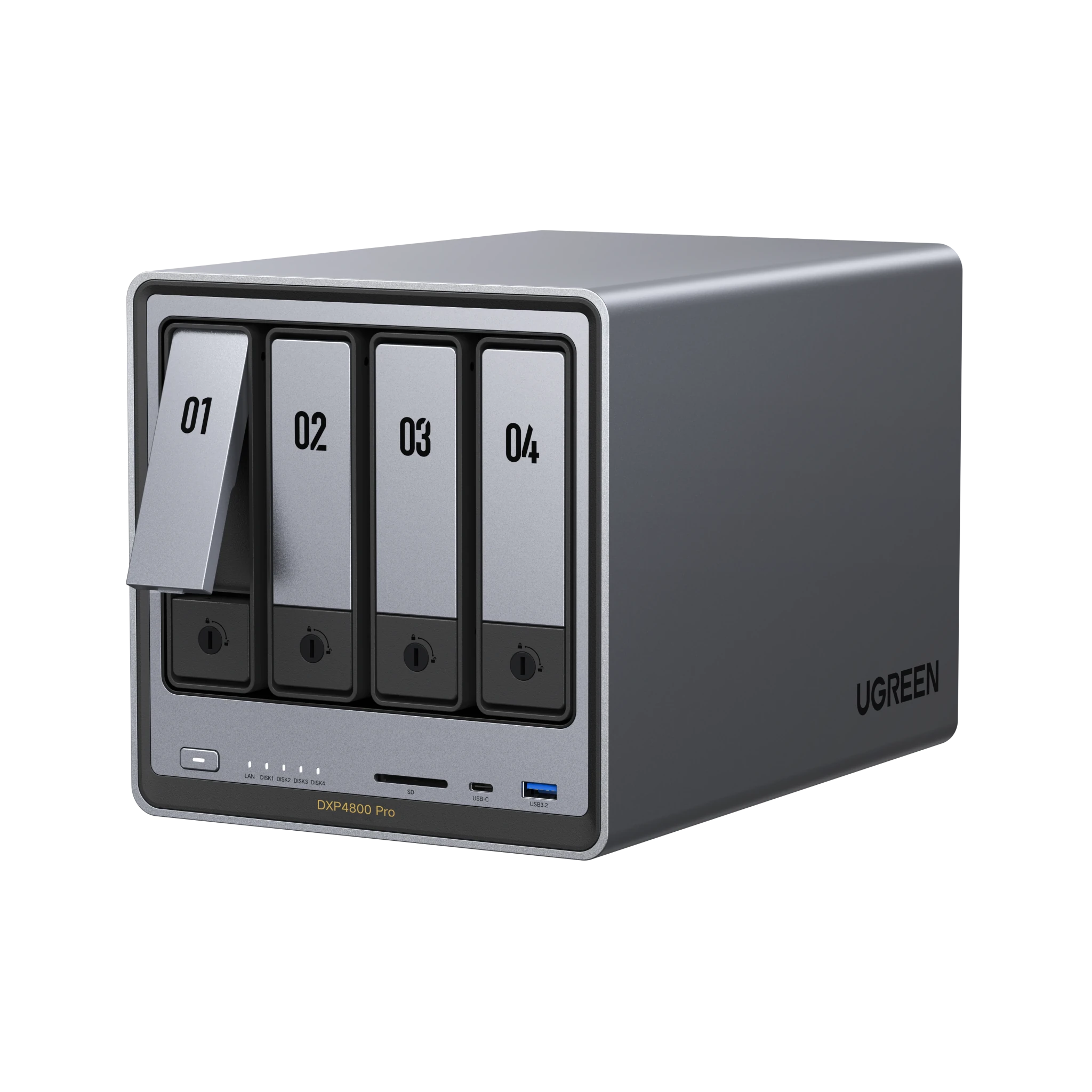
Your needs, this model
Does it fit your priorities?
Can the standalone DXP4800 Pro meet a four-bay, 10GbE and RAID 1 requirement?
Yes as a possible buyer-created arrangement: UGREEN documents four SATA bays, an individual 10GbE port and RAID 1 with a two-drive minimum. The mirror would use two trays and leave two open, but the NAS is diskless and no pair or initialized pool is included. Check the exact drives for compatibility, ensure the entire network path supports 10GbE, and keep a separate backup.
Explore this need in the finder →Does the DXP4800 Pro ship with 144 TB of usable storage?
No. The 144-TB maximum combines four 32-TB SATA drives and two 8-TB M.2 SSDs as raw installed capacity; the standalone NAS is diskless. Cache, separate SSD pools, RAID layout, system use and formatting affect what can be stored in each volume.
Explore this need in the finder →Will its 10GbE port guarantee a 10Gbps file copy?
No. The port’s 10GbE rating is one link’s nominal rate, not a measured transfer result. UGREEN says the client, switch or direct link, suitable cable, drive performance, RAID layout and workload also limit throughput; a second 2.5GbE port does not turn the first into one faster port.
Explore this need in the finder →What makes the DXP4800 Pro different from the DXP4800 Plus?
Both have four SATA bays, two M.2 positions, a 128-GB system SSD, 10GbE plus 2.5GbE and a stated 144-TB raw maximum. UGREEN lists the Pro’s six-core/eight-thread i3-1315U and 96-GB maximum memory, versus the Plus’s Pentium Gold 8505 and 64-GB maximum. That is a paper specification difference, not proof of a particular workload advantage.
Explore this need in the finder →This assessment covers the U.S. standalone DXP4800 Pro variant identified by UGREEN as SKU 85888. It is based on UGREEN’s product page, model comparison and support materials, not a hands-on test. UGREEN’s selector separately names a DXP4800 Pro + UPS3000 package; that is a different configuration with its own review. The maker’s displayed capacity and link rates are specifications, not independent measurements or promises about a seller’s offer.
Four SATA bays and a separate M.2 tier
The DXP4800 Pro gives a buyer four internal SATA positions plus two M.2 NVMe slots. Do not count those M.2 positions as fifth and sixth SATA trays. UGREEN describes M.2 SSDs for caching or as a separate SSD pool, so their capacity may not belong to the same storage pool as the SATA drives. The stated 144-TB maximum combines four 32-TB SATA drives and two 8-TB M.2 SSDs as raw installed capacity. It is neither included storage—the standalone NAS is diskless—nor a claim that one RAID volume can use all of it.
The maker lists Basic, JBOD, RAID 0, 1, 5, 6 and 10. A possible two-drive RAID 1 mirror can use two trays and leave two open; it is an arrangement the buyer would create with compatible drives, not a prepared array in the box. UGREEN’s own example with four equal 8-TB SATA drives estimates about 24 TB for RAID 5 and 16 TB for RAID 6 or RAID 10, before system, file-system and unit-conversion overhead. Those modes make different failure and recovery trade-offs. A mirror or parity array helps with specified drive failures; neither is a separate backup against deletion, malware, theft or enclosure loss. Use the manufacturer’s RAID calculator to compare a specific layout, then verify every full drive model and capacity in the current UGREEN compatibility list.
What “Pro” changes—and what it does not
UGREEN’s comparison describes the DXP4800 Pro as a six-core, eight-thread Intel Core i3-1315U system with 8 GB of DDR5 memory and a stated 96-GB maximum across two SODIMM slots. The DXP4800 Plus uses a Pentium Gold 8505 and has a stated 64-GB ceiling. The Pro’s processor and memory limit are the meaningful documented differences for someone planning virtual machines, containers, indexing or several simultaneous jobs. They are not benchmark evidence, and more memory cannot make an unsupported drive or application compatible. UGREEN says the exact module should be checked against its model-specific list; the base unit does not include an upgrade.
The two four-bay models otherwise share important practical boundaries in UGREEN’s comparison: four SATA bays, two separate M.2 positions, a 128-GB system SSD and one 10GbE port plus one 2.5GbE port. The Pro’s listed 4K HDMI output and SD 3.0 reader are useful connections to account for, but no particular media workflow or simultaneous VM load is proven by a feature checklist. UGREEN’s product copy alternates between “UGOS” and “UGOS Pro” labels in different areas, so check the actual software version and current downloads for the received unit.
A 10GbE connector is only one part of the path
One built-in 10GbE RJ45 port gives this NAS a nominally faster connection than a 2.5GbE-only model; the other RJ45 port is a separate 2.5GbE link. Their ratings are not added together into a single 12.5-Gbps port. A 10-gigabit client adapter and switch—or a compatible direct link—plus suitable cabling are needed before the faster connection can be used. UGREEN suggests Cat6a, or Cat6 for short runs. Even with those pieces, drive speed, RAID layout, file size, protocol overhead and other workloads constrain transfer rates. The stated 1.25-GB/s line rate is a theoretical link ceiling, not a file-copy result.
Package checks before choosing
UGREEN identifies the standalone selection as SKU 85888 and says storage disks are sold separately. Its product page has separately named package variants, including + UPS3000; do not infer an accessory from a generic model title. Confirm the exact variant, seller’s contents and warranty route, then check the desired disks, SSDs and any memory modules by full model number. Also map every part of the network from NAS to client and decide which RAID or pool will be initialized. A two-year maker warranty statement is not a guarantee of any reseller’s terms.
The DXP4800 Pro is worth comparing when four native SATA bays, a 10GbE path and the i3/96-GB paper ceiling fit a real workload better than the Plus. It is less suitable if you want a ready-filled volume, a tested throughput target or an all-in-one power-protected network. Review the DXP4800 Plus assessment for the less expandable processor configuration, and consult UGREEN’s model comparison and download center before finalizing a build. No stock, retailer listing identity, included drives, preconfigured RAID or measured performance is asserted here.
Key specifications
Key details at a glance
| Internal drive bays | 4 bays |
|---|---|
| Documented internal drive media | 3.5-inch SATA HDD / 2.5-inch SATA HDD / 2.5-inch SATA SSD |
| Built-in Ethernet ports | 1 × 10GbE RJ45 / 1 × 2.5GbE RJ45 |
| Fastest individual Ethernet port | 10 Gbps |
| Installed system memory | 8 GB |
| Maximum listed memory | 96 GB |
| Listed storage arrangements | Basic / JBOD / RAID 0 / RAID 1 / RAID 5 / RAID 6 / RAID 10 |
| Hardware warranty | 2 years |
| Data drives included in listed package | No |
| M.2 NVMe slots | 2 |
| M.2 SSD storage-pool support | Yes |
| Processor | Intel Core i3-1315U |
| CPU cores | 6 |
| CPU threads | 8 |
| Installed memory type | UGREEN lists 8 GB DDR5 across two SODIMM slots with a stated 96-GB maximum. It says module support is model-specific; no upgrade is included or endorsed. |
Use the exact model’s instructions for operating limits, supplied equipment and version differences.
Sources for this review
Sources for this assessment
- UGREEN NASync DXP4800 Pro U.S. product page; standalone SKU 85888
- UGREEN DXP4800 Pro product JSON and selector variants
- UGREEN U.S. NAS collection
- UGREEN DXP Series U.S. collection
- UGREEN NAS model specification comparison
- UGREEN model-specific drive and component compatibility list
- UGREEN NAS download center and model documentation selector
- UGREEN RAID and capacity guidance
- UGREEN UGOS software, Docker and virtual-machine information
Check your setup before choosing a NAS
Use the finder to check bay count, the network link you need, and whether a documented two-drive redundant arrangement is essential.