
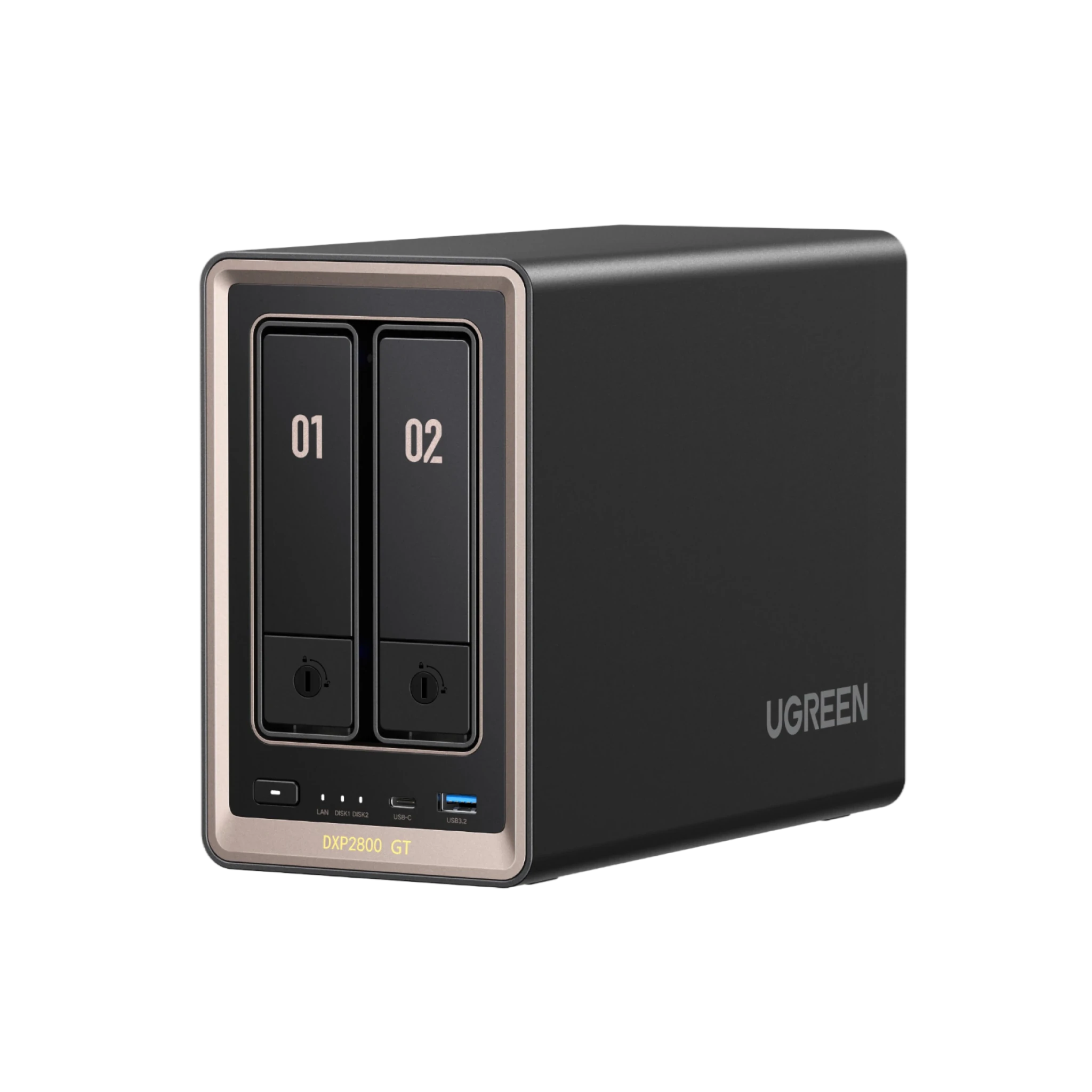
Your needs, this model
Does it fit your priorities?
Can the standalone DXP2800 GT meet a two-bay, 10GbE and RAID 1 requirement?
Yes as a possible buyer-created setup: UGREEN lists two SATA bays, a single 10GbE RJ45 port and RAID 1. The two-disk mirror would use both SATA trays, but the standalone NAS is diskless; select compatible drives, initialize the layout yourself and keep a separate backup. A 10GbE port is a link rating, not a measured file-transfer result.
Explore this need in the finder →Does the DXP2800 GT include 80TB of usable RAID 1 storage?
No. UGREEN's 80TB figure combines two 32TB SATA positions and two 8TB M.2 positions as a maximum raw sum; the NAS is diskless. A two-drive SATA mirror has the capacity of the smaller member before formatting and system overhead, while the M.2 drives remain separate storage decisions.
Explore this need in the finder →Does one built-in 10GbE port promise 10Gbps file copies?
No. The port's nominal rate is only one part of a complete path. The network peer, client port, cable, storage drives, operating setup and workload can limit actual throughput; no file-copy benchmark was performed for this assessment.
Explore this need in the finder →Is every U.2 SSD guaranteed to work because UGREEN mentions U.2 support?
No. The U.S. page advertises optional U.2 SSD support but its detailed table separately lists two SATA bays and two M.2 SSD positions without naming a U.2 adapter or tested U.2 part number. Check UGREEN's exact-model compatibility information and the selected package before relying on that expansion route.
Explore this need in the finder →This is a source-based assessment of the U.S.-listed UGREEN NASync DXP2800 GT, not a hands-on review or a performance test. Its appeal is unusually clear on paper: a compact two-bay enclosure with a single built-in 10GbE port, two separate M.2 positions and an AMD Ryzen Embedded processor. Its main compromise is also clear: it still has only two native SATA bays, and the base unit is diskless.
The GT changes the network link, not the bay count
UGREEN lists two SATA drive bays and two M.2 SSD positions. Those are different storage interfaces; the M.2 slots do not create two extra SATA trays. Two SATA positions can support a buyer-created RAID 1 mirror because the exact model table lists RAID 1, but a two-drive mirror occupies both native SATA bays. That leaves no third SATA position for straightforward later expansion. RAID 1 can help keep data available after one member drive fails, but it is not another copy somewhere else: deletion, malware, theft or losing the complete NAS can still take out the array. Plan a separate backup and a restore process before treating the enclosure as protection. The main specification change from the reviewed standard DXP2800 is its network ceiling. UGREEN lists the older model with an Intel N100, DDR5 memory and one 2.5GbE connection; the GT moves to an AMD Ryzen Embedded R2514, DDR4 and a single 10GbE RJ45 port. The GT keeps the two-bay format. That is a meaningful fit change if your workstation and network already have 10GbE, but it is not evidence that a specific file job will be faster. If your router or switch, client port or cabling is limited to 1GbE or 2.5GbE, the faster NAS port does not upgrade those parts of the path.A 10GbE label is one link, not a transfer result
The exact product page names one RJ45 LAN port rated at 10GbE. That is an individual link rating, not a tested transfer rate. UGREEN's claims about editing footage or moving files describe intended uses, not a benchmark for a chosen drive pair, software, client and workload. Actual results depend on a suitable 10GbE peer, cable, client storage and drives; there is no second Ethernet port to combine. If the faster link is the reason to choose the GT, verify the whole path before upgrading other hardware.Read the 80TB headline as a raw sum
UGREEN advertises up to 80TB using two 32TB SATA devices plus two 8TB M.2 devices. That is a maximum raw sum across four positions; it is not 80TB of included storage or a promise of one usable volume. The standalone package is identified as diskless and the page says storage disks are sold separately. A two-SATA-drive RAID 1 pool would use the smaller member's capacity before formatting and system overhead. Treat M.2 storage separately unless the exact model documentation explains how it can share a storage pool with the SATA pair. The page also advertises optional U.2 SSD support, but the detailed specification table lists two SATA bays and two M.2 SSD positions without naming the U.2 adapter, a tested U.2 drive or an installation procedure. I would not buy a U.2 part from that sentence alone. Use UGREEN's compatibility list to select the exact DXP2800 GT and check the full drive model, capacity and interface. The same caution applies to memory: the table lists 8GB DDR4 installed and a 64GB maximum, but this assessment does not endorse an upgrade module.Check the specification conflicts before using every port
UGREEN's detailed table lists two rear ports as USB 2.0 and gives them a 5Gb/s rate. Those labels conflict, so I have not treated either the USB version or its speed as settled. The page also labels its memory feature “ODECC”; that does not establish an end-to-end ECC configuration. These details may not matter to a simple file-share setup, but buyers planning USB expansion or relying on a particular memory reliability feature should ask UGREEN for the exact model-specific explanation first. The manufacturer lists the case at 231.8 × 109.4 × 178.4mm. Those are device dimensions, not ventilation or cable-clearance guidance. Leave room for the network and power leads and for airflow, and treat UGREEN's 29–34dB noise figure as an unverified manufacturer claim: the inspected page does not state a measurement method or environment that would make it comparable with an independent test. No noise or workload testing was performed for this review.Who should shortlist the DXP2800 GT?
It is a plausible match when two SATA bays are enough, you want one 10GbE port for a compatible wired path, and you will supply two compatible drives and create the RAID 1 setup yourself. UGREEN's R2514, 8GB DDR4 and M.2 specifications do not establish how many Docker, virtual-machine, photo or surveillance services will run well together, or how long each app will remain supported. Confirm current software requirements for the tasks you need. Choose a larger NAS if you need more than two SATA bays or a straightforward growth path. The standard DXP2800 has a lower 2.5GbE ceiling and an Intel N100/DDR5 specification; those parts are not interchangeable with the GT. Before ordering, confirm the standalone GT selector, check drive and memory part numbers, verify your 10GbE path and plan a separate backup. This assessment uses manufacturer specifications, not ownership, bench testing, seller stock or a retailer-package claim.Sources: UGREEN DXP2800 GT U.S. product page, UGREEN compatibility list, and UGREEN RAID and capacity guidance.
Key specifications
Key details at a glance
| Internal drive bays | 2 bays |
|---|---|
| Documented internal drive media | SATA HDD |
| Built-in Ethernet ports | 1 × 10GbE RJ45 |
| Fastest individual Ethernet port | 10 Gbps |
| Installed system memory | 8 GB |
| Maximum listed memory | 64 GB |
| Listed storage arrangements | JBOD / Basic / RAID 0 / RAID 1 |
| Data drives included in listed package | No |
| M.2 NVMe slots | 2 |
| Processor | AMD Ryzen Embedded R2514 |
| CPU cores | 4 |
| CPU threads | 8 |
| Installed memory type | UGREEN lists 8GB DDR4 and a 64GB maximum. The exact compatible module and any upgrade are not included or endorsed; its table's ODECC label is not interpreted as an end-to-end ECC guarantee. |
Use the exact model’s instructions for operating limits, supplied equipment and version differences.
Sources for this review
Sources for this assessment
Check your setup before choosing a NAS
Use the finder to check bay count, the network link you need, and whether a documented two-drive redundant arrangement is essential.