
Your needs, this model
Does it fit your priorities?
Can the 16-GB F4-424 Pro meet a four-bay and 2.5-Gbps one-port requirement?
Yes, on the documented hardware: the exact specification lists four SATA positions and two individual 2.5GbE ports. The finder uses the rating of one port, not the pair's advertised aggregate or a guaranteed file-transfer result; the two M.2 cache sockets do not add SATA bays.
Explore this need in the finder →Can two selected drives use a redundant layout in this configuration?
The model specification lists RAID 1. A buyer could select two exact-model-compatible SATA drives and create a RAID 1 volume in two of the four native trays while using one individual 2.5GbE port. The manufacturer package reference does not list drives or a prepared array; verify the exact compatibility entry and keep a separate backup.
Explore this need in the finder →Does link aggregation make this a built-in 5-Gbps single-port NAS?
No. TerraMaster lists two individual 2.5GbE ports and link aggregation, but the matcher compares one built-in port; a 3-Gbps minimum is above either single-port rating. A workable aggregate path would need compatible peer networking and does not change the individual-port fact.
Explore this need in the finder →The 16-GB option is a distinct configuration
The F4-424 Pro is a four-tray desktop NAS built around Intel's Core i3-N305. The official model page has separate 16-GB and 32-GB memory selections; this assessment is for the 16-GB version, not an assumed 32-GB bundle. TerraMaster's exact 16-GB specification identifies one 16-GB DDR5 non-ECC SODIMM in a single slot and a 32-GB maximum. That gives a useful, concrete upgrade boundary: reaching 32 GB would require replacing the installed module rather than adding a second one. The sources do not establish a particular reseller's shipped unit or memory configuration, so check the selected listing and return terms before treating it as a specific package.
The processor and memory can matter to buyers planning multiple services or virtual machines, but component specifications are not workload results. There is no independent benchmark here for file sharing, containers, databases or virtual machines. If your plan does not have a clear memory need, weigh the choice against drive count, software requirements and the network path instead of treating a higher memory number as a universal speed promise. If you prefer to start at the published limit, the separate 32-GB assessment explains that profile and what it gives up in upgrade headroom.
Four SATA bays plus two separate M.2 positions
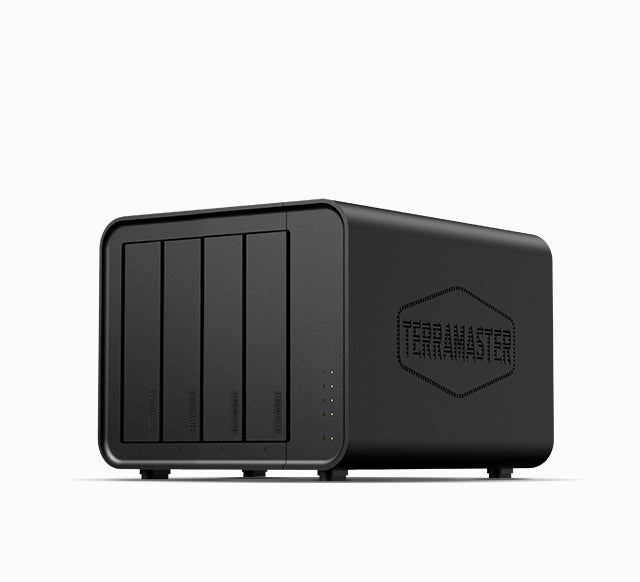
The hardware list names four native positions for 3.5-inch SATA HDDs, 2.5-inch SATA HDDs or 2.5-inch SATA SSDs, with hot-swap support. It also lists two M.2 2280 NVMe sockets, specified as PCIe 3.0 x1 and described as SSD-cache positions. Those sockets may expand the storage design, but they are not two extra SATA trays and do not turn this into a six-bay NAS. Check TerraMaster's changing SSD compatibility entries by exact model and firmware; one listed drive is not proof that every module or two-drive pairing is supported.
Capacity needs similar care. The product specification states 88 TB raw as four 22-TB drives, yet TerraMaster's current compatibility list includes specific F4-424 Pro entries for larger 30-TB and 32-TB drives marked Recommended. Neither source establishes a single settled maximum, a four-drive configuration across those capacities or usable space after a storage layout. For that reason the assessment does not use a capacity ceiling. Start from the exact drive model and current compatibility status, then account separately for redundancy, formatting and the difference between raw and usable capacity. The bay-count and capacity guide covers that distinction without counting the M.2 cache sockets as trays.
Two 2.5GbE ports are not one 5GbE port
TerraMaster lists two individual RJ45 2.5GbE connectors and supports link aggregation. Its product copy describes up to 5 Gbps of aggregate bandwidth, but that should not be read as one 5-Gbps built-in port or as guaranteed file-transfer speed. The finder therefore rates the quickest single connector at 2.5 Gbps. A faster path depends on the client interface, switch or direct connection, cabling and configuration; several endpoints and an aggregation-capable switch may be necessary for an aggregate workload. Storage, protocol, CPU load and the number of active clients also affect transfers. Buyers with a hard 5-Gbps single-port requirement should choose a model with a documented 5GbE connector instead. See the network-path guide before upgrading only one part of the chain.
RAID 1 is a setup choice, not package contents
The exact specification lists RAID 1 among the supported layouts. One possible arrangement is to select two compatible SATA HDDs, install them in two of the four trays and create a RAID 1 volume; two native positions would remain available. That is a buyer-created plan, not evidence that a drive pair or initialized pool ships with the NAS. The published package list names the host, power cord, adapter, network cable, Quick Installation Guide, warranty note and screws, but an individual reseller can alter or describe a package differently. Confirm its contents and the exact drives before ordering, and back up existing data before creating or changing a pool. A mirror helps with some drive-failure situations; it is not a separate backup against deletion, malware, fire, theft or a failed enclosure. The redundancy guide explains those limits.
What the specification says about the chassis
TerraMaster lists a 90-W supply, one 120-mm fan and a 3.4-kg enclosure measuring 222 × 179 × 154 mm. Its 21.0-dB(A) noise figure is tied to two SATA drives or SSDs in standby, a 17.3-dB(A) ambient level and a one-metre test distance. That is a manufacturer-stated condition, not an independent test or a promise for a different room or disk set. The specification's example power values likewise depend on four particular 4-TB Seagate drives and stated read/write or hibernation states; they are not a universal energy-use estimate. There is no redundant power supply listed.
Who should shortlist this version?
The 16-GB F4-424 Pro is a plausible candidate when four native SATA positions, a 2.5-Gbps individual network port and a documented RAID 1 option fit the plan, and the published single-slot 16-to-32-GB memory ceiling is sufficient. Its two M.2 sockets are an additional cache path, not additional hot-swap bays. It is a poor match for a hard 5-Gbps single-port requirement, an expectation of included drives, or a buyer who wants more than the documented 32-GB memory limit. The memory selector and product JSON distinguish this configuration, but their internal numeric variant identifiers are not retail part numbers; the exact variant SKU and barcode are blank. Ask the seller to identify the 16-GB configuration, confirm the package, and verify each SATA and NVMe model against the current compatibility tables. This is documentation-based analysis, not a report of hands-on use.
Key specifications
Key details at a glance
| Internal drive bays | 4 bays |
|---|---|
| Documented internal drive media | 3.5-inch SATA HDD / 2.5-inch SATA HDD / 2.5-inch SATA SSD |
| Built-in Ethernet ports | 2 x individual built-in RJ45 2.5GbE ports |
| Fastest individual Ethernet port | 2.5 Gbps |
| Installed system memory | 16 GB |
| Maximum listed memory | 32 GB |
| Listed storage arrangements | TRAID / Single / JBOD / RAID 0 / RAID 1 / RAID 5 / RAID 6 / RAID 10 |
| Internal file systems | Btrfs / EXT4 |
| Dimensions (H × W × D) | 222 x 179 x 154 mm (H x W x D) |
| Weight | 3.4 kg |
| Data drives included in listed package | No |
| M.2 NVMe slots | 2 |
| Processor | Intel Core i3-N305 |
| CPU cores | 8 |
| Installed memory type | 16 GB DDR5 non-ECC SODIMM (one preinstalled 16-GB module) |
Use the exact model’s instructions for operating limits, supplied equipment and version differences.
Sources for this review
Sources for this assessment
- TerraMaster U.S.-facing F4-424 Pro model page and specifications
- TerraMaster F4-424 Pro official product-handle JSON
- TerraMaster official F4-424 Pro 16-GB specification page
- TerraMaster official NAS hard-drive compatibility table
- TerraMaster official SSD compatibility table
- TerraMaster TOS 7 Storage Pool guide
- TerraMaster Home/SOHO NAS catalogue page
- Official F4-424 Pro product image linked from its exact model page

Check your setup before choosing a NAS
Use the finder to narrow documented desk/shelf or rack formats, internal-bay minimums, a single Ethernet-port rating and optional redundancy requirements.