
Your needs, this model
Does it fit your priorities?
Can this exact profile be set up as a two-drive mirror?
Yes. QNAP's six-bay QTS and QuTS hero tables list RAID 1. Choose one operating system, confirm two exact compatible drives and create the mirror yourself; the guide's standard contents do not include data drives or a prepared array. Keep a separate backup.
Explore this need in the finder →Does the i5 package raise the built-in network speed above 2.5GbE?
No. QNAP lists two 2.5GbE ports for both i5-32G and i3-16G profiles. A faster 5GbE or 10GbE card is an optional PCIe expansion decision, not a base connection or guaranteed transfer rate.
Explore this need in the finder →Can its base built-in port meet a 3-Gbps single-port minimum?
No. The fastest built-in individual port is 2.5GbE. The separately listed PCIe adapter route is not a built-in port, and line rate should not be confused with file-transfer throughput.
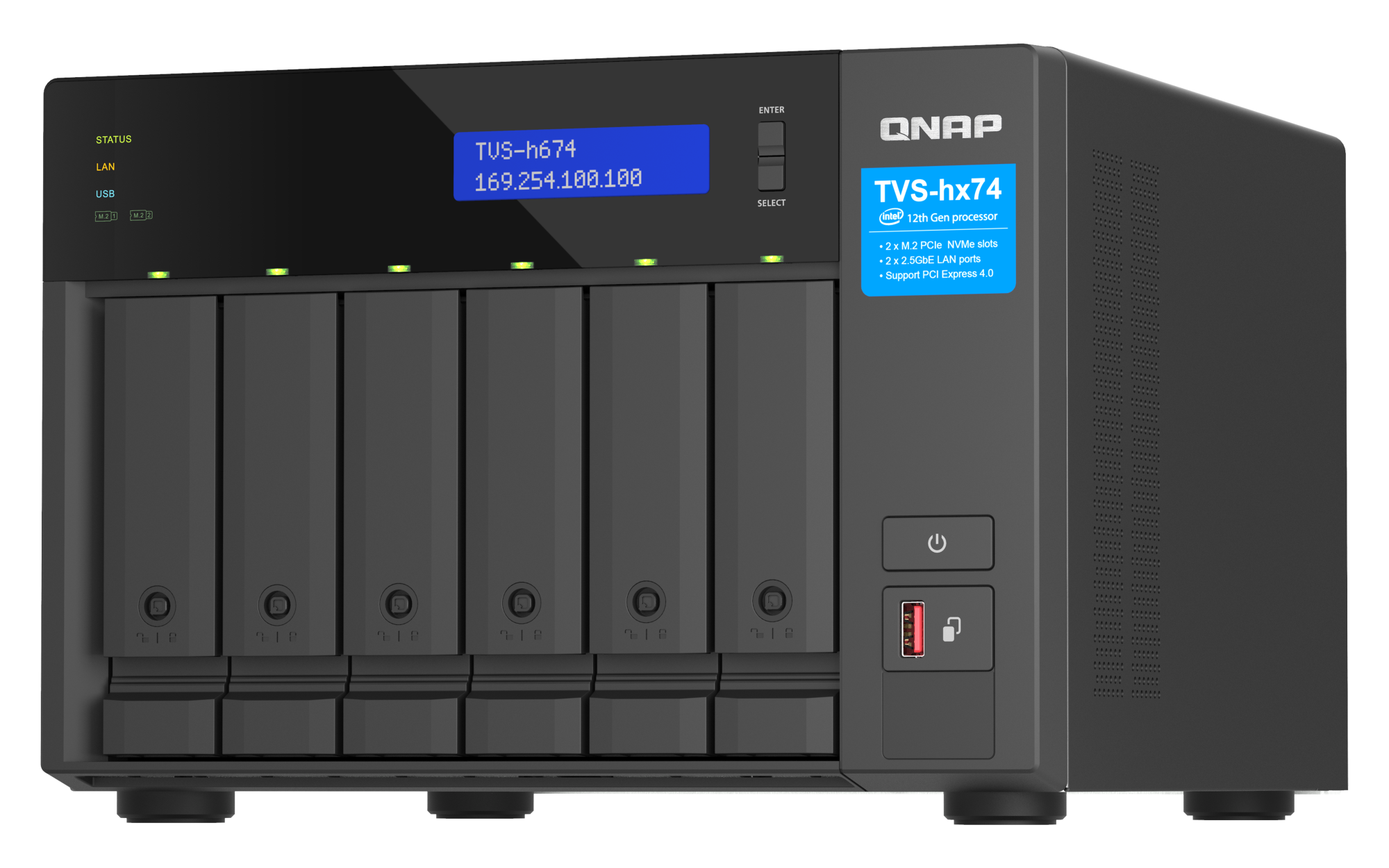
Explore this need in the finder →The QNAP TVS-h674-i5-32G-US is the six-bay, non-Thunderbolt version of QNAP’s compact TVS-hx74 tower. QNAP’s U.S. selector and the exact U.S. Store title identify an i5-32G profile: a Core i5-12400 and 32 GB of starting memory. This is a research-based assessment of manufacturer documents, not a hands-on test, personal ownership report, or independent performance result. It is important not to blend it with the i3-16G sibling or with the separately assessed TVS-h674T, whose model name includes a T and whose documented connectivity differs.
Six native SATA bays, plus two separate M.2 sockets
QNAP lists six 3.5-inch SATA positions in the chassis and two internal M.2 2280 PCIe Gen 4 x4 sockets for NVMe media. The M.2 devices are separate from the six front trays, so they do not make this a nominal eight-bay tower. They also use a different service path: QNAP explicitly says M.2 SSDs are not hot-swappable. The front trays are the part of the storage plan to count as native bays and to check for ordinary drive service.
There is a useful compatibility discrepancy to resolve before ordering drives. The current U.S. hardware selector names 3.5-inch SATA hard drives and 2.5-inch SATA SSDs for the six trays. The English-U.S. guide also lists 2.5-inch SATA hard drives, so those sources do not give the same media breadth. The QNAP model-filtered TVS-h674 compatibility route is the appropriate next check, but the saved page response did not expose a specific drive-and-firmware row. Do not treat the tray size alone as drive approval; check the complete model and firmware before building a pool.
The i5-32G suffix changes the processor and starting memory
The exact selector profile specifies an Intel Core i5-12400 with six cores and 12 threads, a listed burst ceiling of 4.4 GHz, and 32 GB of DDR4 SODIMM memory. QNAP’s English guide breaks that memory out as two 16 GB modules; the selector lists two slots and a 64 GB maximum. The maximum is not an included upgrade kit. QNAP advises using compatible identical memory modules, so buyers should confirm a specific supported replacement rather than treating any retail SODIMM as interchangeable.
The distinct TVS-h674-i3-16G-US retains the six native bays and the same dual 2.5GbE base ports but uses a Core i3-12100, four cores/eight threads, a 4.3 GHz burst figure and 16 GB starting memory. Those are documented differences, not a claim that one will complete a particular workload faster. This i5 package offers the higher listed CPU tier and twice the factory memory; whether that difference matters depends on services, users and applications that have not been independently benchmarked here.
One specification conflict is worth preserving rather than silently resolving: the current U.S. selector names UHD Graphics 730 for the i5 profile, while QNAP’s English-U.S. TVS-hx74 guide lists UHD Graphics 770 for the same i5-32G ordering P/N. Graphics are not a reason to buy this configuration on the evidence reviewed here.
Dual 2.5GbE is built in; faster networking is an expansion decision
Both h674 processor packages list two built-in 2.5GbE ports. The fastest single built-in Ethernet port is therefore 2.5 Gbps; two jacks do not make one 5-Gbps connection. QNAP lists optional 5GbE or 10GbE cards through PCIe, but an expansion card is not a base port and its fit, compatibility and effect on the second PCIe slot need checking. The published link rating also is not a file-transfer prediction: the client, switch, cables, chosen drives and workload shape the entire path.
The selector lists two PCIe Gen 4 slots, one x16 and one x4, alongside HDMI and USB Type-A/Type-C ports. No Thunderbolt port is listed for this non-T TVS-h674; compare the separate h674T review if direct Thunderbolt connectivity is essential. Do not assume an add-in card from a different chassis has the same clearance or leaves another slot usable.
Choose the filesystem and create the mirror yourself
QNAP documents QTS with EXT4 and QuTS hero with ZFS as alternative systems for the TVS-h674. The six-bay software table includes RAID 1, but that means an owner can choose two compatible drives and create a mirror after selecting the operating system; it does not mean the retail unit arrives with a completed array. QNAP’s series guide lists the NAS, cord, network cable, drive screws, M.2 heatsinks, tray keys and quick guide, not data drives. A seller may offer a different package, so obtain a written contents list for the exact TVS-h674-i5-32G-US suffix.
The operating systems use different filesystems, and QNAP says the drives must be removed before switching from QuTS hero to QTS. Plan the choice before loading data and maintain an independent backup. RAID 1 can tolerate a single member-drive failure while the mirror remains healthy; it does not protect against deletion, theft, a chassis-level event or a bad backup. Verify the exact SATA and NVMe media before initialization.
Measure carefully and treat the published weight as unresolved
QNAP’s current selector gives the h674 dimensions as 7.09 × 10.41 × 11.01 inches HWD and notes that the height excludes a foot pad that can add up to 1.18 inches. The English-U.S. guide instead prints 7.41 × 10.41 × 11.01 inches. Its mass row is internally inconsistent too: it pairs 6.55 kg with 17.90 lb, while the current selector lists 13.93 lb. These figures do not support a precise fit or lifting plan. Leave service and airflow space and ask QNAP to confirm the relevant revision where close cabinet clearance or weight is material.
Who should shortlist this profile?
This i5-32G package fits a buyer who wants six conventional SATA positions, two separate NVMe sockets, built-in dual 2.5GbE and the higher of the two documented h674 processor/memory profiles. It is a poor shortcut for someone requiring a built-in 10GbE port, an assured 2.5-inch HDD compatibility row, included storage, a ready RAID array, Thunderbolt, or settled cabinet dimensions and weight. Confirm drives and firmware, decide which filesystem to initialize, create the desired storage layout, and keep a backup before treating the tower as ready for service.
Key specifications
Key details at a glance
| Internal drive bays | 6 bays |
|---|---|
| Documented internal drive media | 3.5-inch SATA HDDs / 2.5-inch SATA SSDs |
| Built-in Ethernet ports | 2 x built-in 2.5GbE RJ45 |
| Fastest individual Ethernet port | 2.5 Gbps |
| Installed system memory | 32 GB |
| Maximum listed memory | 64 GB |
| Listed storage arrangements | QTS six-bay class: RAID 1 is listed among supported layouts / QuTS hero six-bay class: RAID 1 is listed among supported layouts |
| Internal file systems | EXT4 (QTS alternative) / ZFS (QuTS hero alternative) |
| M.2 NVMe slots | 2 |
| Processor | Intel Core i5-12400 |
| CPU cores | 6 |
| CPU threads | 12 |
| Installed memory type | 32 GB DDR4 SODIMM; the English-U.S. guide lists 2 x 16 GB |
Use the exact model’s instructions for operating limits, supplied equipment and version differences.
Sources for this review
Sources for this assessment
- TVS-h674 — QNAP U.S. product page
- Rendered TVS-h674 hardware selector — QNAP U.S.
- Rendered TVS-h674 software specifications — QNAP U.S.
- TVS-hx74 User Guide, English U.S. — QNAP
- TVS-h674-i5-32G-US — QNAP U.S. Official Store
- SMB Desktop category, page 2 — QNAP U.S. Official Store
- QNAP compatibility route filtered to TVS-h674
- TVS-h674 official family chassis image — QNAP U.S. product page

Check your setup before choosing a NAS
Use the finder to narrow documented desk/shelf or rack formats, internal-bay minimums, a single Ethernet-port rating and optional redundancy requirements.