
Your needs, this model
Does it fit your priorities?
Can this exact profile be set up as a two-drive mirror?
Yes. QNAP's six-bay QTS and QuTS hero tables list RAID 1. Choose one operating system, confirm two exact compatible drives and create the mirror yourself; the guide's standard contents do not include data drives or a prepared array. Keep a separate backup.
Explore this need in the finder →Does the i3 package have a slower built-in network port than the i5 version?
No. Both exact TVS-h674 selector profiles list two 2.5GbE ports. The documented difference is processor and starting memory, not base Ethernet speed; optional faster adapters are a separate PCIe check.
Explore this need in the finder →Can its base built-in port meet a 3-Gbps single-port minimum?
No. The fastest built-in individual port is 2.5GbE. The separately listed PCIe adapter route is not a built-in port, and line rate should not be confused with file-transfer throughput.
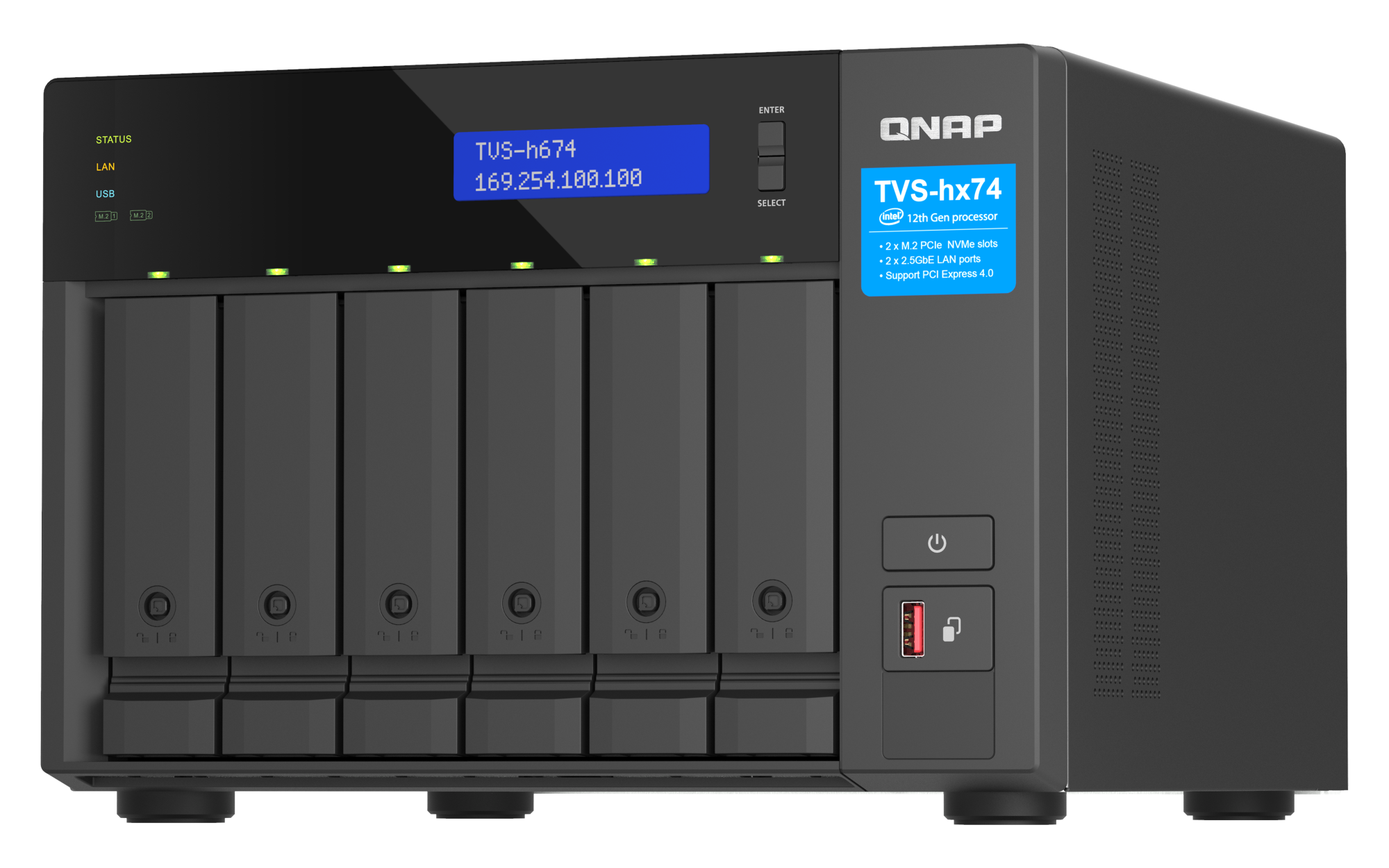
Explore this need in the finder →The TVS-h674-i3-16G-US is the six-bay entry configuration in QNAP’s TVS-h674 tower family. QNAP’s U.S. hardware selector lists a Core i3-12100 and 16 GB of starting DDR4 memory for the i3-16G profile; its U.S. Store item identifies the exact -US suffix. This assessment is based on manufacturer pages and the English-U.S. series guide. No NAS was set up or tested for this review, and the source material does not establish seller stock or the contents of a future shipment.
It has the same six-bay storage footprint as the i5 build
The chassis includes six internal 3.5-inch SATA positions. QNAP also specifies two M.2 2280 PCIe Gen 4 x4 sockets for NVMe SSDs, which are separate from the SATA trays. The two M.2 sockets do not count as additional native bays, and QNAP’s selector says M.2 SSDs are not hot-swappable. For someone deciding between the i3-16G and the i5-32G, this means the base storage count does not change: the trade is in the documented processor and installed memory profile, not the number of front positions.
Media descriptions require a closer check. In the current U.S. hardware selector QNAP lists 3.5-inch SATA hard drives and 2.5-inch SATA SSDs for the six trays. The English-U.S. TVS-hx74 guide expands that wording to include 2.5-inch SATA hard drives as well. Because these official descriptions differ, do not infer that an arbitrary 2.5-inch HDD works from the tray dimensions. Use QNAP’s TVS-h674-filtered compatibility page to check the exact disk and firmware. The saved response is a client-rendered shell without an accessible per-drive row, so no exact drive is called compatible here.
The i3-16G and i5-32G are not interchangeable packages
QNAP specifies the i3-16G with an Intel Core i3-12100, four cores and eight threads, up to a 4.3 GHz burst figure, and 16 GB of DDR4 SODIMM memory. The English guide identifies the included memory as one 16 GB module. The two SODIMM slots support a stated 64 GB maximum, but that is a platform limit rather than a promise that an arbitrary kit is supported. QNAP recommends compatible memory of matching specifications; verify the exact approved module before planning an upgrade.
The separate TVS-h674-i5-32G-US uses a Core i5-12400 with six cores/twelve threads and starts with 32 GB as two 16 GB modules. This difference is useful when the required CPU tier or out-of-box memory is known; it is not enough to predict virtual-machine capacity, simultaneous-user performance, transcoding quality or a real file-copy rate. Those depend on workload, applications, media and configuration, and no independent test was performed for either profile.
Network speed does not change with the processor suffix
QNAP lists dual built-in 2.5GbE RJ45 ports for the i3 and i5 variants. That is the base connection even though the selector mentions optional 5GbE or 10GbE PCIe cards. A card would be a separate compatibility, fit and purchase decision, not a faster port already in this -US configuration. The highest individual base port is 2.5 Gbps; the two ports are not one aggregated single-client link, and that rating does not promise a matching transfer rate through a real switch, computer, cabling and workload.
The chassis also has two PCIe Gen 4 positions, one x16 and one x4, HDMI 1.4b, and Type-A and Type-C USB ports. QNAP’s current selector does not list Thunderbolt for this non-T model. If a workstation needs direct Thunderbolt, compare the distinct TVS-h674T-i5-32G-US rather than assuming that two related product names share the same connectors.
Set up the storage operating system before copying files
QNAP documents both QTS (with EXT4) and QuTS hero (with ZFS) for the TVS-h674 family. They are alternatives, not simultaneous modes. The six-bay software specifications include RAID 1, which lets an owner select two compatible disks and initialize a mirrored array. The manual’s listed package includes the NAS, power cord, network cable, screws, M.2 heatsinks, tray keys and a quick guide, with no data drives identified. This is a diskless storage decision: choose the exact drives and build the pool rather than expecting a ready-to-use mirror.
QNAP warns that changing between QuTS hero and QTS requires removing the installed drives. Pick the filesystem and plan before committing files; protect data separately before OS changes or migration. A two-drive RAID 1 arrangement can help keep the volume available after one member fails, but it is not a backup against accidental changes or an event affecting the whole NAS. A second, recoverable copy remains a different task.
Published dimensions and weight do not fully agree
The current U.S. selector lists 7.09 × 10.41 × 11.01 inches HWD and says a foot pad can add up to 1.18 inches to the height. The English-U.S. guide gives a 7.41-inch height, with the same width and depth. More significantly, its weight row pairs 6.55 kg with 17.90 lb, while the selector gives 13.93 lb. The metric and imperial guide figures do not agree with one another, so those records do not establish a dependable lifting or cabinet-clearance value. Leave room for airflow and access, and get a confirmed figure from QNAP if a tight fit makes it necessary.
Best fit for a defined six-bay, 2.5GbE plan
The i3-16G profile is a sensible shortlist candidate when six SATA positions, separate internal NVMe sockets and dual 2.5GbE satisfy the documented requirement and the lower starting CPU/RAM package is acceptable. Compare the i5 version when its higher listed processor tier and 32 GB base memory matter, but do not assume it adds faster Ethernet. Before purchase, check exact drive/firmware support, the delivered SKU, OS choice, memory options and physical measurements. None of those checks is a substitute for a separate backup plan or for confirming the complete shipment in writing.
Key specifications
Key details at a glance
| Internal drive bays | 6 bays |
|---|---|
| Documented internal drive media | 3.5-inch SATA HDDs / 2.5-inch SATA SSDs |
| Built-in Ethernet ports | 2 x built-in 2.5GbE RJ45 |
| Fastest individual Ethernet port | 2.5 Gbps |
| Installed system memory | 16 GB |
| Maximum listed memory | 64 GB |
| Listed storage arrangements | QTS six-bay class: RAID 1 is listed among supported layouts / QuTS hero six-bay class: RAID 1 is listed among supported layouts |
| Internal file systems | EXT4 (QTS alternative) / ZFS (QuTS hero alternative) |
| M.2 NVMe slots | 2 |
| Processor | Intel Core i3-12100 |
| CPU cores | 4 |
| CPU threads | 8 |
| Installed memory type | 16 GB DDR4 SODIMM; the English-U.S. guide lists 1 x 16 GB |
Use the exact model’s instructions for operating limits, supplied equipment and version differences.
Sources for this review
Sources for this assessment
- TVS-h674 — QNAP U.S. product page
- Rendered TVS-h674 hardware selector — QNAP U.S.
- Rendered TVS-h674 software specifications — QNAP U.S.
- TVS-hx74 User Guide, English U.S. — QNAP
- TVS-h674-i3-16G-US — QNAP U.S. Official Store
- SMB Desktop category, page 4 — QNAP U.S. Official Store
- QNAP compatibility route filtered to TVS-h674
- TVS-h674 official family chassis image — QNAP U.S. product page

Check your setup before choosing a NAS
Use the finder to narrow documented desk/shelf or rack formats, internal-bay minimums, a single Ethernet-port rating and optional redundancy requirements.