
Your needs, this model
Does it fit your priorities?
Does QNAP's PT-8G guide settle support for a 2.5-inch SATA hard drive?
No. The English-U.S. PT-8G guide lists 2.5-inch SATA HDDs, but QNAP's current U.S. hardware selector for PT-8G lists only 3.5-inch SATA HDDs and 2.5-inch SATA SSDs. Check the exact drive model and firmware in QNAP's compatibility resource rather than assuming the broader guide wording applies to the drive you plan to install.
Explore this need in the finder →Is a TVS-h474-PT-8G-US retailer suffix verified by QNAP's current U.S. store page?
Not from the sources checked. QNAP's U.S. selector and English-U.S. guide list the manufacturer profile TVS-h474-PT-8G, but the exact-looking U.S. Official Store path ending in -US returned 404. The hardware profile is reviewed without inventing an -US retail SKU; verify the full suffix on any actual offer.
Explore this need in the finder →Does the PT-8G arrive with a two-drive RAID 1 mirror?
No. QNAP lists four-bay RAID 1 under both QTS and QuTS hero, but the owner chooses the operating system, supplies two exact compatible drives and creates the mirror. The PT-8G guide's contents do not list data drives or a prepared array; use a separate backup as well.
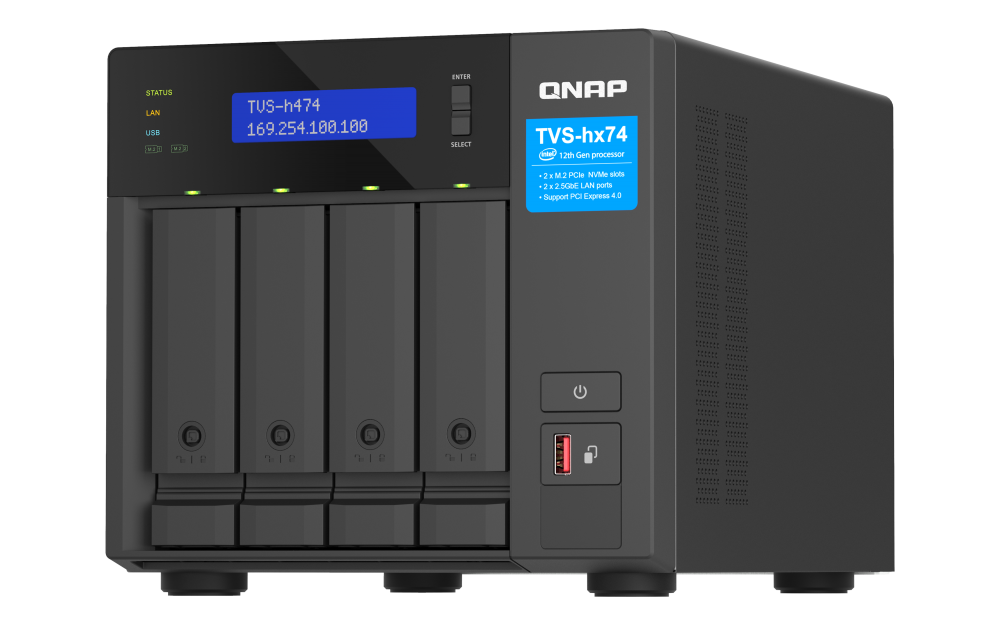
Explore this need in the finder →The four-bay TVS-h474-PT-8G uses QNAP's Pentium Gold G7400/8 GB profile. QNAP's current U.S. selector and English-U.S. TVS-hx74 guide both identify the PT-8G hardware profile, but no matching current U.S. Official Store item with a “-US” suffix was verified; the exact-looking store URL returned HTTP 404. This is a source-based assessment, not a hands-on test. Treat it as a documented model reference, and confirm the precise suffix and offer details before purchase.
Four native bays, not six storage positions
QNAP identifies four 3.5-inch SATA drive bays. The two M.2 2280 PCIe Gen 3 x2 NVMe sockets are separate from those four trays; the sockets may support caching or other documented storage uses, but they are not two extra hot-swappable SATA bays. QNAP says M.2 SSDs are not hot-swappable. Check the exact NVMe part and firmware against the manufacturer's compatibility resource rather than inferring fit from the connector shape.
There is a meaningful drive-media conflict. The current U.S. hardware selector lists 3.5-inch SATA hard drives and 2.5-inch SATA solid-state drives for the PT profile. The English-U.S. guide's PT-8G row also lists 2.5-inch SATA hard drives. Since those are different manufacturer records for the same named profile, do not silently treat the broader line as settled. Use the exact compatibility list for each full drive model and firmware, especially before using 2.5-inch hard drives.
The Pentium profile differs from the Core i3 sibling
The current selector names a Pentium Gold G7400 processor with two cores, four threads and a 3.7 GHz clock, with Intel UHD Graphics 710. It lists 8 GB of DDR4 SODIMM memory, two memory slots and a 64 GB maximum. The English-U.S. guide is more specific about the PT package: it lists one 8 GB DDR4 SODIMM module. QNAP warns that unsupported memory can cause errors or prevent the operating system from starting and recommends compatible modules. A 64 GB ceiling is not a supplied upgrade kit or a workload recommendation.
The separate TVS-h474-i3-8G-US profile keeps four bays, 8 GB starting memory, dual 2.5GbE and the same two M.2 positions, but its selector lists a Core i3-12100, four cores/eight threads and UHD Graphics 730. These are specification differences, not a measured comparison. QNAP's U.S. Official Store page for the i3 SKU also contains a Pentium feature snippet despite its i3 title and SKU, so verify the actual processor on any offer rather than relying on copied short descriptions.
Dual 2.5GbE is the built-in ceiling per port
The PT selector lists two built-in 2.5GbE ports. One built-in interface meets a 2.5-Gbps rating screen, not a 5-Gbps single-port rating or a promised copy speed. A switch or router, client adapter, cabling, media and workload all affect real transfers. QNAP lists optional 5GbE and 10GbE adapters over PCIe; such a card is a separate expansion decision. Confirm its exact compatibility, width and which second slot or card arrangement remains usable before planning around it.
Other listed connections include PCIe Gen 4 x16 and Gen 3 x2 expansion slots and HDMI 1.4b. The current selector lists one USB 3.2 Gen 1 port (connector type unstated), one Type-A and one Type-C Gen 2 port. The PT-8G guide instead calls all three Gen 2, with two Type-A plus one Type-C. Both total three; their generation and connector assignments conflict, so check the exact revision if it matters. This is a desktop tower, not a short-depth rackmount chassis. The product page does not promise that every optional card and storage configuration can be installed together.
RAID 1 is an owner-created option, not a factory array
QNAP's four-bay software tables list RAID 1 for both QTS and QuTS hero. A buyer can therefore plan a two-drive mirror after selecting compatible disks and one operating system; neither a ready-made array nor drives are implied by the model name. A RAID 1 mirror uses two native bays and can continue after one member drive fails while the mirror is healthy, but it is not a separate backup against deletion, malware, theft or a failed enclosure.
QNAP describes QTS with EXT4 and QuTS hero with ZFS as alternatives, not a simultaneous setup. It warns that all drives must be removed before changing from QuTS hero to QTS. Make the OS decision before putting data on the volume. The PT-specific guide's standard contents table lists the NAS, a power cord, one Cat5e network cable, drive screws, two M.2 heatsinks, tray keys and a quick installation guide; no data drives or precreated storage pool are listed. Check the exact seller's written package list for any additional drives or other items.
Published physical figures do not agree
For this PT configuration the current U.S. hardware selector lists a height of 7.09 inches, a 7.85-inch width, an 11.01-inch depth and 13.45 lb net weight; it notes that the listed height excludes a foot pad that may add up to 1.18 inches. The English-U.S. guide instead lists 7.41 × 7.85 × 11.01 inches and 14.55 lb for the PT-8G. Those are source conflicts, not an invitation to pick the more convenient measurement. Keep the exact clearance and lifting weight unresolved, measure against the unit revision if fit is tight, and leave room for airflow and cables.
Who should consider the PT-8G profile?
It belongs on a shortlist when four SATA positions, a 2.5GbE link, dual M.2 sockets and the Pentium/8-GB starting profile match a real file-sharing or backup plan. It is not a fit for a requirement above four native bays or more than 2.5GbE on a single built-in port. The exact U.S. retail suffix, 2.5-inch HDD support, dimensions and the contents of any particular seller package are unresolved. Verify those points, choose one OS, list compatible drives and plan an independent backup before committing.
Key specifications
Key details at a glance
| Internal drive bays | 4 bays |
|---|---|
| Documented internal drive media | 3.5-inch SATA HDDs / 2.5-inch SATA SSDs |
| Built-in Ethernet ports | 2 x built-in 2.5GbE RJ45 |
| Fastest individual Ethernet port | 2.5 Gbps |
| Installed system memory | 8 GB |
| Maximum listed memory | 64 GB |
| Listed storage arrangements | Four-bay QTS table: RAID 1 listed / Four-bay QuTS hero table: RAID 1 listed |
| Internal file systems | EXT4 (QTS alternative) / ZFS (QuTS hero alternative) |
| USB 3.2 Gen 1 ports | 1 |
| M.2 NVMe slots | 2 |
| Processor | Intel Pentium Gold G7400 |
| CPU cores | 2 |
| CPU threads | 4 |
| Installed memory type | 8 GB DDR4 SODIMM; English-U.S. guide lists one 8 GB module for the PT-8G profile |
Use the exact model’s instructions for operating limits, supplied equipment and version differences.
Sources for this review
Sources for this assessment
- TVS-h474 — QNAP U.S. product page
- Rendered TVS-h474 U.S. hardware selector — QNAP
- Rendered TVS-h474 U.S. software specifications — QNAP
- Rendered TVS-h474 U.S. package contents — QNAP
- TVS-hx74 User Guide, English U.S. — QNAP
- TVS-h474-i3-8G-US — QNAP U.S. Official Store
- TVS-h474 family chassis image — QNAP U.S. product page
- TVS-h474 Hardware Specs — QNAP U.S.

Check your setup before choosing a NAS
Use the finder to narrow documented desk/shelf or rack formats, internal-bay minimums, a single Ethernet-port rating and optional redundancy requirements.