
Your needs, this model
Does it fit your priorities?
How many internal drive bays should I count on the TVS-h474-i3-8G-US, including its M.2 sockets?
Count four native SATA bays. The two M.2 NVMe sockets are separate positions and do not turn this into a six-SATA-bay model; QNAP also says M.2 SSDs are not hot-swappable. Check exact NVMe compatibility before adding them.
Explore this need in the finder →Do the two built-in network ports provide a 5-Gbps port for one client?
No. QNAP lists two individual 2.5GbE ports. The combined presence of two jacks does not make one 5-Gbps link; faster 5GbE or 10GbE requires a separately checked PCIe adapter and a compatible network path.
Explore this need in the finder →Will QNAP supply data drives and a configured RAID 1 mirror?
No such setup is listed. QNAP's four-bay software tables list RAID 1 as an option, but the owner selects compatible drives, chooses QTS or QuTS hero and creates the array. The family package list does not list data drives or a prepared pool; plan a separate backup.
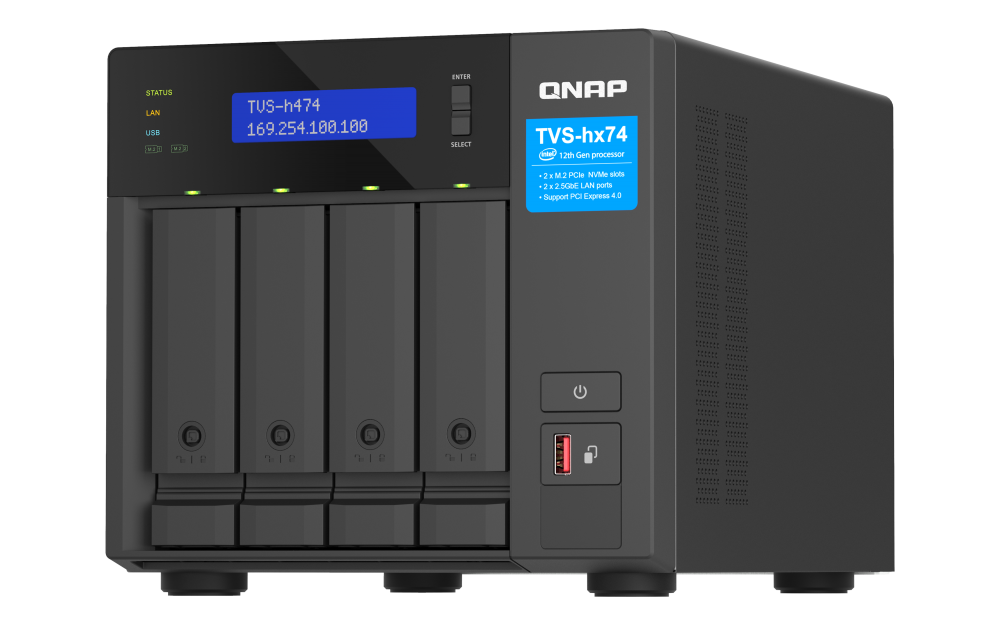
Explore this need in the finder →The QNAP TVS-h474-i3-8G-US is the four-bay TVS-h474 configuration whose current U.S. hardware selector lists a Core i3-12100 processor and 8 GB of DDR4 memory. This is a source-based assessment, not a hands-on test. The exact configuration matters: QNAP also lists a Pentium Gold TVS-h474-PT-8G sibling with the same starting memory and core storage layout, but a different processor. Do not assume the two suffixes are interchangeable.
Confirm the model suffix before choosing it
QNAP's current U.S. hardware selector identifies a TVS-h474-i3-8G option with an Intel Core i3-12100, four cores, eight threads and a listed burst ceiling of 4.3 GHz. That is the evidence used for this profile. There is a real identity warning at the retail layer: the QNAP Official Store item's title and structured SKU say TVS-h474-i3-8G-US, while its short feature description says Pentium Gold. The selector and the offer text therefore do not agree. Before ordering, match the complete suffix and CPU on the actual offer and its invoice; do not use the store's short snippet as proof of the processor. The separate TVS-h474-PT-8G assessment covers the Pentium profile.
Four internal SATA bays, with two different M.2 positions
The h474 has four native 3.5-inch SATA bays. QNAP lists 3.5-inch SATA hard drives and 2.5-inch SATA solid-state drives for them. Two M.2 2280 PCIe Gen 3 x2 NVMe sockets sit alongside those trays, but are not extra bays, and QNAP says M.2 SSDs are not hot-swappable. Confirm a specific NVMe model and firmware against the compatibility list. Count this as a four-bay NAS, not a six-bay one.
Do not extend the i3 profile's media list by borrowing the PT-only guide row: the English-U.S. TVS-hx74 guide lists 2.5-inch SATA HDDs for the PT-8G, while the current selector's i3 row names 3.5-inch SATA HDDs and 2.5-inch SATA SSDs. For this exact i3 package, treat 2.5-inch hard-drive support as unresolved and confirm the complete drive model with QNAP before building a pool.
Dual 2.5GbE is useful only if the whole path supports it
QNAP lists two built-in 2.5GbE ports, so the fastest single built-in port is rated at 2.5 Gbps. Two ports do not become one 5-Gbps client link. The selector lists optional 5GbE and 10GbE adapters through PCIe; those are separate purchases, not base ports, and require a compatibility and slot-clearance check. Real throughput also depends on the client, network path, drives and workload.
Expansion uses PCIe Gen 4 x16 and Gen 3 x2. The exact i3 selector lists one USB 3.2 Gen 1 port (connector type unstated), plus one Type-A and one Type-C Gen 2 10-Gbps port and HDMI 1.4b. The shared TVS-hx74 guide row describes two Type-A and one Type-C as Gen 2 but does not isolate the i3. Both list three ports overall; generation and connector assignment differ, so check the exact revision if it matters. Match add-in cards to QNAP's compatibility record and available slot space; not every optional combination is promised.
Starting memory is 8 GB; a platform maximum is not an upgrade kit
The current selector lists 8 GB of DDR4 SODIMM memory, two SODIMM slots and a 64 GB maximum. For the i3 profile, the source does not state whether the starting 8 GB is one module or a pair, so this review does not invent a module layout. QNAP warns that unsupported memory can cause errors or prevent booting and recommends its compatible modules. Treat 64 GB as a manufacturer-listed platform ceiling, not included memory, a recommendation for every workload or proof that a particular upgrade will work. The Pentium sibling also starts at 8 GB, but processor and graphics labels differ; QNAP's documents do not establish a workload benchmark between them.
Choose one operating system and create the mirror yourself
QNAP describes QTS with EXT4 and QuTS hero with ZFS as alternative systems for the h474. Its four-bay software tables list RAID 1 under each system, which supports a two-drive mirror plan if you choose compatible drives and create the layout during setup. It does not mean the retail unit arrives with an array initialized. A two-drive RAID 1 uses two of the four native bays and has the failure-tolerance limits of a mirror; it is not a separate backup against deletion, theft, a failed enclosure or a bad update.
Choose the OS before storing data. QNAP notes that QTS and QuTS hero use different file systems and that all drives must be removed before switching from QuTS hero to QTS. Its U.S. family package list includes the NAS and installation accessories but does not list data drives or a prebuilt pool. Check the exact seller offer for any added drives, then plan an independent backup and a restore test.
Allow for the foot pad and check the actual package
The current U.S. selector lists dimensions of 7.09 × 7.85 × 11.01 inches and notes that the height excludes a foot pad that can add as much as 1.18 inches. The user guide's PT-only table gives a different height and net weight for its Pentium configuration, so it is not a substitute for an i3-specific clearance measurement. Leave room for cables, ventilation and service access rather than fitting the tower to the edge of a shelf on a single published figure. QNAP's family contents page lists a power cord, Ethernet cable, drive screws, M.2 heatsinks, tray keys and a quick guide; it does not settle what a reseller might add.
Who should shortlist this configuration?
This profile is worth comparing when four SATA bays, separate NVMe sockets, built-in 2.5GbE and the i3-12100 selector configuration fit the intended file-sharing or backup plan. It is a poor match when the plan needs more than four native bays, more than 2.5GbE on one built-in port, or certainty about the disputed drive or offer. Verify the suffix, drives, chosen OS, add-in card and separate backup plan before purchase.
Key specifications
Key details at a glance
| Internal drive bays | 4 bays |
|---|---|
| Documented internal drive media | 3.5-inch SATA HDDs / 2.5-inch SATA SSDs |
| Built-in Ethernet ports | 2 x built-in 2.5GbE RJ45 |
| Fastest individual Ethernet port | 2.5 Gbps |
| Installed system memory | 8 GB |
| Maximum listed memory | 64 GB |
| Listed storage arrangements | Four-bay QTS table: RAID 1 listed / Four-bay QuTS hero table: RAID 1 listed |
| Internal file systems | EXT4 (QTS alternative) / ZFS (QuTS hero alternative) |
| USB 3.2 Gen 1 ports | 1 |
| M.2 NVMe slots | 2 |
| Processor | Intel Core i3-12100 |
| CPU cores | 4 |
| CPU threads | 8 |
| Installed memory type | 8 GB DDR4 SODIMM; exact i3 profile module count is not stated in the inspected U.S. selector or guide |
Use the exact model’s instructions for operating limits, supplied equipment and version differences.
Sources for this review
Sources for this assessment
- TVS-h474 — QNAP U.S. product page
- Rendered TVS-h474 U.S. hardware selector — QNAP
- Rendered TVS-h474 U.S. software specifications — QNAP
- Rendered TVS-h474 U.S. package contents — QNAP
- TVS-hx74 User Guide, English U.S. — QNAP
- TVS-h474-i3-8G-US — QNAP U.S. Official Store
- SMB Desktop category, page 3 — QNAP U.S. Official Store
- TVS-h474 family chassis image — QNAP U.S. product page
- TVS-h474 Hardware Specs — QNAP U.S.

Check your setup before choosing a NAS
Use the finder to narrow documented desk/shelf or rack formats, internal-bay minimums, a single Ethernet-port rating and optional redundancy requirements.