
Your needs, this model
Does it fit your priorities?
Do the two rear NVMe positions count toward this unit's four-bay SATA capacity?
No. QNAP's TS-h665U-8G selector lists four front 3.5-inch SATA positions separately from two rear E1.S/M.2 NVMe Gen3 x1 positions. The extra slots can serve a different SSD role, but they do not turn the chassis into a six-position SATA NAS. Check the exact planned drive models and firmware in QNAP's compatibility information; the inspected route did not expose an approved model-specific drive row.
Explore this need in the finder →Do the two built-in network ports provide one 5-Gbps connection?
No. Each built-in port is rated at 2.5GbE, which is the matcher’s individual-port ceiling. Port trunking or SMB Multichannel uses a compatible multi-connection setup; it does not make either jack a single 5GbE port or promise application throughput. If one path needs a faster link, verify the optional PCIe network card and every switch/client/cable connection.
Explore this need in the finder →Can a buyer configure two-drive redundancy, and is it already set up?
The model-specific four-bay QTS and QuTS hero profiles each list RAID 1, so a buyer can plan a mirror after selecting one operating system and two compatible drives. The page does not show a prepared array; choose drives and verify their exact firmware support before installation. RAID 1 may help with one member-drive failure but is not a separate backup.
Explore this need in the finder →Research note: This is a source-based assessment of the QNAP TS-h665U-8G-US, not a hands-on test. QNAP’s U.S. product page and hardware/software selectors were checked on October 31, 2026. The 8G profile is a four-bay rack NAS with two additional NVMe positions, dual built-in 2.5GbE, and one 250 W power supply. That final detail is the important difference from the similarly named RP configuration.
Four SATA bays plus two distinct NVMe positions
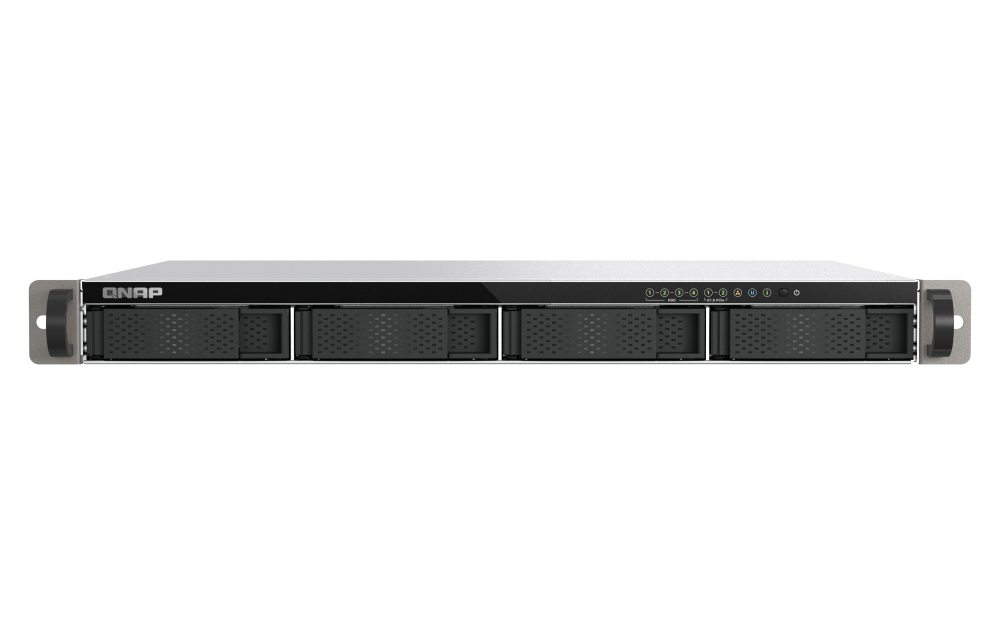
The TS-h665U-8G-US is a 1U rackmount NAS, not the tower TS-h665. Its U.S. hardware selector describes four front 3.5-inch SATA positions for hard disks or 2.5-inch SATA SSDs. Two rear E1.S/M.2 NVMe Gen3 x1 positions are separate: QNAP lists E1.S media and M.2 NVMe drives used with its preinstalled QDA-E1SM3 adapter. Those SSD slots can serve a different storage or cache role, but they do not make this a six-SATA-bay machine. A separate external TL-R1200C-RP shelf is also not part of the chassis bay count.
The selected hardware profile has 8 GB of DDR5 SODIMM memory in one slot, with 16 GB as the listed maximum. QNAP describes the memory as non-ECC with In-Band ECC support and recommends its modules. The Intel CPU is described as four-core, but the U.S. selector does not name the exact processor SKU; this assessment does not borrow a processor label from the TS-h665 tower or the RP model. Confirm memory modules and optional PCIe cards against QNAP’s model-specific support before building around them.
RAID 1 is possible, not preconfigured
For a four-bay storage plan, QNAP’s model-specific software selector lists RAID 1 under both the QTS 6.1.0 / EXT4 profile and the QuTS hero h6.1.0 / ZFS profile. The product page describes QuTS hero as preinstalled, while the selector exposes QTS as an alternative. Those are separate OS choices, not a promise that one array can use both file systems. QNAP warns that switching between the operating systems requires backing up data and removing the disks, so decide on the software plan before committing the drive layout.
A buyer still needs to choose two compatible drives and create the mirror after setup. The selector identifies supported media types, but the inspected compatibility route did not show an exact drive-and-firmware approval row. Check the precise drive model, capacity, and firmware against QNAP’s current compatibility information. The standard package list names hardware, cables, screws, hangers, and a quick guide; it does not name a prepared storage pool. The captured selector did not explicitly state a drive-inclusion policy, so confirm the seller’s written bill of materials rather than assuming drives or a configured array are included. RAID 1 can help with one member-drive failure; it is not a backup against deletion, theft, fire, or loss of the whole NAS.
Two 2.5GbE jacks are not one 5GbE link
Both built-in Ethernet ports are rated at 2.5GbE, so the fastest individual built-in port is 2.5 Gbps. Port trunking and SMB Multichannel may help a compatible workload that uses multiple connections, but they do not turn either jack into a single 5GbE port or promise file-transfer speed. The complete path still depends on the switch or router, client interface, cabling, storage arrangement, and workload. If the plan calls for a faster individual link, QNAP lists optional network expansion; verify the exact card and its fit in the single PCIe Gen3 x2 slot before ordering.
QNAP’s lab example uses an optional 10GbE card, QTS, and eight SATA SSDs; it is not a result or prediction for this base four-bay system. The listed TL-R1200C-RP shelf remains a separate external system; it does not change the NAS’s four-bay count.
The non-RP power tradeoff
Do not treat “RP” as a cosmetic suffix. The TS-h665U-8G-US selector lists one 250 W supply. QNAP’s separate TS-h665U-RP-8G profile lists two 300 W supplies. Both profiles share the four SATA positions and two built-in 2.5GbE links, but the non-RP unit has no second supply to cover a failed PSU. If power-supply redundancy is an operating requirement, compare the distinct TS-h665U-RP-8G assessment and confirm that the delivered order code is the intended one. Even dual supplies only help against a supply or path failure when their upstream power feeds are suitably separated.
Measure the rack, not just the faceplate
QNAP lists the body at 43.3 × 430 × 374.9 mm (H × W × D). Those chassis dimensions do not prove that a given cabinet, rail set, mounting depth, or rear-cable route will work. The model’s accessory list shows RAIL-B02 separately; its standard list names two hangers, not a rail kit. Confirm rail compatibility and the rack’s post spacing, usable depth, airflow, cable bend space, and loaded weight before installation. One 250 W PSU is also a nameplate rating, not a measurement of typical wall draw.
Who should shortlist it?
This profile is worth comparing when a deployment specifically needs a compact 1U NAS, four native SATA bays, two separate NVMe options, and built-in 2.5GbE. It offers a documented owner-created RAID 1 plan under either listed operating system, but the drive/firmware match, exact package contents, and rack fit still need verification. Its one-slot 16 GB memory ceiling and single power supply are real tradeoffs; it is not the RP unit, and it is not a six-bay SATA system. QNAP’s U.S. Store item identity and hardware selector agree on the TS-h665U-8G-US configuration, but an indexed item identifier does not establish current stock or seller terms.
Before choosing, use the drive-compatibility checklist to verify the planned media, and trace the whole network path if you need more than 2.5GbE on one built-in port. For documented redundancy, plan the mirror and its separate backup. This review reports manufacturer documentation, not observed ownership, measured performance, or installation testing.
Key specifications
Key details at a glance
| Internal drive bays | 4 bays |
|---|---|
| Documented internal drive media | 3.5-inch SATA hard disk drives / 2.5-inch SATA solid-state drives / E1.S NVMe SSDs / M.2 NVMe SSDs with the preinstalled QDA-E1SM3 adapter |
| Built-in Ethernet ports | 2 x built-in 2.5GbE RJ45 |
| Fastest individual Ethernet port | 2.5 Gbps |
| Installed system memory | 8 GB |
| Maximum listed memory | 16 GB |
| Listed storage arrangements | QTS: RAID 1 listed for the exact four-bay software profile / QuTS hero: RAID 1 listed for the exact four-bay software profile |
| Internal file systems | QTS: EXT4 / QuTS hero: ZFS |
| Dimensions (H × W × D) | 43.3 x 430 x 374.9 mm (H x W x D) |
| Hardware warranty | 3 years |
| M.2 NVMe slots | 2 |
| Maximum total drive bays with listed expansion | 16 bays |
| Expansion-unit note | QNAP says this model can connect up to one external 12-bay TL-R1200C-RP. Its twelve external positions are a separately powered expansion enclosure, not part of this four-bay chassis. Confirm the current model/cabling compatibility and use a backup plan independent of the expansion. |
| Listed expansion unit | QNAP TL-R1200C-RP 12-bay JBOD (QNAP product page says up to one unit) |
| Processor | Intel four-core processor (exact model not named in the inspected U.S. selector) |
| CPU cores | 4 |
| Installed memory type | 8 GB DDR5 SODIMM; QNAP describes the memory as non-ECC with In-Band ECC support |
Use the exact model’s instructions for operating limits, supplied equipment and version differences.
Sources for this review
Sources for this assessment
- QNAP U.S. Tower / SMB product grid — TS-h665U family card
- TS-h665U — QNAP U.S. product page
- TS-h665U-8G U.S. hardware, software and package selector — rendered observations
- QNAP U.S. compatibility route for TS-h665U
- QNAP U.S. Official Store TS-h665U-8G-US item and 1U category observation
- TS-h665U official front chassis image — QNAP U.S.

Check your setup before choosing a NAS
Use the finder to narrow documented desk/shelf or rack formats, internal-bay minimums, a single Ethernet-port rating and optional redundancy requirements.