
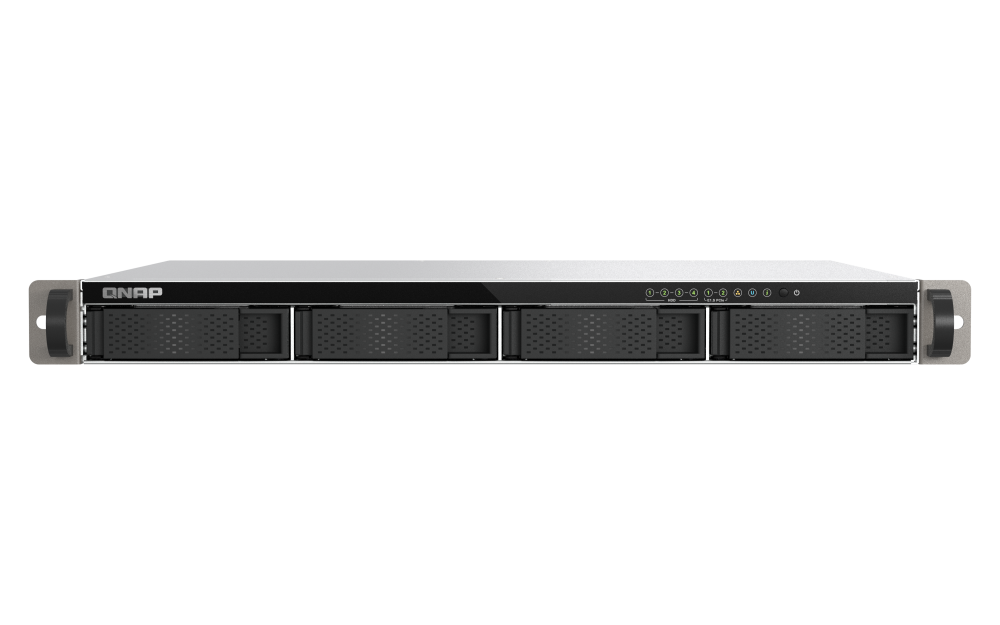
Your needs, this model
Does it fit your priorities?
Do its rear NVMe positions or a JBOD shelf count toward four internal SATA bays?
No. QNAP lists four front native 3.5-inch SATA positions. The two rear E1.S/M.2 NVMe Gen3 x1 positions use different media and do not raise the internal SATA-bay count; a TL-R1200C-RP is a separate external enclosure. QNAP's listed package does not name data drives, and the captured compatibility route did not return an exact drive/firmware approval row.
Explore this need in the finder →Do the two built-in network jacks provide one 5-Gbps port?
The exact U.S. selector lists two individual 2.5GbE ports, so the fastest built-in port is rated 2.5GbE. Port trunking or SMB Multichannel may help a compatible multi-connection workload but does not make either jack one built-in 5GbE port or promise a file-transfer rate. QNAP lists optional PCIe network adapters, which require separate card and network-path checks.
Explore this need in the finder →Can I plan on two-drive redundancy without buying an array already configured?
Yes as a buyer-created plan: the exact four-bay QTS and QuTS hero selector profiles each list RAID 1. Choose one OS, verify two compatible SATA drives, and create the mirror after setup. The listed package has no data drives or prepared pool; a mirror can help with one member-drive failure but does not replace a separately recoverable backup.
Explore this need in the finder →What should I verify before putting this 1U chassis in a rack?
QNAP lists 43.3 x 430 x 374.9 mm and dual 300 W supplies; those dimensions do not establish rail fit, post depth, rear-cable clearance or loaded rack weight. The page lists RAIL-B02 separately, while the standard package list names two hangers. Confirm the exact rail kit, rack depth, airflow and supplied parts in writing. For power-path resilience, place supply cords on appropriately independent upstream paths rather than the same circuit.
Assessment basis: this is a document-led assessment of QNAP's U.S. TS-h665U-RP and its TS-h665U-RP-8G hardware-selector profile. It is not a hands-on test. QNAP describes the model as a small-business 1U rack NAS and says its long-term supply/support horizon extends through 2031; that statement is not a stock or delivery promise.
Four front SATA bays, not six
The core sizing question is the chassis's four native front 3.5-inch SATA bays. QNAP's exact selector lists 3.5-inch SATA hard drives or 2.5-inch SATA SSDs in those bays. It separately lists two rear E1.S/M.2 NVMe Gen3 x1 positions, with M.2 NVMe media supported through a preinstalled QDA-E1SM3 adapter. Those rear positions can be relevant to an SSD cache or system-drive plan, but they are not extra front SATA trays. Likewise, QNAP says the NAS can attach one TL-R1200C-RP 12-bay JBOD; that adds a separate expansion enclosure, not a fifth through sixteenth internal bay.
That distinction matters if a future expansion plan is doing the work of a present capacity requirement. If four SATA positions are enough and NVMe has a separate role, the layout is flexible. If the buyer needs more than four native SATA bays in the initial chassis, this configuration does not meet that requirement. QNAP's 12-bay TS-h1465U-RP is a different, larger 2U choice; it should not be confused with this four-bay 1U model simply because both have an RP suffix.
Networking: dual 2.5GbE is not one 5GbE port
The exact hardware profile lists two built-in 2.5GbE RJ45 ports and one PCIe Gen3 x2 slot. Each built-in link is rated at 2.5Gbps; adding two ports does not create one faster native port. Port trunking and SMB Multichannel can use multiple paths in suitable network and client configurations, but they do not guarantee a single client flow at the summed rate. Router or switch capability, client interfaces, cabling, storage layout, protocol and workload all affect actual transfer results.
QNAP lists optional network cards for 5GbE and 10GbE, so a faster connection is a possible expansion project rather than part of this base-port rating. Verify the exact card's current compatibility, low-profile fit, switch or direct-client port, cable path and expected workload before treating that as a plan. The official product page publishes throughput figures, but its stated test setup names TS-h665U (without RP), an optional QXG-10G2TB, QTS 5.2.6.3209 and eight SATA SSDs. That is not the four-bay TS-h665U-RP profile reviewed here, so those figures are not used as a performance prediction.
Two RAID 1 choices still require owner setup
QNAP's model-specific software selector lists QTS 6.1.0 with EXT4 and QuTS hero h6.1.0 with ZFS as alternatives. It lists RAID 1 under each four-bay profile. The U.S. product page says QuTS hero is preinstalled and explains that changing between QTS and QuTS hero requires a backup and removal of the disks before switching; plan the operating system before storing data rather than treating the two filesystems as simultaneous modes.
Either documented RAID 1 option is a configuration choice, not a prebuilt mirror. The owner must choose an OS, confirm drive model and firmware support, install compatible drives and initialize the array. A two-drive mirror uses two of the four SATA positions and can help with one member-drive failure, but it does not protect against accidental deletion, malware, theft, fire or failure of the NAS itself. Keep another recoverable copy on a separate device or service and test a restore.
Compact rack body, but verify the installation kit
QNAP lists a 1U chassis measuring 43.3 x 430 x 374.9 mm (height, width, depth) and two 300W power supplies. Two power supplies are useful only when the rest of the power path is considered: cords feeding the same circuit or PDU still share that upstream failure. The listed wattage is a supply rating, not measured wall consumption.
Do not turn chassis depth into a rack-fit guarantee. Post-to-post distance, front/rear clearance, cable bend, airflow and loaded weight still matter. QNAP places RAIL-B02 in the accessory list, while the standard package selector names two hangers rather than a rail kit. Check the exact rail compatibility and actual supplied parts for the order code in writing before scheduling installation. The selector's one SODIMM slot, 8GB installed memory and 16GB maximum are also important limits for workloads that grow; QNAP recommends its approved modules, and the precise installed part number was not established here.
Purchase identity and package checks
The manufacturer hardware selector exposes one TS-h665U-RP-8G profile. QNAP's U.S. Official Store category card links to an item whose page title, product heading and SKU all identify TS-h665U-RP-8G-US; that confirms the RP order code for this selector profile. The nearby TS-h665U-8G-US page is a separate no-RP sibling, not the linked RP item. This resolves manufacturer item identity, but it does not verify a separate retailer's exact offer or seller-added contents. QNAP's standard package list names the NAS, cable, two power cords, screws, two hangers and quick guide; it does not name data drives or a prepared storage pool. Check the delivered suffix and written bill of materials for the actual seller offer.
Who should keep it on the shortlist?
Consider this profile when four native SATA positions, separate rear NVMe capability, dual 2.5GbE, a single PCIe expansion slot and a 1U rack footprint align with the planned host, network and storage layout. It can support a buyer-created two-drive mirror under either listed OS, but drives and backup remain the buyer's work. Pass if the requirement is five or more native SATA bays or a built-in single port above 2.5GbE; an external shelf or optional network card is not the same as a larger, faster base chassis. Verify exact drive firmware, rack rails, OS choice and seller contents before committing. No hands-on performance, power, noise or installation measurement is claimed here.
Key specifications
Key details at a glance
| Internal drive bays | 4 bays |
|---|---|
| Documented internal drive media | 3.5-inch SATA HDD / 2.5-inch SATA SSD / E1.S NVMe SSD / M.2 NVMe SSD with preinstalled QDA-E1SM3 adapter |
| Built-in Ethernet ports | 2 x built-in 2.5GbE RJ45 |
| Fastest individual Ethernet port | 2.5 Gbps |
| Installed system memory | 8 GB |
| Maximum listed memory | 16 GB |
| Listed storage arrangements | QTS: RAID 1 listed for the exact four-bay software profile / QuTS hero: RAID 1 listed for the exact four-bay software profile |
| Internal file systems | QTS: EXT4 / QuTS hero: ZFS |
| Dimensions (H × W × D) | 43.3 x 430 x 374.9 mm (H x W x D) |
| Hardware warranty | 3 years |
| M.2 NVMe slots | 2 |
| Maximum total drive bays with listed expansion | 16 bays |
| Expansion-unit note | Four positions are inside the TS-h665U-RP chassis. QNAP says one external 12-bay TL-R1200C-RP may be connected, but those are separately powered external positions and do not turn this into a 16-native-bay chassis. Confirm current expansion compatibility and cabling. |
| Listed expansion unit | QNAP TL-R1200C-RP 12-bay JBOD (QNAP product page says up to one unit) |
| Processor | Intel 4-core processor (exact model not named in the inspected U.S. selector) |
| CPU cores | 4 |
| Installed memory type | 8 GB DDR5 SODIMM; QNAP describes non-ECC memory with In-Band ECC support |
Use the exact model’s instructions for operating limits, supplied equipment and version differences.
Sources for this review
Sources for this assessment
- QNAP U.S. Tower / SMB product grid — TS-h665U-RP family card
- TS-h665U-RP — QNAP U.S. product page
- TS-h665U-RP U.S. rendered hardware selector — QNAP
- TS-h665U-RP U.S. rendered software selector — QNAP
- TS-h665U-RP U.S. rendered package selector — QNAP
- QNAP U.S. product compatibility route — TS-h665U-RP query
- Separate TS-h665U-8G-US no-RP sibling — QNAP U.S. Official Store (historical comparison)
- TS-h665U-RP official front chassis image — QNAP U.S.
- QNAP U.S. Official Store TS-h665U-RP-8G-US item detail identity

Check your setup before choosing a NAS
Use the finder to narrow documented desk/shelf or rack formats, internal-bay minimums, a single Ethernet-port rating and optional redundancy requirements.