
Your needs, this model
Does it fit your priorities?
Do the twelve native bays include the four E1.S/M.2 positions, and are data drives in the package?
No. QNAP lists twelve native 3.5-inch SATA bays plus four separate E1.S/M.2 PCIe positions; the four rear positions are not extra SATA bays. The exact U.S. selector says the NAS ships without HDDs. QNAP lists SATA and E1.S/M.2 media types, but the captured compatibility response did not provide exact drive/firmware rows, so check each drive model before ordering.
Explore this need in the finder →Does the built-in 10GbE port guarantee 10Gb/s file transfers to a client?
No. The U.S. selector lists one built-in 10GBASE-T port and two separate 2.5GbE ports. The fastest individual built-in port is rated at 10GbE, but the switch, client NIC, cabling, storage layout and workload also matter. QNAP's published lab figures used a specified SSD-populated RAID setup and multiple 25GbE connections, not a diskless one-client test.
Explore this need in the finder →Can the owner configure a two-drive mirror under both listed operating systems?
The exact model's software selector lists RAID 1 with both QTS/EXT4 and QuTS hero/ZFS. In either environment the owner selects compatible drives and creates the two-drive mirror during storage setup; the package is diskless and contains no prebuilt array. A mirror may tolerate one member-drive failure, but it is not protection from deletion, ransomware, theft or loss of the NAS. Keep a separate tested backup.
Explore this need in the finder →What should be checked before fitting the 3U chassis in a shallow rack?
QNAP lists a 5.24 x 17.02 x 11.69-inch H x W x D chassis and 23.74 lb net weight, but body depth is not rail length or cable clearance. Verify rack-post depth, a compatible rail kit, rear connections, airflow and loaded rack capacity. The exact U.S. profile is listed without HDDs; confirm the delivered SKU and complete seller package contents, including any cables or rails. The dual 300 W supplies do not create electrical redundancy if they share one upstream feed.
Explore this need in the finder →This is a source-based assessment of the exact U.S. TS-h1655XeU-RP-8G-US configuration. I did not own or test the unit, measure its throughput or noise, or verify an installed drive combination. QNAP's own laboratory figures and the seller's mutable offer fields are not treated as independent performance or purchase evidence.
Short-depth rack hardware with a useful bay-count distinction
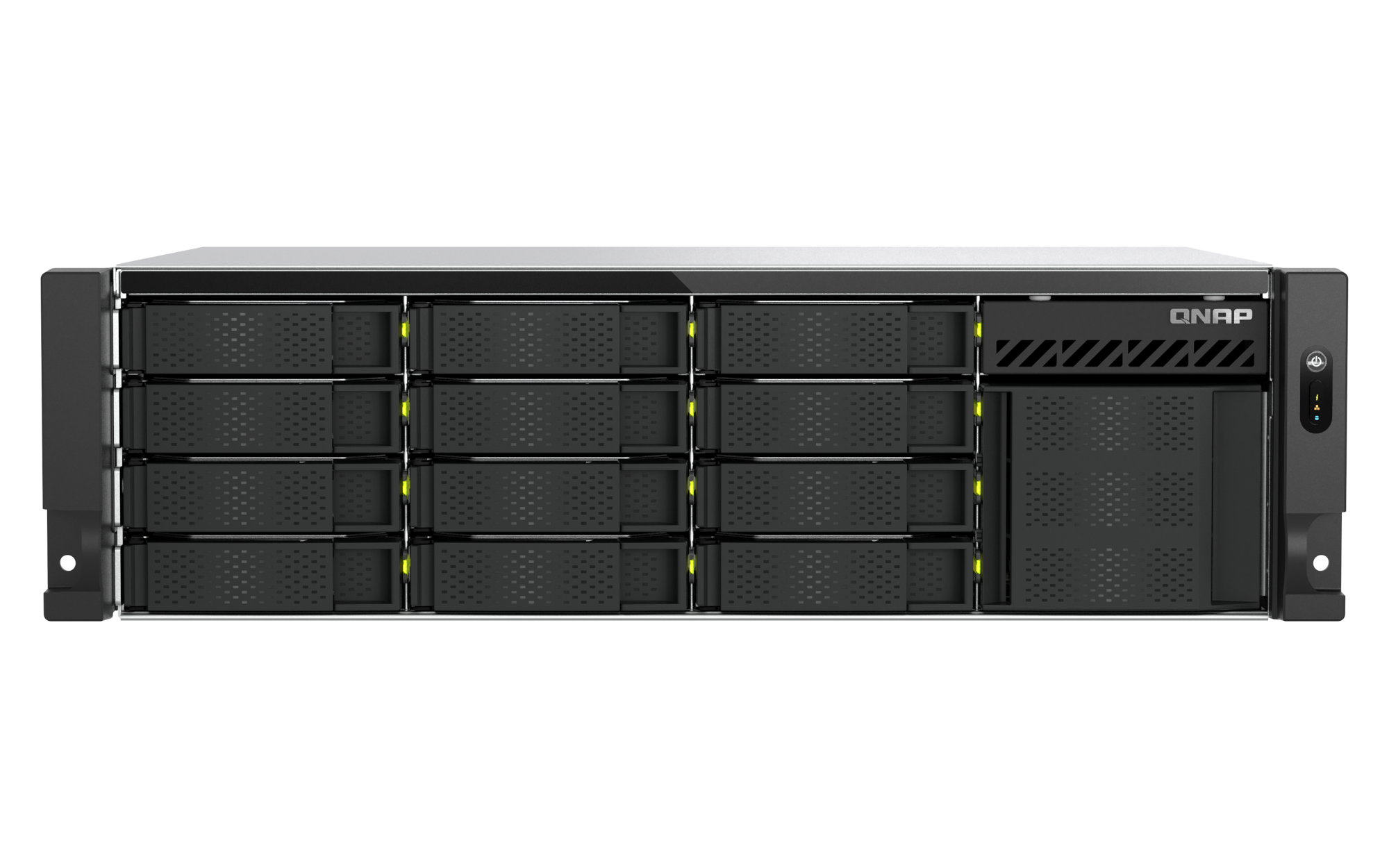
QNAP describes the TS-h1655XeU-RP as a 3U short-depth rack NAS. Its U.S. hardware selector identifies one TS-h1655XeU-RP-8G profile, and the U.S. Official Store names the order code TS-h1655XeU-RP-8G-US. The selector lists twelve native 3.5-inch SATA bays, while the product page rounds the chassis depth to about 11.6 inches and the hardware table gives 5.24 × 17.02 × 11.69 inches (height, width, depth). This is a rack installation, not a desktop enclosure; check rack-post spacing, airflow, rear connections and the exact rail kit rather than treating the metal-case depth as an installed depth.
The bay count is twelve, not sixteen. QNAP separately lists four rear E1.S/M.2 PCIe Gen 3 x2 positions. They are an additional fast-storage layer, not four more SATA trays, and each position is shared between supported E1.S and M.2 arrangements rather than representing both at once. The U.S. hardware selector lists support for 3.5-inch and 2.5-inch SATA drives, E1.S SSDs and M.2 2280 PCIe SSDs. That format list does not confirm every drive SKU or firmware revision; use QNAP's current model-specific compatibility records before choosing media.
Installation details matter for the smaller rear positions. The manufacturer says 5.9 mm E1.S SSDs require removal of the built-in E1.S-to-M.2 adapter, while 9.5 mm and 15 mm E1.S devices require the separately sold TRAY-E1S-01. The same four positions are promoted for SSD cache, SSD pools, QuTS hero system drives and a network module, so decide how they will be allocated before purchasing optional parts. These are not a no-questions-asked four-drive upgrade bay.
Built-in 10GbE changes the network planning
The reviewed profile includes one 10GBASE-T port and two 2.5GbE ports. The useful distinction is one built-in 10-Gbps-rated path, not a promise of a 10-Gbps file copy: the client NIC, switch, cable, protocol, installed disks and workload all matter. The two 2.5GbE ports remain separate links; their ratings should not be added to claim a single faster client connection. QNAP lists optional 25GbE cards, but they require a compatible card, network peer and cabling.
QNAP also publishes its own sequential SMB test figures. The listed environment uses twelve Samsung 870 EVO 1 TB drives, a RAID 5 thick volume, three hosts and four 25GbE connections. That is a description of a vendor lab setup, not evidence for the diskless package or the result a single office client will see. The safer buying decision is to map your intended clients and switch first, then size the storage and network path together; the network-path guide explains those dependencies.
Two storage systems, owner-created arrays
The exact software selector exposes QuTS hero, which uses ZFS, and QTS, which uses EXT4. They are alternative storage environments, not two filesystems operating simultaneously. QNAP lists RAID 1 for this twelve-bay configuration under both selectors. That supports an owner-created two-drive mirror plan whichever environment is chosen, but the NAS ships without data drives and has no preconfigured pool. Select compatible drives, choose the operating system and initialize the pool deliberately.
A two-drive RAID 1 arrangement mirrors data and is designed to keep the array available through a single member-drive failure in its documented degraded state. It is not a second copy against deletion, malware, theft, controller damage or a building event. A separate backup with a tested restore path is still required; see why RAID is not backup. A twelve-bay system can support much larger storage plans too, but that makes drive compatibility, RAID-group limits, expansion and recovery procedures more—not less—important.
Memory, power and package checks
The U.S. selector lists 8 GB of non-ECC DDR4 SODIMM memory, two slots and a 64 GB maximum (2 × 32 GB). QNAP says ECC modules are supported but must not be mixed with non-ECC memory; its dual-DIMM guidance calls for a matched pair. The base 8G model name is not a promise that every retailer ships the same DIMM revision or any upgrade module. Confirm approved memory for the exact profile, particularly if you expect to run a memory-intensive file system, apps or virtual machines.
QNAP lists two 300 W power supplies and a three-year standard warranty. Redundant supplies do not protect against a shared failed PDU or circuit, and a power-supply rating is not measured wall draw. The hardware page's typical 121.7 W figure is explicitly tied to a fully populated WD10EFRX test; QNAP also lists a separate disk-standby value. Neither number should be applied to an unpopulated or differently configured installation. The exact U.S. selector identifies a diskless configuration, but it does not establish what a particular retailer includes in the box or which rail kit fits your cabinet. Confirm the exact delivered SKU, complete package contents, compatible rails, rack-post depth and rear cable clearance before installation.
How it compares within QNAP's rack range
Against the separately assessed QNAP TS-1273AU-RP-8G-US, this model keeps the same twelve-native-bay headline but changes the fit: it is 3U and short-depth with one built-in 10GbE link and four E1.S/M.2 positions, while the TS-1273AU-RP is a 2U chassis with two built-in 2.5GbE ports and a deeper body. Those are actual hardware differences, not proof that either NAS will deliver a particular throughput. If your cabinet needs 2U, the extra height matters; if your switch and clients are 1GbE or 2.5GbE only, the 10GbE port may not change today's transfer path.
Who should shortlist this profile?
It is a documented candidate for a rack deployment that needs twelve native SATA bays, one built-in 10GbE port, a short chassis depth, and the option to build a separate NVMe layer. It is less suitable for someone expecting a ready-filled pool, a small desktop NAS or an unplanned collection of incompatible E1.S parts. Confirm the exact TS-h1655XeU-RP-8G-US order suffix, supported drive and memory part numbers, the chosen operating system, network path, rack rails, airflow and seller contents before ordering. I found no independent test of this exact configuration, and the source record does not settle drive/firmware compatibility or real-world noise and power behavior.
Key specifications
Key details at a glance
| Internal drive bays | 12 bays |
|---|---|
| Documented internal drive media | 3.5-inch SATA HDD / 2.5-inch SATA HDD / 2.5-inch SATA SSD / E1.S SSD / M.2 PCIe 2280 SSD through the E1.S-to-M.2 adapter |
| Built-in Ethernet ports | 1 x built-in 10GBASE-T RJ45 / 2 x built-in 2.5GbE RJ45 |
| Fastest individual Ethernet port | 10 Gbps |
| Installed system memory | 8 GB |
| Maximum listed memory | 64 GB |
| Listed storage arrangements | QuTS hero: Single, RAID 0, RAID 1, RAID 5, RAID 6, RAID 10, RAID 50, RAID 60, Triple Mirror, Triple Parity / QTS: JBOD, Single, RAID 0, RAID 1, RAID 5, RAID 6, RAID 10, RAID 50, RAID 60 |
| Internal file systems | QuTS hero: ZFS / QTS: EXT4 |
| Dimensions (H × W × D) | 5.24 x 17.02 x 11.69 inches (H x W x D); QNAP rounds the short-depth profile as 29.6 cm / 11.6 inches |
| Weight | 10.77 kg |
| Hardware warranty | 3 years |
| Data drives included in listed package | No |
| M.2 NVMe slots | 4 |
| M.2 SSD storage-pool support | Yes |
| Maximum total drive bays with listed expansion | 60 bays |
| Expansion-unit note | QNAP says up to two TL-R2400PES-RP units can add up to 48 drives, for a 60-drive system total. These are external JBOD positions, not built-in bays; expansion units, interfaces, installation and a multi-group storage plan are additional decisions. |
| Listed expansion unit | QNAP TL-R2400PES-RP (up to two 24-bay JBOD expansion units) |
| Processor | Intel Atom C5125 |
| CPU cores | 8 |
| Installed memory type | 8 GB non-ECC DDR4 SODIMM in the U.S. selector profile |
Use the exact model’s instructions for operating limits, supplied equipment and version differences.
Sources for this review
Sources for this assessment
- QNAP U.S. Tower/SMB product grid — TS-h1655XeU-RP family observation
- TS-h1655XeU-RP — QNAP U.S. product page
- TS-h1655XeU-RP U.S. rendered hardware selector — QNAP
- TS-h1655XeU-RP U.S. rendered software selector — QNAP
- TS-h1655XeU-RP-8G-US — QNAP U.S. Official Store
- RAID types — QTS 5.2.x User Guide
- QuTS hero h5.2.x User Guide — QNAP
- TS-h1655XeU-RP official chassis image — QNAP U.S.

Check your setup before choosing a NAS
Use the finder to narrow documented desk/shelf or rack formats, internal-bay minimums, a single Ethernet-port rating and optional redundancy requirements.