
Your needs, this model
Does it fit your priorities?
Are the twelve positions twelve built-in drive bays, and are disks included?
QNAP identifies twelve native 3.5-inch SATA positions and says the system ships without HDDs. The current hardware selector lists 3.5-inch SATA HDDs and 2.5-inch SATA SSDs; the TS-x73AU guide additionally lists 2.5-inch SATA HDDs, but that wording is not repeated in the current selector and the captured compatibility route had no exact drive/firmware rows. Check the complete drive model before ordering media or estimating usable space.
Explore this need in the finder →Can the two built-in 2.5GbE ports give one client a 5-Gbps path?
No single built-in port is rated above 2.5GbE. QNAP says 5 Gbps may be attained through port trunking, but the jacks remain separate links and a single client/flow is not promised 5 Gbps. A built-in 5GbE or 10GbE port is not listed; optional compatible network cards require the right PCIe fit plus matching switch, client and cable.
Explore this need in the finder →Can an owner create a two-drive mirror under either supported system?
The exact model's QTS and QuTS hero selectors both list RAID 1. Each is a two-drive, owner-created arrangement that tolerates one member failure; neither HDDs nor a prebuilt array are included. Pick QTS/EXT4 or QuTS hero/ZFS before initialization. QuTS hero requires at least 8 GB, while QNAP recommends 16 GB or more for TS-x73A use, especially with multiple applications. Keep a separate backup.
Explore this need in the finder →Is the 8 GB base memory enough to plan for a memory-heavy QuTS hero setup?
The reviewed TS-1273AU-RP-8G profile has one 8 GB DDR4 UDIMM in two slots. QNAP's model page gives 8 GB as the QuTS hero minimum, but recommends 16 GB or more for the TS-x73A family, particularly with multiple apps. The current selector and detailed guide table list 64 GB maximum, while the guide's overview says 32 GB; verify QNAP-approved modules and the delivered revision instead of assuming an upgrade path.
Explore this need in the finder →The TS-1273AU-RP-8G-US is best understood as a rack-storage platform that needs a plan, not as twelve drives in a box. This assessment is based on QNAP's current model selectors, its U.S. Official Store identity, and the TS-x73AU installation guide; it is not a hands-on test or a measurement of real-world throughput.
A twelve-bay 2U profile with a specific memory starting point
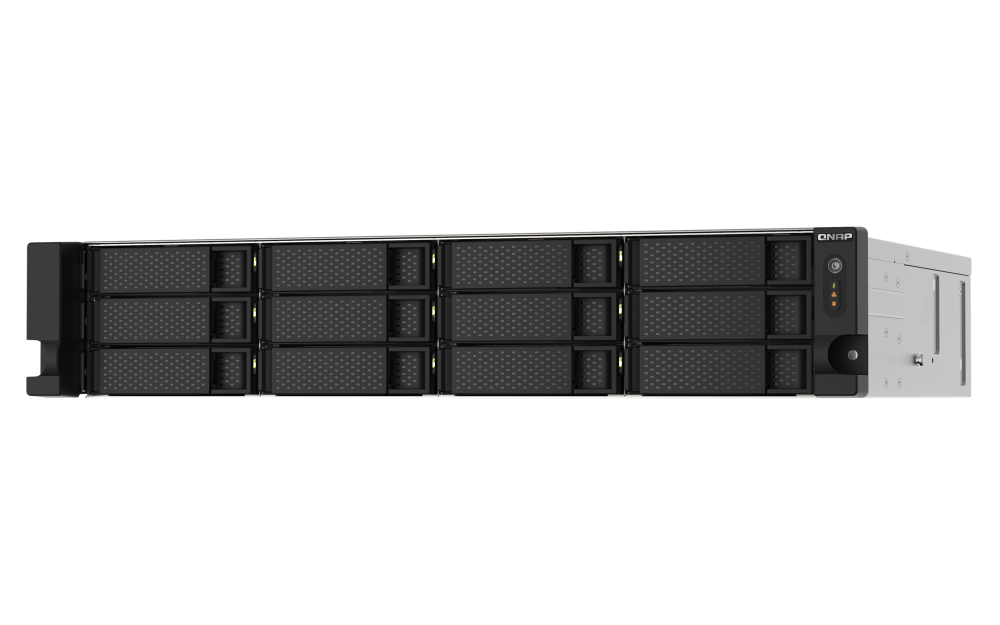
QNAP's exact selector identifies the TS-1273AU-RP-8G configuration: twelve native 3.5-inch SATA positions, a 2U rack chassis, Ryzen Embedded V1500B processing, two 2.5GbE ports and redundant power. The manual maps the -8G profile to twelve bays, 8 GB memory and redundant supplies. It is a capacity step above the eight-bay TS-873AU family, while the 16-bay TS-1673AU-RP is a taller 3U chassis. Compare the drive count you actually need with the rack space and rail envelope.
The system is listed without HDDs. Buyers must select compatible media, then decide how to lay it out. The current selector lists 3.5-inch SATA HDDs and 2.5-inch SATA SSDs; the guide also names 2.5-inch SATA HDDs in 3.5-inch trays. QNAP's current exact-family compatibility data includes named HDD and SSD model/firmware entries, plus a separate M.2 SSD section, but no distinct 2.5-inch HDD category. That omission proves neither support nor absence and does not settle the selector-guide difference; check every full drive model and firmware in the current list before purchase. Tray count alone is not a compatibility guarantee or a usable-capacity estimate.
The exact profile starts with one 8 GB DDR4 UDIMM and has two slots. QNAP's current selector and the guide's detailed table list a 64 GB ceiling, although the guide's opening overview says up to 32 GB. Use the current selector and detailed table as the listed maximum, not as proof any third-party DIMM will work; verify approved modules and the delivered revision. QuTS hero needs at least 8 GB, and QNAP recommends 16 GB or more for this family, especially with several applications, so the base amount is a minimum rather than a workload recommendation.
Dual 2.5GbE is not one five-gigabit port
The two built-in RJ45 interfaces negotiate up to 2.5GbE each. QNAP describes up to 5 Gbps using port trunking, but aggregation depends on network configuration and does not make one port or one client flow a guaranteed 5-Gbps connection. Switch, client, cable, protocol, storage and workload affect the path. QNAP lists optional 5GbE and 10GbE network adapters; these are expansion choices, not built-in ports, and need compatibility and slot checks.
QNAP's published test material describes its own lab configuration, including twelve Samsung SSDs in RAID 5, QTS 4.4.2 and an added dual-port 10GbE card. That setup is far removed from an unpopulated unit or a two-drive mirror. It is useful for understanding the conditions behind the vendor's figures, not as an independent benchmark or a promised transfer rate for a buyer's network.
Choose the operating system before creating storage
QNAP's current exact-model software selectors list QTS with EXT4 and QuTS hero with ZFS as alternatives. The 12-bay selector offers RAID 1 within each system's supported storage arrangements. A buyer can therefore create a two-drive mirror under one selected OS, but the manual and hardware selector do not describe a preconfigured array: supply two compatible drives and create the pool during setup. RAID 1 can continue after one member fails, but it uses roughly one drive's capacity before overhead and is not a second copy against deletion, malware, theft or failure of the whole NAS.
QNAP says changing between QTS and QuTS hero requires removing all drives before installing the other system. Decide which environment belongs in the long-term plan before initializing the data pool. The memory guidance matters particularly for QuTS hero: 8 GB reaches QNAP's stated minimum, but the manufacturer recommends 16 GB or more for the family, especially with multiple applications. Do not select that route on the assumption that the base DIMM is generous for every workload.
Rack, expansion and package checks matter
QNAP lists two PCIe Gen 3 x4 positions and optional QM2 cards for adding M.2 SSD storage or cache; the chassis does not list built-in M.2 drive bays. A suitable card may also add faster networking, but card length, bracket, slot clearance, supported models and network equipment all need checking. The documented two 300 W PSUs are redundant power components, not a measure of typical wall draw or a guarantee against a shared upstream power failure.
Rack fit deserves more than reading “2U.” QNAP's selector reports 88.6 × 432 × 370.7 mm and 11.13 kg net; the guide gives 89.5 × 425.3 × 371 mm and 9.69 kg. The selector excludes an ear hook and protruding PSU section; neither source is a full clearance drawing. The guide identifies RAIL-B02 as compatible and says rails are separate. Verify the current rail, cabinet depth, cable space, ventilation and loaded-weight limit. The standard package list includes two power cords, a CAT5e cable, screws and a quick-install guide, but no HDDs or rails. Confirm seller contents and written warranty terms for the U.S. SKU.
Who should keep it on the shortlist?
It is a plausible research candidate for a rack deployment that needs twelve internal SATA positions, two built-in 2.5GbE links and redundant PSU hardware, with a deliberate choice between QTS and QuTS hero. Its owner-configured mirror option can matter when a two-drive start is planned even though the chassis has more positions for later expansion. It is a poor shortcut for someone expecting included disks, a prebuilt pool, native 10GbE, a quiet desktop enclosure or a guaranteed 5-Gbps single-client path. If the decision depends on a specific drive, memory upgrade, rack rail or workload performance, resolve that exact compatibility question with QNAP and the seller before treating this model as a fit.
Key specifications
Key details at a glance
| Internal drive bays | 12 bays |
|---|---|
| Documented internal drive media | 3.5-inch SATA HDD / 2.5-inch SATA SSD in a 3.5-inch tray |
| Built-in Ethernet ports | 2 x built-in 2.5GbE RJ45 |
| Fastest individual Ethernet port | 2.5 Gbps |
| Installed system memory | 8 GB |
| Maximum listed memory | 64 GB |
| Listed storage arrangements | QTS: RAID 1 option / QuTS hero: RAID 1 option |
| Internal file systems | QTS: EXT4 / QuTS hero: ZFS |
| USB 3.2 Gen 1 ports | 1 |
| Maximum listed single-volume size | 250 TB |
| Dimensions (H × W × D) | Current selector: 88.6 × 432 × 370.7 mm (H × W × D), excluding ear hook and protruding PSU; TS-x73AU guide v04: 89.5 × 425.3 × 371 mm. These source measurement differences are not a complete rack clearance drawing. |
| Weight | 11.13 kg |
| Manufacturer's idle noise figure | 25.2 dB(A) |
| Hardware warranty | 3 years |
| Data drives included in listed package | No |
| M.2 NVMe slots | 0 |
| Processor | AMD Ryzen Embedded V1500B |
| CPU cores | 4 |
| CPU threads | 8 |
| Installed memory type | 8 GB DDR4 UDIMM profile; the manual's exact order table specifies 1 x 8 GB. QNAP says the device can use ECC modules; base-module ECC status is not asserted. |
| Single-volume limit condition | Current QTS profile lists a 250 TB maximum volume size and states that at least 4 GB RAM is required; this is a software maximum, not usable capacity guarantee for a buyer's drive layout. |
Use the exact model’s instructions for operating limits, supplied equipment and version differences.
Sources for this review
Sources for this assessment
- QNAP U.S. Tower/SMB 95-card product grid
- TS-1273AU-RP — QNAP U.S. product page
- TS-1273AU-RP-8G rendered hardware selector — QNAP
- QTS and QuTS hero rendered software selectors — QNAP U.S.
- TS-1273AU-RP-8G-US — QNAP U.S. Official Store
- TS-x73AU User Guide, English U.S., version 04 — QNAP
- TS-1273AU-RP and TS-1264U-RP comparison — QNAP U.S.
- QNAP compatibility route queried for TS-1273AU-RP
- RAID types — QTS 5.2.x User Guide
- QuTS hero h5.2.x User Guide, English U.S. — QNAP
- TS-1273AU-RP official product rendering — QNAP U.S.
- QNAP official exact-family compatibility JSON — TS-1273AU-RP

Check your setup before choosing a NAS
Use the finder to narrow documented desk/shelf or rack formats, internal-bay minimums, a single Ethernet-port rating and optional redundancy requirements.