
Your needs, this model
Does it fit your priorities?
Do the two built-in 2.5GbE sockets give one 5GbE client connection?
No. QNAP rates each built-in port at up to 2.5GbE and describes up to 5Gbps through port trunking across the pair. That is not a single 5Gbps link or a promised file-transfer rate; the switch, client, cabling, storage and workload must all suit the path. The one PCIe slot is an optional expansion route, not an included 10GbE adapter.
Explore this need in the finder →Does RP mean the files are mirrored or backed up?
No. RP identifies the redundant-power-supply design: the current profile lists two 250W supplies. A two-drive RAID 1 mirror is a separate, owner-created storage choice; QNAP documents RAID 1, but compatible disks and pool setup are not included. Neither dual PSUs nor a drive mirror replaces a separate backup copy.
Explore this need in the finder →Can I use an M.2 SSD without giving up the single PCIe slot?
The selector lists no native M.2 position; M.2 storage is optional through a PCIe adapter. This chassis has one PCIe Gen 3 x2 slot, so any adapter or network-card plan needs an exact compatibility and co-installation check. M.2 does not add to the four native SATA bays.
Explore this need in the finder →Assessment basis: This is a source-based review of QNAP's U.S. TS-464U-RP-8G-US profile, not a hands-on rack, drive, network or performance test. QNAP's exact U.S. selector lists an unmarked 8G profile, and the Official Store page identifies the -8G-US code. Those records establish configuration identity, not current stock, seller condition or package additions.
Four native SATA bays in a 1U chassis
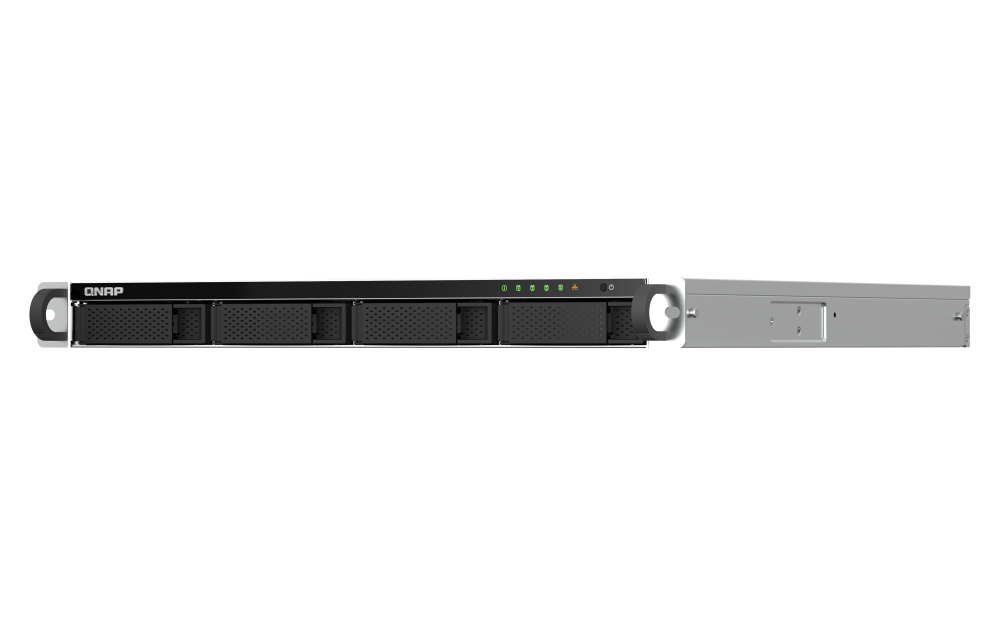
The useful distinction is compact rack storage, not maximum bay density. QNAP lists four 3.5-inch SATA positions; its exact profile sheet also lists 3.5-inch SATA hard drives and 2.5-inch SATA solid-state drives. It does not turn the optional M.2 route into a fifth bay: M.2 is available only through a PCIe adapter. QNAP's current TS-464U-RP family compatibility data contains named model-and-firmware entries in its HDD and SSD categories, but it is not a 4G/8G-specific bundle or an included-drive list. Match the full model and firmware of each intended disk against that live list; the absence of a separate 2.5-inch HDD category does not settle the selector/manual wording difference.
QNAP describes SATA bays as hot-swappable but explicitly carves out the optional M.2 SSD path. The selector's package contents show screws and rack hangers, while data drives and rail hardware are not listed. Treat a seller's bundle as a separate question, and plan usable capacity only after choosing drives and a storage layout. A two-disk RAID 1 mirror can help keep service running through a member-drive failure, but it consumes two of four positions and does not protect against deletion, malware or loss of the entire unit.
2.5GbE is a per-port limit, not a transfer promise
Two built-in RJ45 ports are rated up to 2.5GbE each. QNAP describes up to 5Gbps through port trunking across both ports; that aggregate figure is not the speed of one client link. A compatible switch or router, client interface, cabling, storage, protocol and workload all shape actual file movement. If you need a single built-in port faster than 2.5GbE, this configuration does not meet that as shipped. QNAP lists optional faster network cards, but an add-in card must fit the single PCIe Gen 3 x2 slot and match the rest of the path.
Separate the PSU decision from storage protection
RP is the power-supply distinction: QNAP lists two 250W supplies. That is meaningful when a rack design intends to retain operation after a supply failure, but only if the power-input and upstream circuit arrangement is designed accordingly. Dual supply hardware alone does not establish two independent electrical paths, backup runtime or fault tolerance for the rack. For replacement work on a used unit, QNAP warns that a TS-464U-RP with the older DPS-250AB-81 A / SP-469U-S-PSU supply needs the PWR-SET-DT04 kit with a cage and two supplies; the newer PWR-PSU-250W-DT04 alone is not compatible with that older setup. Check the installed PSU revision before ordering service parts; this is not a statement about what ships with a new seller package. RAID is another layer, configured with the storage drives; a mirror is not a backup.
QTS is the documented default, while QuTS hero is an alternative ZFS-based operating system. At 8GB the current profile meets QNAP's stated QuTS hero memory minimum. QNAP says inline data deduplication needs 16GB and recommends 32GB; this hardware's listed 16GB maximum reaches the minimum but not the recommendation. Switching the operating system, compatibility, memory changes and migration require a separate plan, not an assumption that both filesystems run together.
Expansion and rack fit need exact checks
The system lists one PCIe Gen 3 x2 slot and no onboard M.2 position. A QM2-style adapter can add an M.2 path, while a network card is another possible use; do not assume both options can be installed together. Confirm the exact card and revision in QNAP's compatibility listing. QNAP calls the chassis 1U and gives current dimensions of 1.7 × 16.93 × 18.86 inches. Its older English-U.S. guide gives different TS-464U-RP physical dimensions and net weight. The measurement basis is not explained, so do not use the convenient smaller figure to approve a cabinet fit.
QNAP's current TS-464U-RP compatibility response lists RAIL-B02 in its Rail Kit category, resolving the manufacturer-listed kit identity; the older guide's RP rail cell is blank, but that blank does not negate the newer exact-family row. QNAP describes RAIL-B02 as designed for racks with 25-inch mounting depth and warns that an 18-inch-deep rack may need extra adjustment space. This does not establish fit for every rail/chassis revision or cabinet: confirm post spacing, depth, mounting pattern, rear cable bend, airflow, service clearance and loaded weight. A small rack server still needs room to install and maintain safely.
Who should shortlist it?
This profile is a plausible document-supported candidate when four native bays, two built-in 2.5GbE ports, one PCIe expansion route and dual PSUs match a rack-based file or backup role. It is a narrower fit than a twelve-bay rack unit such as the QNAP TS-1264U-RP-8G-US if native drive positions are the priority. It is not a generic promise of server performance: the memory ceiling, one-slot expansion choice, uncertain rail fit, individual disk compatibility and full network path remain the actual decision checks.
Key specifications
Key details at a glance
| Internal drive bays | 4 bays |
|---|---|
| Documented internal drive media | 3.5-inch SATA hard disk drives / 2.5-inch SATA solid-state drives |
| Built-in Ethernet ports | 2 x built-in 2.5GbE RJ45 |
| Fastest individual Ethernet port | 2.5 Gbps |
| Installed system memory | 8 GB |
| Maximum listed memory | 16 GB |
| Listed storage arrangements | QTS: RAID 1 (two drives) / QuTS hero: RAID 1 (two drives) |
| Internal file systems | QTS: EXT4 / QuTS hero: ZFS |
| Hardware warranty | 3 years |
| M.2 NVMe slots | 0 |
| Processor | Intel Celeron N5095 |
| CPU cores | 4 |
| CPU threads | 4 |
| Installed memory type | 8GB DDR4 SODIMM; the current selector says 8GB since 2024/01, with two slots and 16GB maximum |
Use the exact model’s instructions for operating limits, supplied equipment and version differences.
Sources for this review
Sources for this assessment
- QNAP U.S. TS-464U-RP product page
- QNAP U.S. rendered TS-464U-RP hardware selector
- QNAP U.S. TS-464U-RP profile comparison
- QNAP TS-x64U Series User Guide (English-U.S.)
- QNAP U.S. TS-464U-RP package contents
- QNAP U.S. Official Store TS-464U-RP-8G-US page
- QNAP U.S. TS-464U-RP product-page gallery image
- QNAP official exact-family compatibility JSON — TS-464U-RP
- QNAP U.S. TS-464U-RP product page, current optional-accessory and PSU-replacement notes

Check your setup before choosing a NAS
Use the finder to narrow documented desk/shelf or rack formats, internal-bay minimums, a single Ethernet-port rating and optional redundancy requirements.