
Your needs, this model
Does it fit your priorities?
Should I count the optional M.2 card or an expansion shelf as part of the twelve internal bays?
No. The exact 8G profile lists twelve native 3.5-inch SATA positions. M.2 is available only through a separate PCIe adapter, and an expansion unit is another device; neither increases this chassis's native bay count. Verify the exact drive and firmware list, because the assessment did not capture a model-specific approval row.
Explore this need in the finder →Does dual 2.5GbE meet a single-port requirement above 2.5GbE?
Not as shipped. Each built-in port is rated up to 2.5GbE; QNAP's combined port-trunking figure is not a single 5-Gbps flow. A faster PCIe network card is optional, consumes the one expansion slot and needs a compatible switch/client/cable route.
Explore this need in the finder →Can I plan a twelve-bay system around a two-drive mirror and QuTS hero?
The 8G profile meets QNAP's stated 8-GB QuTS hero minimum, and QNAP lists RAID 1 for its eight-bay-and-larger QuTS hero profile. The buyer must choose compatible disks and create that pool; it is not prebuilt storage, and RAID is not a separate backup.
Explore this need in the finder →What must be settled before installing this 2U unit in a rack?
Confirm the exact current rail-kit part number, measurement convention, cabinet post spacing, rear cable clearance, ventilation and loaded weight with QNAP. The product page, current accessories list and old guide do not all name the same rail; the Store detail page was inaccessible. Two 300-W supplies also need suitable independent upstream circuits if power-path redundancy is a goal.
Assessment basis: This is a document-based review of QNAP’s current U.S. TS-1264U-RP-8G-US profile, its rendered U.S. hardware and software selectors, and the manufacturer’s family guide. It is not a hands-on test. The U.S. selector identifies twelve native SATA bays, two 2.5GbE ports and two 300-W power supplies. QNAP’s official Store result supplies the exact U.S. order code, but its detail page could not be inspected; no price, stock, shipping, complete seller package or seller-added parts are claimed.
Twelve trays are the storage decision
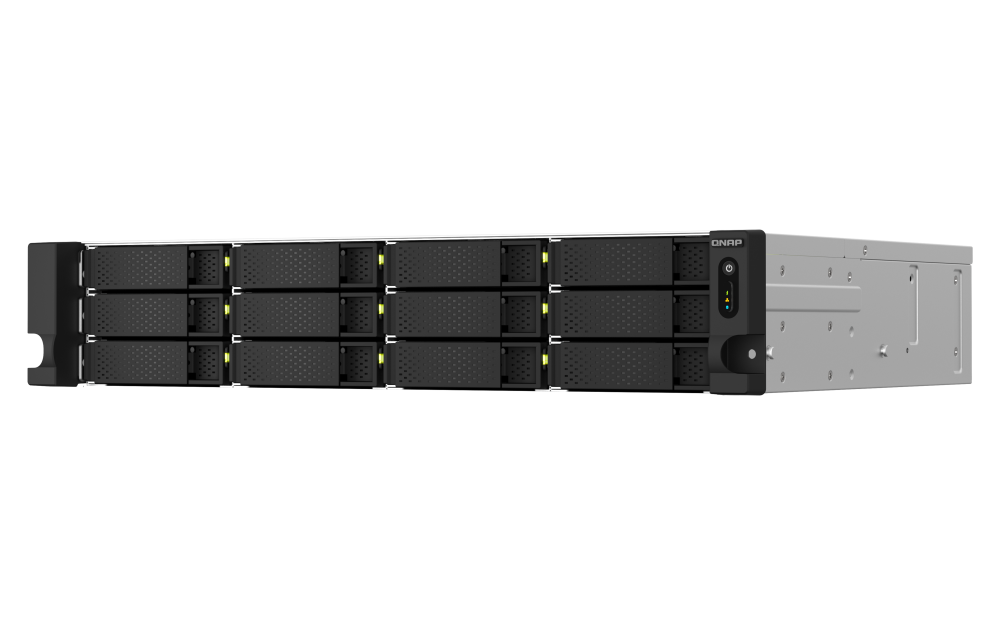
The useful starting point is twelve hot-swappable 3.5-inch SATA positions in a 2U rackmount chassis. QNAP’s current hardware profile lists 3.5-inch SATA hard drives and 2.5-inch SATA SSDs for those bays. It also mentions that M.2 can be added through a PCIe adapter; that is an optional card-and-media plan, not a thirteenth built-in bay. External expansion units are another separate system and do not alter the internal count. QNAP’s U.S. package page lists one TS-1264U-RP, an Ethernet cable, two power cords, 48 screws for 3.5-inch HDDs, 36 for 2.5-inch HDDs and a quick-installation guide. It lists no drives or rail kit; this family-level list does not verify exact Store-SKU contents or seller additions. Check invoices for claimed extras. QNAP’s current TS-1264U-RP family compatibility response lists Seagate model ST24000NT002-3N1101 with firmware EN01 under 3.5-inch HDDs. That family-level entry is not a 4G/8G suffix-specific claim, an included drive, or a general recommendation. The response has no separate 2.5-inch HDD category; that does not prove support or absence. Verify the exact drive and firmware you plan to use against QNAP’s current list before ordering.
The model also offers several storage layouts, but more bays do not prescribe a useful array. QNAP lists RAID 1 among the eight-bay-and-larger choices under both its QTS and QuTS hero profiles. Either can be planned as an owner-created two-drive mirror; the buyer selects compatible disks and creates the pool. It does not arrive with an initialized mirror. A mirror can keep a volume available after one member-drive failure, subject to the array’s condition, but it is not a second backup. Deletion, malware, theft, fire or loss of the whole chassis can affect both copies. Keep another recoverable copy on separate storage and test restoration.
Two 2.5GbE links are not one 5GbE port
QNAP lists two built-in 2.5GbE RJ45 interfaces. For a shopping requirement about the speed of one built-in port, the ceiling is 2.5GbE. The manufacturer describes up to 5Gbps combined through port trunking, but that does not promise a single client transfer at that rate; the switch, client, network configuration and workload matter. Optional 5GbE or 10GbE expansion requires a compatible PCIe card, and the machine has one PCIe Gen 3 x2 slot. That means a faster card competes with any other planned PCIe adapter, including a card for M.2 storage. Confirm the complete host-to-NAS path rather than treating an adapter listing as a guaranteed end-to-end speed.
The 8GB profile widens the software choice
The exact current selector lists an Intel Celeron N5095 four-core processor and 8GB of DDR4 SODIMM memory as the TS-1264U-RP-8G profile. Two memory slots and a 16GB maximum are listed. QNAP identifies QTS as the default system and QuTS hero as an alternative; these are different operating systems, not simultaneous filesystems. QTS uses EXT4, while QuTS hero uses ZFS. The product FAQ sets an 8GB minimum for QuTS hero, which this profile meets as supplied. QNAP says inline data deduplication needs at least 16GB and recommends 32GB, while the selector caps this model at 16GB. That distinction matters for a planned data-reduction workload: the unit cannot reach the published 32GB recommendation. If memory changes are part of the plan, verify the exact supported module and installation conditions instead of assuming any SODIMM will work.
The older TS-1264U-RP-4G-US is not the same supplied configuration. QNAP marks its 4G profile “Legacy,” and the manufacturer’s official Store search result confirms the separate 4G-US code. It has the same documented twelve bays, 2.5GbE limit and redundant power, but starts at 4GB; see its separate TS-1264U-RP-4G-US assessment. A memory upgrade may change that older unit’s usable OS options, but verify the exact supported parts and delivered configuration rather than treating 4G and 8G as interchangeable.
Rack power, depth and the rail question
QNAP lists two 300-W supplies and two power cords. Dual supplies can address a failed module only if the installation and upstream electrical plan are suitable; two cords on one shared circuit do not create independent power. The exact selector gives 3.49 × 17.01 × 14.59 inches (H × W × D), 23.46lb net and 30.89lb gross. Those are manufacturer figures, not a rack-fit guarantee. More importantly, the English-U.S. guide for the legacy 4G edition gives 18.98 inches wide, 16.69 inches deep and 20.79lb net. The page selector currently displays different width/depth and weight values for the 4G profile. The figures may reflect differing measurement conventions or a document issue; confirm the dimensions with QNAP and the cabinet manufacturer before calculating rail clearance or loaded rack weight.
The rail record also needs care: the product page references optional RAIL-S01, the current accessories list marks RAIL-S01 end-of-life while listing RAIL-B02 and RAIL-S02, and the English guide names RAIL-B02 as compatible. Those pages do not settle which kit fits a specific rack depth, post spacing and service arrangement. Ask QNAP to confirm the current rail part number for the exact order code. The shallow chassis dimension alone is not enough to decide clearance behind the unit for power, network or expansion cables.
Overall, this is a plausible 12-bay reference for a rack plan that needs dual 2.5GbE, an owner-built RAID layout and the option to choose QTS or QuTS hero. Its strongest decision points are native bay count, a modest single-port network ceiling, a one-slot expansion tradeoff and redundant supply hardware. Drives, memory modules, rack rails and the exact seller package remain checks; none is proven by the front-side rendering. No independent measurements, benchmarks, noise results, installation experience or customer feedback are claimed.
Key specifications
Key details at a glance
| Internal drive bays | 12 bays |
|---|---|
| Documented internal drive media | 3.5-inch SATA hard disk drives / 2.5-inch SATA solid-state drives |
| Built-in Ethernet ports | 2 x built-in 2.5GbE RJ45 |
| Fastest individual Ethernet port | 2.5 Gbps |
| Installed system memory | 8 GB |
| Maximum listed memory | 16 GB |
| Listed storage arrangements | QTS: RAID 1 listed for eight-bay-and-larger profiles / QuTS hero: RAID 1 listed for eight-bay-and-larger profiles |
| Internal file systems | QTS: EXT4 / QuTS hero: ZFS |
| M.2 NVMe slots | 0 |
| Processor | Intel Celeron N5095 |
| CPU cores | 4 |
| CPU threads | 4 |
| Installed memory type | 8 GB DDR4 SODIMM (one 8-GB module in the current selector) |
Use the exact model’s instructions for operating limits, supplied equipment and version differences.
Sources for this review
Sources for this assessment
- QNAP U.S. TS-1264U-RP product page
- QNAP U.S. rendered TS-1264U-RP hardware and software selectors
- QNAP U.S. TS-1264U-RP profile comparison
- QNAP TS-x64U Series User Guide (English-U.S.)
- QNAP U.S. Official Store TS-1264U-RP-8G-US identity result
- QNAP U.S. TS-1264U-RP product-page image
- QNAP official exact-family compatibility JSON — TS-1264U-RP
- QNAP U.S. TS-1264U-RP package contents
- QNAP U.S. TS-1264U-RP product overview
- QNAP U.S. TS-1264U-RP optional accessories section

Check your setup before choosing a NAS
Use the finder to narrow documented desk/shelf or rack formats, internal-bay minimums, a single Ethernet-port rating and optional redundancy requirements.