
Your needs, this model
Does it fit your priorities?
Does the TS-1264U-RP-4G actually have four bays because one guide table says four?
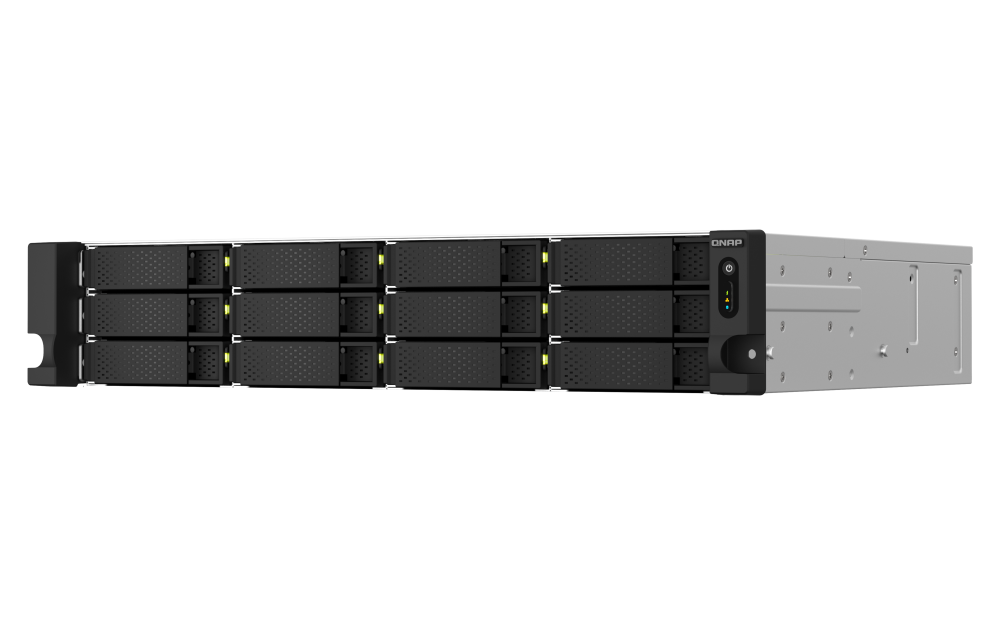
No. QNAP's detailed model table and its U.S. 4G selector both list twelve native 3.5-inch positions; the guide's short ordering table is inconsistent. Do not confuse the label 4G (memory) with drive count. Verify the exact chassis name and order suffix before accepting a delivery.
Explore this need in the finder →Can the legacy 4GB configuration run the QuTS hero plan as supplied?
No. QNAP's FAQ gives QuTS hero an 8GB minimum, while the legacy selector profile ships with 4GB. It may be considered only after confirming and installing supported memory to reach at least 8GB; its 16GB limit also falls short of QNAP's 32GB QuTS hero recommendation for optimal performance.
Explore this need in the finder →Can the TS-1264U-RP-4G support a two-disk mirror?
QNAP lists RAID 1 for the eight-bay-and-larger QTS profile. The buyer must provide compatible drives and create the two-disk array; the standard package is not a preconfigured mirror, and a mirror does not replace a separate backup.
Explore this need in the finder →Which measurements and rail kit should I use for a rack plan?
The current selector and older U.S. guide disagree on the 4G configuration's dimensions and net weight. The older guide lists RAIL-B02, while current accessory references also mention RAIL-S01 and RAIL-S02. Confirm the exact current rail, width/depth convention, loaded weight, rack posts and cable clearance with QNAP.
Explore this need in the finder →Assessment basis: This is a document-based assessment of the U.S. TS-1264U-RP-4G-US configuration, which QNAP’s current U.S. selector labels “Legacy.” The exact SKU appears on QNAP’s official Store result, but direct access to that item failed; I do not infer current availability, seller contents or a shipped condition from the indexed title. The older English-U.S. family guide and the present U.S. selector both identify the TS-1264U-RP-4G profile, although a small number of their specifications disagree.
A twelve-bay NAS, not a four-bay unit
The manual has a misleading one-line ordering table that associates the TS-1264U-RP-4G with four bays. Its detailed model-specific table states twelve 3.5-inch SATA bays, and QNAP’s current U.S. selector also lists twelve positions for the legacy profile. The surrounding “4” is best treated as an apparent source typo, not a different four-bay edition. The same detailed guide names SATA hard drives and SSDs, hot-swapping, two built-in 2.5GbE interfaces and a 2U rack form factor. QNAP’s selector lists 3.5-inch SATA hard drives and 2.5-inch SATA SSDs. QNAP’s current TS-1264U-RP family compatibility response lists Seagate model ST24000NT002-3N1101 with firmware EN01 under 3.5-inch HDDs. The family-level response is not specific to the 4G or 8G suffix, and it does not mean a drive is included or recommended. It has no separate 2.5-inch HDD category; that absence does not establish support or absence. Verify the exact intended model and firmware against QNAP’s current list before ordering.
M.2 storage is optional through a PCIe adapter, not an additional row of internal SATA trays. QNAP lists one PCIe Gen 3 x2 slot, so any card needs to match the exact chassis and may compete with other expansion plans. A shelf or external drive enclosure is also a separate device, cost and connection path; neither should be counted as native bays. QNAP's U.S. package-contents page lists the TS-1264U-RP, one Ethernet cable, two power cords, 48 flat-head screws for 3.5-inch drives, 36 for 2.5-inch drives and a quick-installation guide. It does not list data drives or rail hardware. That is the manufacturer's family-level package list, not the inaccessible exact 4G-US Store page or a seller-added bundle; verify the seller's written invoice.
The older 4GB memory package changes the OS plan
Memory is the main difference from the current 8G profile. QNAP’s hardware selector lists 4GB DDR4 in the legacy configuration, two SODIMM slots and a 16GB maximum. Its product page describes QuTS hero as a switchable operating-system option, and the manufacturer’s FAQ sets an 8GB minimum for QuTS hero. So a 4GB unit as supplied should be assessed around QTS; QuTS hero requires a supported upgrade to at least 8GB first. Do not assume an arbitrary module will work: QNAP tells owners to use compatible memory and matching module specifications. The maximum also matters if data deduplication is central to the plan: QNAP sets 16GB as the minimum for that feature and recommends 32GB, beyond this model’s listed ceiling.
QTS and QuTS hero are distinct operating-system and filesystem routes, not simultaneous modes. QNAP lists RAID 1 in its eight-bay-and-larger software table, so a two-drive mirror is a supported owner-created option under the documented QTS plan. The guide describes the pool as something the user creates, and the U.S. package list names no prebuilt array or supplied data drives. A mirror can help maintain access through one member-drive failure, but it does not provide a separate recovery copy for deletion, malware, theft, fire or failure of the entire NAS. Plan an independent backup and test a restore.
Network speed is per port
The base unit has two 2.5GbE ports. That is the documented rate of one built-in port; combining ports does not turn them into one guaranteed 5Gbps client flow. A requirement of 3Gbps or higher on a single built-in interface is not met by the stock configuration. QNAP lists optional faster PCIe networking, but the added card needs to be compatible and consumes the single expansion slot. Router or switch, client, cabling, network configuration, disks and workload can all limit transfers, so no actual file-transfer rate follows from the port label.
Redundant power and a rack-fit document conflict
QNAP specifies two 300-W power supplies for this model and two power cords in the older guide. That provides redundant hardware, not two independent electrical feeds by itself. If power resilience matters, check the power distribution and use suitable separate upstream circuits. QNAP’s current selector reports 3.49 × 17.01 × 14.59 inches and 23.46lb net for the 4G profile; its guide lists 3.49 × 18.98 × 16.69 inches and 20.79lb net. These differences are material for cabinet width, depth, rail clearance and load calculations. The guide separately lists RAIL-B02, but QNAP’s product page points to RAIL-S01 and the current accessory list marks RAIL-S01 EOL while showing RAIL-S02. Confirm the appropriate rail, measurement convention and exact fit with QNAP before installation; do not choose from the model suffix or nominal depth alone.
Compare it with the current 8G profile, not a guessed bundle
QNAP’s selector keeps the TS-1264U-RP-8G and TS-1264U-RP-4G (Legacy) profiles separate. The current 8G configuration starts at twice the listed memory, while both profiles share the documented twelve-bay layout, two 2.5GbE ports and dual 300-W supplies. The exact legacy Store suffix confirms a U.S. 4G identity but does not show what any other reseller will ship or how that seller configures memory. Buyers who need the additional RAM headroom should compare the separate TS-1264U-RP-8G-US assessment and verify the exact code on the quotation or nameplate.
The 4G profile remains a relevant earlier NAS configuration, but it is a narrower fit: it has a documented two-drive RAID 1 path with QTS as supplied, a 2.5GbE single-port ceiling and a specific memory-upgrade decision before QuTS hero. The right choice depends on required services and a confirmed configuration, not the number of bays alone. No stock, price, benchmark, installation experience or customer-use result is asserted here.
Key specifications
Key details at a glance
| Internal drive bays | 12 bays |
|---|---|
| Documented internal drive media | 3.5-inch SATA hard disk drives / 2.5-inch SATA hard disk drives / 2.5-inch SATA solid-state drives |
| Built-in Ethernet ports | 2 x built-in 2.5GbE RJ45 |
| Fastest individual Ethernet port | 2.5 Gbps |
| Installed system memory | 4 GB |
| Maximum listed memory | 16 GB |
| Listed storage arrangements | QTS: RAID 1 listed for eight-bay-and-larger profiles / QuTS hero: RAID 1 listed for eight-bay-and-larger profiles after required memory upgrade |
| Internal file systems | QTS: EXT4 / QuTS hero: ZFS after memory upgrade |
| M.2 NVMe slots | 0 |
| Processor | Intel Celeron N5095 |
| CPU cores | 4 |
| CPU threads | 4 |
| Installed memory type | 4 GB DDR4 SODIMM as supplied |
Use the exact model’s instructions for operating limits, supplied equipment and version differences.
Sources for this review
Sources for this assessment
- QNAP U.S. TS-1264U-RP product page
- QNAP U.S. rendered TS-1264U-RP hardware and software selectors
- QNAP U.S. TS-1264U-RP profile comparison
- QNAP TS-x64U Series User Guide (English-U.S.)
- QNAP U.S. Official Store TS-1264U-RP-4G-US identity result
- QNAP U.S. TS-1264U-RP product-page image
- QNAP official exact-family compatibility JSON — TS-1264U-RP
- QNAP U.S. TS-1264U-RP package contents
- QNAP U.S. TS-1264U-RP product overview
- QNAP U.S. TS-1264U-RP optional accessories section

Check your setup before choosing a NAS
Use the finder to narrow documented desk/shelf or rack formats, internal-bay minimums, a single Ethernet-port rating and optional redundancy requirements.