
Your needs, this model
Does it fit your priorities?
What is materially different about the 4G Legacy profile?
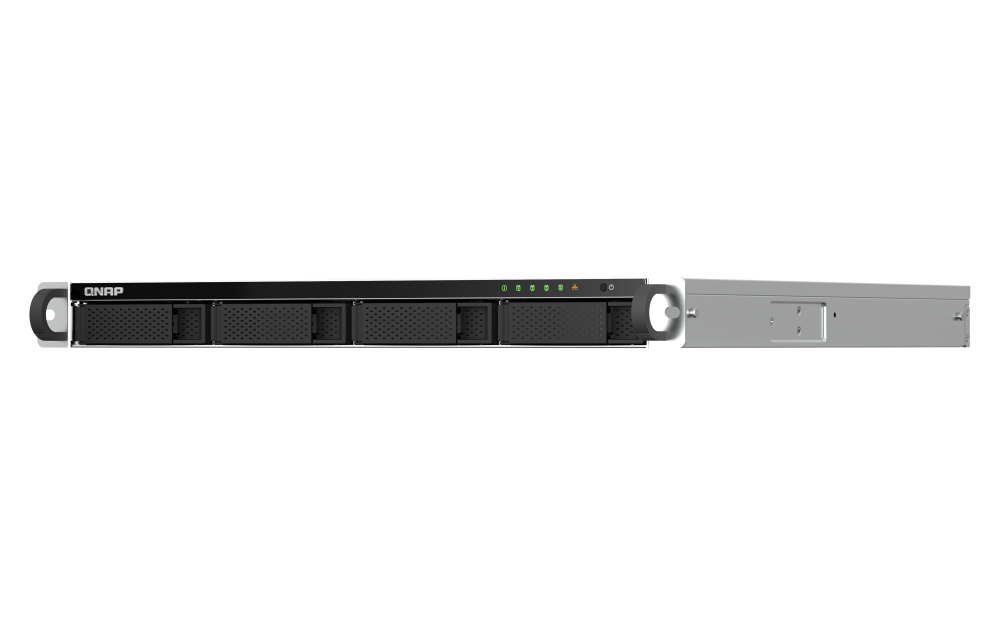
QNAP's U.S. selector marks TS-464U-RP-4G Legacy and lists 4GB installed memory rather than the current 8G profile's 8GB. The chassis, four bays, two 2.5GbE ports and two 250W power supplies remain listed alike. QNAP shows two SODIMM slots and a 16GB maximum, but confirm a supported memory part before planning an upgrade.
Explore this need in the finder →Can the supplied 4GB run QuTS hero?
Not at the documented starting memory: QNAP specifies an 8GB minimum for QuTS hero. The 4G profile has a listed 16GB maximum, so a compatible supported upgrade to at least 8GB is a prerequisite, not something assumed in this as-supplied assessment. QNAP lists 16GB as the minimum for inline deduplication and recommends 32GB, beyond this chassis's listed maximum.
Explore this need in the finder →Is an RP mirror the same as a drive mirror?
No. The 4G profile has two 250W power supplies; QNAP separately documents RAID 1 as a two-drive option. It does not arrive with an installed array or data disks, and power-supply redundancy does not protect files from deletion, malware or loss of the whole NAS. Plan a distinct backup and confirm the exact rack power paths.
Explore this need in the finder →Assessment basis: This review covers the exact TS-464U-RP-4G profile that QNAP's U.S. hardware selector marks “Legacy.” It is a documented U.S.-market configuration, not a verified promise of a current retail offer. The inspected U.S. Official Store page identifies the separate TS-464U-RP-8G-US profile; I did not find an exact RP-4G-US SKU in the checked sources. Do not substitute the distinct non-RP TS-464U-4G listing when identifying a seller package.
Four bays and 2.5GbE remain; memory is the dividing line
The selector lists four native 3.5-inch SATA positions, two built-in 2.5GbE ports, a single PCIe Gen 3 x2 slot and a 1U chassis. It also lists 4GB of installed DDR4 SODIMM memory, two slots and a 16GB maximum. QNAP's parallel 8G profile starts at twice the memory while keeping the same listed drive-bay, network, power and chassis configuration. That difference matters more for operating-system and memory-intensive plans than for bay count.
QTS is the default OS path and the TS-x64U guide documents RAID 1 as a two-drive arrangement. A buyer supplies compatible drives and creates the pool; the package list does not include disks or a prebuilt mirror. If two drives are mirrored, that consumes two of the four positions, and a separate backup remains necessary. QNAP's current TS-464U-RP family compatibility data contains named model-and-firmware entries in its HDD and SSD categories; it is family-level rather than 4G-specific and does not establish a seller's drive bundle. Match the full model and firmware of each intended drive against the current list. The absence of a separate 2.5-inch HDD category does not settle the selector/manual media wording difference.
QuTS hero requires an upgrade from the 4GB start
QNAP lists QuTS hero as an alternative OS and states an 8GB memory minimum. The 4GB legacy profile is therefore not an as-supplied QuTS hero plan. It has two SODIMM positions and a listed 16GB ceiling, so a compatible, supported upgrade to at least 8GB is a prerequisite if that ZFS-based option is the aim. Confirm the actual memory module and hardware revision with QNAP; this review does not assume that any generic DIMM will work.
There is another ceiling worth noticing before treating the upgrade as a long-term platform fix: QNAP says inline deduplication needs at least 16GB and recommends 32GB. The listed maximum is 16GB. Meeting the minimum for a feature is not the same as meeting the vendor's recommendation, and the 4G profile cannot reach that 32GB figure under the published specification.
The “RP” decision is about power, not networking or RAID
QNAP lists two 250W power supplies for the RP configuration. That is different from the single-supply non-RP TS-464U family member; it is also different from a RAID mirror. Redundant modules do not guarantee that the unit will stay online if both are fed by the same failed circuit, and they do not provide battery runtime. For service or replacement on a used TS-464U-RP, QNAP says to check the installed PSU: the older DPS-250AB-81 A / SP-469U-S-PSU setup is not compatible with the newer PWR-PSU-250W-DT04 alone and requires the PWR-SET-DT04 cage-and-two-supply kit. This does not establish which PSU revision a particular seller is offering. If PSU resilience matters, plan suitable power inputs separately from drive-failure protection and backup.
Each built-in Ethernet interface is rated up to 2.5GbE. Although QNAP describes up to 5Gbps through trunking both ports, this is not a single 5Gbps link. A faster add-in network adapter is optional and would use the only PCIe slot, as would an adapter-based M.2 path. QNAP's selector lists no native M.2 position; neither M.2 nor an external enclosure adds an internal SATA bay.
Installation remains a model-specific check
The current selector displays 1.7 × 16.93 × 18.86 inches and 20.59 pounds for this profile. The older English-U.S. guide lists 1.70 × 19.0 × 20.03 inches and 17.90 pounds for TS-464U-RP-4G. I cannot resolve whether this reflects rack ears, a measurement convention or a source/revision change, so do not use either set as a guaranteed clearance or loaded-weight figure. QNAP's current exact-family compatibility response lists RAIL-B02 in its Rail Kit category; its product page says the kit is designed for a 25-inch mounting depth and may need adjustment space in an 18-inch rack. This confirms the maker-listed rail identity, not fit for every rail/chassis revision or cabinet. Verify post spacing, depth, mounting pattern, rear cable and service clearances with QNAP before installation.
Four HDD trays, two cords, cable and mounting hardware are shown in the manufacturer's package list; those entries do not settle what an individual reseller adds. Confirm the exact chassis and SKU on a seller's invoice and ask whether drives or rails are included. If the priority is a fresh installation with the stated 8GB starting profile, compare the separately reviewed TS-464U-RP-8G-US; if this earlier configuration is the candidate, treat memory support, package identity, PSU revision and physical fit as pre-purchase verification items, not as assumed facts.
Key specifications
Key details at a glance
| Internal drive bays | 4 bays |
|---|---|
| Documented internal drive media | 3.5-inch SATA hard disk drives / 2.5-inch SATA solid-state drives |
| Built-in Ethernet ports | 2 x built-in 2.5GbE RJ45 |
| Fastest individual Ethernet port | 2.5 Gbps |
| Installed system memory | 4 GB |
| Maximum listed memory | 16 GB |
| Listed storage arrangements | QTS: RAID 1 (two drives) / QuTS hero: RAID 1 (two drives) |
| Internal file systems | QTS: EXT4 / QuTS hero: ZFS |
| Hardware warranty | 3 years |
| M.2 NVMe slots | 0 |
| Processor | Intel Celeron N5095 |
| CPU cores | 4 |
| CPU threads | 4 |
| Installed memory type | 4GB DDR4 SODIMM as supplied; two slots and 16GB maximum are listed |
Use the exact model’s instructions for operating limits, supplied equipment and version differences.
Sources for this review
Sources for this assessment
- QNAP U.S. TS-464U-RP product page
- QNAP U.S. rendered TS-464U-RP hardware selector
- QNAP U.S. TS-464U-RP profile comparison
- QNAP TS-x64U Series User Guide (English-U.S.)
- QNAP U.S. TS-464U-RP package contents
- QNAP U.S. TS-464U-RP product-page gallery image
- QNAP official exact-family compatibility JSON — TS-464U-RP
- QNAP U.S. TS-464U-RP product page, current optional-accessory and PSU-replacement notes

Check your setup before choosing a NAS
Use the finder to narrow documented desk/shelf or rack formats, internal-bay minimums, a single Ethernet-port rating and optional redundancy requirements.