
Your needs, this model
Does it fit your priorities?
Can this DXP6800 Ultra meet a six-bay, one-port 10GbE and two-drive-mirror requirement?
Yes as a possible buyer-created setup: the exact model table lists six SATA bays, individual 10GbE ports and RAID 1. A two-SATA-drive mirror would leave four SATA trays physically open. The NAS is diskless, so verify the exact compatible pair and create the pool yourself; one 10GbE port is a link rating rather than a measured copy speed, and RAID is not a separate backup.
Explore this need in the finder →Does UGREEN's 208TB maximum mean the DXP6800 Ultra arrives with 208TB of usable space?
No. The official figure adds six 32TB SATA drives and two 8TB M.2 SSDs as raw capacity. The selected standalone product is diskless; RAID layout, any supported M.2 role, system use and formatting change how much space is available, so this is not included or guaranteed usable volume capacity.
Explore this need in the finder →Do the DXP6800 Ultra's dual 10GbE and two Thunderbolt 4 ports make one 20Gbps Ethernet path?
No. UGREEN lists two separate 10GbE jacks and two separate Thunderbolt 4 ports. The questionnaire uses the fastest individual Ethernet port: 10GbE. Aggregation requires a supported network configuration, Thunderbolt is a different interface, and neither rating proves a particular client's copy speed.
Explore this need in the finder →Do the two M.2 slots count as two more SATA bays?
No. The exact specification lists six SATA bays and two separate M.2 NVMe SSD slots. The product's 208TB raw-capacity arithmetic includes both types of drive position, but a six-bay minimum is still six SATA trays; the M.2 positions and 128GB system SSD do not add SATA bays.
Explore this need in the finder →This documentation-based assessment covers the UGREEN NASync DXP6800 Ultra U.S. standalone configuration, manufacturer SKU 95580. UGREEN labels the product diskless; its listed storage maximum is not an included-drive package. I have not tested or owned this NAS, so the discussion below is a reading of manufacturer material rather than a claim about measured speed, noise, or day-to-day reliability.
Six SATA bays are the core of the design
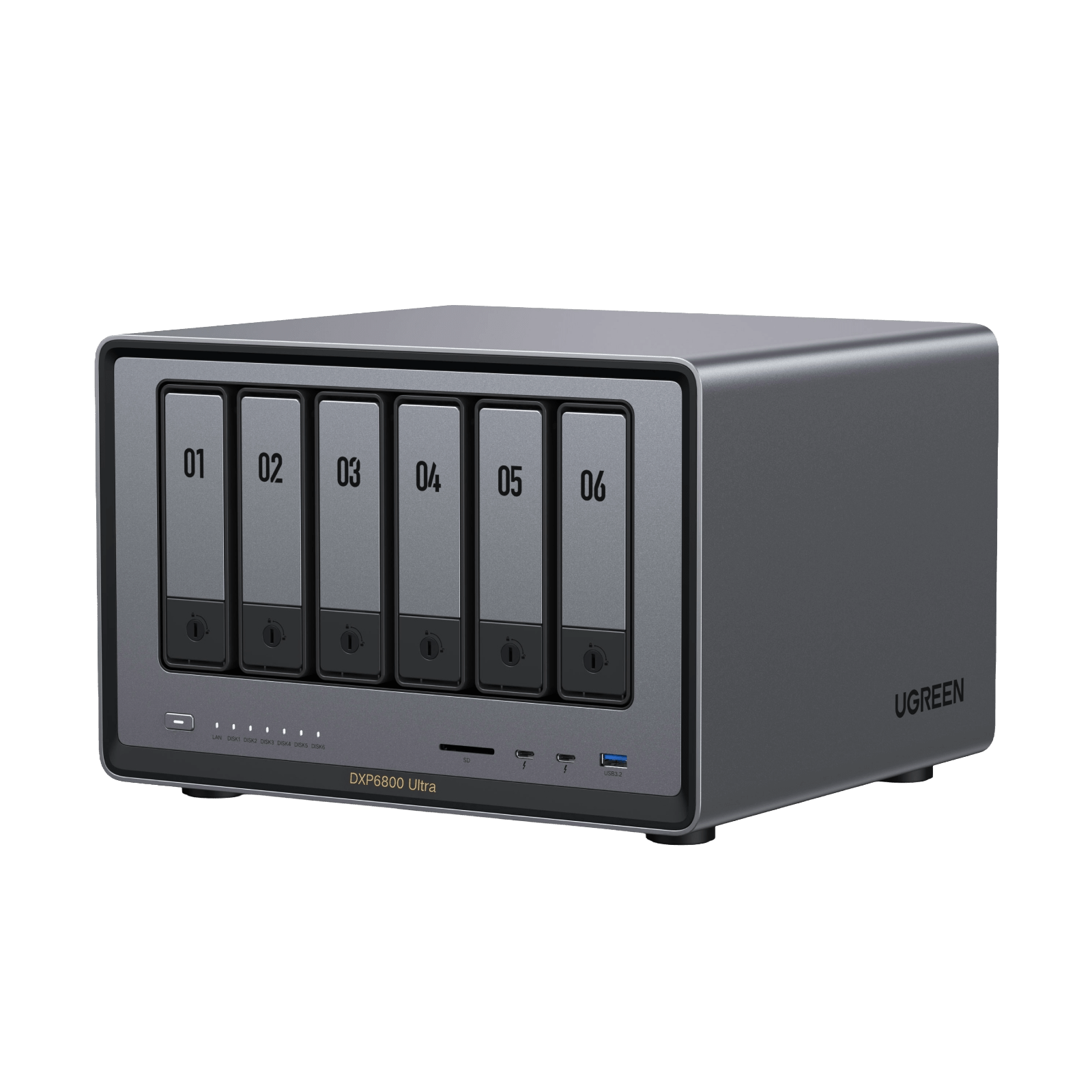
The defining choice is six native SATA positions, with two separate M.2 NVMe SSD slots. Count the SATA trays as six internal drive bays; the M.2 connectors do not turn it into an eight-tray NAS, and the 128GB system SSD is not a seventh data bay. This distinction matters when a shelf plan, drive budget, or future expansion decision is based on physical bays rather than every connector mentioned on the product page.
Six trays leave more room for a larger disk set than a four-bay chassis, but they also raise the cost of filling it. UGREEN's page gives a 208TB maximum as six 32TB SATA drives plus two 8TB M.2 SSDs. That is raw arithmetic across separately purchased media, not a single promised volume or usable capacity. RAID layout, whatever M.2 storage role the current software supports, system use and formatting all affect space available to files. The official page marks the reviewed standalone configuration diskless, so budget for compatible drives separately.
Redundancy is a plan to create, not a supplied feature
UGREEN lists Basic, JBOD, RAID 0, RAID 1, RAID 5, RAID 6 and RAID 10 for this model. A possible two-drive RAID 1 arrangement uses two compatible SATA drives and leaves four of the six SATA trays physically open. That is a buyer-created configuration: the product is not shown with a preinstalled pair or initialized mirror, and available capacity depends on the smaller member of the pair, formatting and the software layout. Check the complete model and capacity of both drives in UGREEN's current compatibility information before ordering.
A mirror can keep a volume available after certain single-drive failures, but it does not protect against accidental deletion, malware, theft, fire, or enclosure failure. Keep another recoverable copy on a separate system or off-site service and test that restore plan. An empty tray is physical room, not proof that an existing storage pool can be expanded without rebuilding or following the current software's rules.
Two 10GbE jacks are not one 20GbE port
The product table lists two individual 10GbE RJ45 ports. UGREEN describes aggregating them in a supported network setup, but that is not a single 20GbE connector and the maker's maximum is not a test result. The finder therefore treats 10GbE as the highest documented rate of one built-in Ethernet port. A one-port requirement above 10Gbps is not met merely because the NAS has a second jack or two Thunderbolt connectors.
Plan the entire network path before paying for 10GbE: the workstation or server needs a compatible interface, the switch or direct connection must support the link, and the cabling, storage layout and workload must all cooperate. A 10GbE port rating does not mean every file copy will run at 10Gb/s. Aggregation also depends on configuration and what the client and network can use; do not treat a port count as a throughput promise.
Thunderbolt 4 and the system specification
UGREEN lists two Thunderbolt 4 ports at up to 40Gb/s per connection and positions that route for workstation-focused tasks, alongside networked access through Ethernet. Thunderbolt is a different interface from Ethernet; the advertised line rate is not an SMB transfer result, and the exact cable, host, software setup and simultaneous-use limits should be checked against instructions for the unit received. The captured U.S. Download Center page did not expose a DXP6800 Ultra-specific manual link, so this assessment does not make a manual-verified setup claim.
The U.S. product specifications name an Intel Core 5 120U with 10 cores and 12 threads, 8GB DDR5-4800 memory, a listed maximum memory expansion of 96GB, and a 128GB SSD system disk. The 96GB figure is a manufacturer ceiling, not confirmation of a particular module, slot arrangement or seller-installed upgrade. The page also marks ODECC as supported; that label does not establish that the included memory is ECC. Verify the exact memory part number and support status rather than choosing by capacity or DDR generation alone. The product table calls the operating software UGOS but does not identify the installed firmware build.
Space, fit and the final checks
UGREEN lists dimensions of 294 × 258 × 189mm (length × width × height). Measure the shelf or desk area in that orientation, leave access for the trays and connectors, and allow for the installation environment; the source page does not provide a weight in its captured specification table. The chassis can make sense for a media workspace or small team that can use six SATA bays, one 10GbE link, and a separately planned second connection. It is less attractive if you want a complete drive bundle, assume 208TB is ready-to-use space, need tested throughput, or cannot support compatible high-speed networking.
Before ordering, confirm the exact NASync DXP6800 Ultra and U.S. SKU 95580, the actual seller's package and return terms, the drive and memory part numbers in UGREEN's current lists, and the software/manual for the delivered configuration. The product JSON identifies the exact manufacturer variant; it does not identify an Amazon listing or prove any reseller's stock, accessories, warranty handling, installed drives, or firmware. Keep those checks separate from the model's documented hardware capabilities.
Key specifications
Key details at a glance
| Internal drive bays | 6 bays |
|---|---|
| Built-in Ethernet ports | 2 × 10GbE RJ45 |
| Fastest individual Ethernet port | 10 Gbps |
| Installed system memory | 8 GB |
| Maximum listed memory | 96 GB |
| Listed storage arrangements | JBOD / Basic / RAID 0 / RAID 1 / RAID 5 / RAID 6 / RAID 10 |
| Data drives included in listed package | No |
| System drives included (not data-bay drives) | 128GB SSD system disk, separate from the six SATA data bays |
| M.2 NVMe slots | 2 |
| Processor | Intel Core 5 120U |
| CPU cores | 10 |
| CPU threads | 12 |
| Installed memory type | The exact U.S. model table lists 8GB DDR5-4800 and 96GB maximum expansion. It also marks ODECC as supported, which does not establish that the supplied module is ECC. The captured compatibility reference did not establish an exact upgrade module, slot arrangement or seller-installed memory. |
Use the exact model’s instructions for operating limits, supplied equipment and version differences.
Sources for this review
Sources for this assessment
- UGREEN NASync DXP6800 Ultra U.S. product page and exact model specification table
- UGREEN DXP6800 Ultra product JSON and selected U.S. variant identity
- UGREEN U.S. NAS collection with DXP6800 Ultra listing
- UGREEN RAID calculator and storage-layout guide
- UGREEN NAS drive and memory compatibility reference
- UGREEN Download Center static page reviewed for an exact DXP6800 Ultra manual link
- Official UGREEN DXP6800 Ultra product image mapped to the selected U.S. product variant
Check your setup before choosing a NAS
Use the finder to narrow documented desk/shelf or rack formats, internal-bay minimums, a single Ethernet-port rating and optional redundancy requirements.