
Your needs, this model
Does it fit your priorities?
Can the DXP4800 GT supply one 10GbE link, and do its two ports mean a single client gets 20Gbps?
The UGREEN page lists two 10GbE RJ45 ports, so one individual port meets a 10Gbps link threshold. UGREEN says link aggregation may combine them across multiple concurrent connections; one workstation remains on one 10GbE link. A compatible switch or direct connection, client NIC, cabling, storage and workload are still required.
Explore this need in the finder →Does the standalone DXP4800 GT include 144TB of usable disk space?
No. The standalone selector is diskless. UGREEN's 144TB arithmetic is four 32TB SATA drives plus two 8TB M.2 SSDs, all purchased separately. RAID, separate pools or cache, system use and formatting change usable capacity, and compatible U.2 devices replace SATA drives in bays 1 or 2.
Explore this need in the finder →Does the DXP4800 GT arrive with ECC memory installed?
No. Although UGREEN says the platform supports compatible ECC memory, it states that the supplied 8GB DDR4 module is standard non-ECC. ECC requires a compatible separately purchased module; verify the exact part number in the current list. The page's ODECC field is not evidence that the included module is ECC.
Explore this need in the finder →Can a two-drive RAID 1 plan coexist with its 10GbE port requirement?
UGREEN lists four SATA bays, RAID 1 and two 10GbE RJ45 ports. A buyer-created two-drive mirror can use two trays and one individual 10GbE link, leaving two SATA bays free. The diskless NAS does not ship with the drives or an initialized array, and RAID is not a separate backup.
Explore this need in the finder →Documentation-based assessment; no DXP4800 GT was physically tested or used for these conclusions.
What this four-bay model is actually buying you
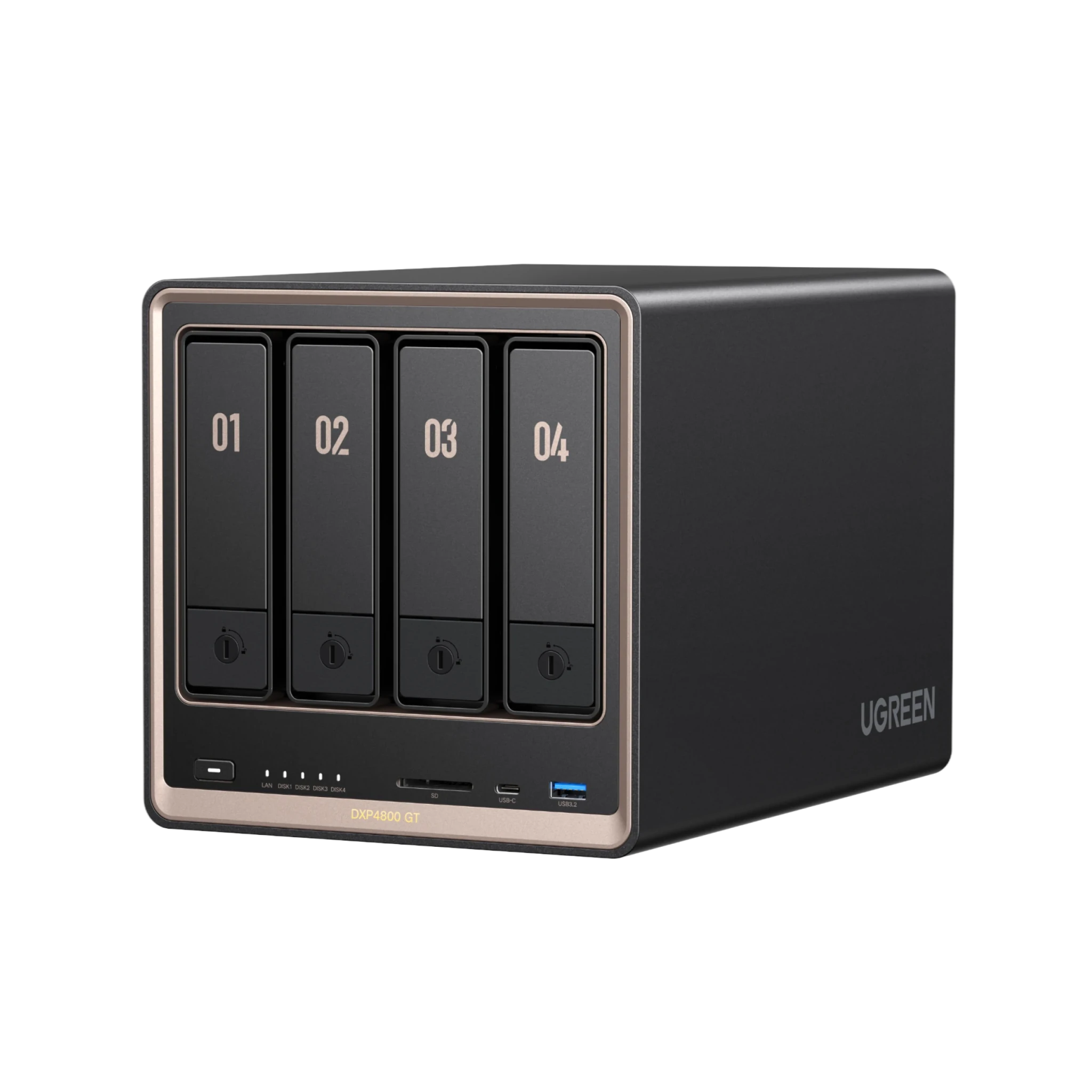
The NASync DXP4800 GT is a diskless desktop NAS built around a clear difference from the other four-bay UGREEN systems: two individual 10GbE RJ45 ports. UGREEN lists four SATA drive bays, two separate M.2 positions, an AMD Ryzen Embedded R2514 processor, 8GB of DDR4 memory and a 64GB eMMC system disk. That is a capable set of ingredients for a home studio or a technically inclined household, but the connector list is not a transfer-speed test and the advertised storage ceiling is not a ready-to-use pool.
The exact U.S. selector identifies the standalone NAS as manufacturer SKU 16057. UGREEN describes the base system as diskless and says drives are sold separately. Check that the offer you are considering is the standalone model rather than the separately selected + UPS bundle; this assessment does not infer seller-added drives or a prepared RAID array.
Two 10GbE ports still mean 10GbE per client
Having two 10GbE ports can be useful when different clients or network segments need a fast path, or when a supported switch and configuration can aggregate links for multiple simultaneous connections. UGREEN's own FAQ draws the important boundary: one workstation using one link remains limited to 10GbE, not 20Gbps. A 10GbE-capable client adapter, switch or direct connection, appropriate cabling and storage able to feed the transfer are all part of the path. The second jack cannot make a slower router, drive set or workload faster.
This port arrangement is the strongest reason to compare the GT with the DXP4800 Pro. UGREEN lists the Pro with one 10GbE and one 2.5GbE port; the GT has two 10GbE ports and documented U.2 support in the first two front bays. The Pro instead uses an Intel Core i3-1315U, has a higher listed 96GB memory ceiling, and offers Intel Quick Sync as a relevant option for some media-server workloads. Neither processor family is a universal winner: decide which documented feature addresses your actual network or application constraint.
Four SATA bays, separate M.2 slots, and a U.2 caveat
UGREEN lists four SATA HDD bays and two M.2 NVMe positions. It describes the M.2 devices as cache or a separate SSD pool, so they are not extra SATA bays and a cache is not the same as general-purpose file capacity. The maker says compatible PCIe 3.0 x4 U.2 drives can go in front bays 1 and 2, replacing the SATA drive that would otherwise occupy each bay. Treat that as an alternative media choice for those trays, not two bonus drive positions. Check a specific model and capacity in the current UGREEN compatibility selector before buying.
The stated 144TB maximum adds four 32TB SATA drives and two 8TB M.2 SSDs. None are included with the standalone system. The sum also does not describe one guaranteed volume: a mirror, parity layout, separate SSD pool, cache, system use and formatting all change the capacity available for files. UGREEN lists JBOD, Basic and RAID 0, 1, 5, 6 and 10. A buyer can plan a two-drive RAID 1 mirror in two of the four SATA bays, leaving two trays open, but must supply compatible disks and create the array during setup. Redundancy helps with a drive failure; it is not a second copy or an offsite backup.
Memory, ECC wording, and software workload
The product table lists a four-core/eight-thread Ryzen Embedded R2514 and a maximum boost frequency of 3.7GHz. It specifies 8GB DDR4 and a 64GB expansion ceiling, plus 64GB of eMMC system storage. Those values describe the hardware, not a promise about how many virtual machines, Docker containers or media tasks will feel responsive together. UGREEN lists UGOS Pro and support for Docker and virtual machines; the usable headroom depends on memory, drives, workload and software choices.
Be careful with ECC marketing. The page labels ODECC as supported and calls the system ECC-capable, but its own FAQ says the included 8GB module is standard non-ECC. An ECC-capable platform is therefore not the same as an out-of-box ECC configuration. A buyer who needs error-correcting memory must select a compatible module separately and confirm the exact part number with UGREEN. No memory upgrade is included or assumed here.
Small source conflicts that should stay visible
UGREEN's detailed table labels two rear connectors as USB 2.0 and also assigns them a 5Gb/s rate. Because those statements conflict, this assessment does not use either label as a definitive advantage. The manufacturer also advertises a 29–34 dB cooling figure without a method or test environment in the material reviewed; that is not an independent noise comparison. The listed 10.1-by-7-by-7-inch dimensions apply to the chassis, while space for cables, ventilation and drives is still needed.
The DXP4800 GT makes most sense when two 10GbE ports, a four-bay chassis and a flexible combination of SATA, M.2 or U.2 storage matter more than plug-and-play drives or included ECC memory. If you do not own the 10GbE network path, count the adapter, switch and cabling as part of the system. If your work needs the Pro's Intel-specific media features or higher listed memory limit, compare that model on those terms instead. This assessment makes no claim of hands-on setup, measured speed, noise, reliability or current seller availability.
Key specifications
Key details at a glance
| Internal drive bays | 4 bays |
|---|---|
| Documented internal drive media | SATA HDD |
| Built-in Ethernet ports | 2 × 10GbE RJ45 |
| Fastest individual Ethernet port | 10 Gbps |
| Installed system memory | 8 GB |
| Maximum listed memory | 64 GB |
| Listed storage arrangements | JBOD / Basic / RAID 0 / RAID 1 / RAID 5 / RAID 6 / RAID 10 |
| Hardware warranty | 2 years |
| Data drives included in listed package | No |
| M.2 NVMe slots | 2 |
| M.2 SSD storage-pool support | Yes |
| Processor | AMD Ryzen Embedded R2514 |
| CPU cores | 4 |
| CPU threads | 8 |
| Installed memory type | UGREEN lists 8GB DDR4 and a 64GB maximum. Its product FAQ says the shipped module is standard non-ECC memory, although the platform can use compatible ECC modules installed separately. Confirm any replacement by exact part number in the current model-specific list; ECC is not supplied as configured. |
Use the exact model’s instructions for operating limits, supplied equipment and version differences.
Sources for this review
Sources for this assessment
- UGREEN NASync DXP4800 GT U.S. product page, standalone variant
- UGREEN DXP4800 GT product JSON and exact U.S. selector SKUs
- UGREEN U.S. NAS collection card and distinct standalone/bundle placements
- UGREEN U.S. NAS specification comparison page
- UGREEN DXP GT official launch and drive-selection guide
- UGREEN NAS component compatibility selector
- UGREEN UGOS Pro software and workload support guide
Check your setup before choosing a NAS
Use the finder to narrow documented desk/shelf or rack formats, internal-bay minimums, a single Ethernet-port rating and optional redundancy requirements.