
Your needs, this model
Does it fit your priorities?
How does the SA3610 meet a 12-bay, 10GbE baseline?
It has twelve native internal drive bays and at least one built-in 10GbE data port. A 10GbE link rating does not guarantee end-to-end file throughput; the network, client, media, pool and workload also matter.
Explore this need in the finder →Can I build a two-drive mirror inside the SA3610?
Synology lists RAID 1 for this model, so two compatible internal drives can form a mirror. That only protects against a drive failure; keep a separate backup for deletion, corruption, malware and site loss.
Explore this need in the finder →Does the base SA3610 already contain all of its possible bays?
No. It has twelve native bays. Synology documents expansion to 96 total bays using seven RX1222sas units sold separately. The simple finder counts native internal bays, not optional shelf capacity.
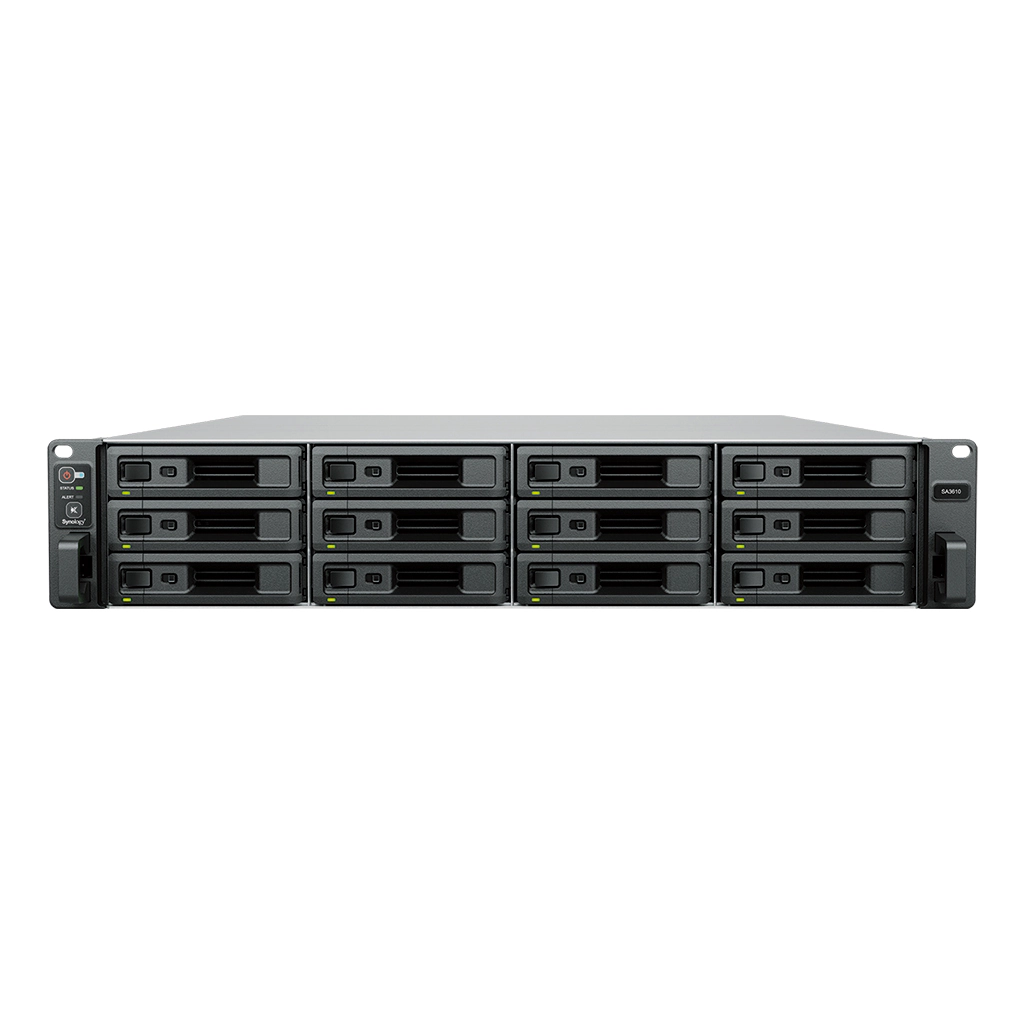
Explore this need in the finder →The Synology SA3610 is a 2U rack NAS built around twelve internal hot-swap bays and a long expansion runway. It is aimed at organizations that need a central file store, backup target or mixed file-and-block platform and already have the rack, network and staff to run enterprise storage. The meaningful choice within the SA3610/SA3410 pair is not bay count or Ethernet: it is the processor. The SA3610 uses a 12-core Xeon D-1567 where the SA3410 uses an eight-core D-1541; the rest of their principal platform specifications are closely aligned.
Twelve bays, with a deliberately broad media list
Synology lists twelve native positions for 3.5-inch SAS or SATA hard drives and 2.5-inch SAS or SATA SSDs. The exact supported drive list matters more than the connector shape: the manufacturer warns that an unvalidated disk may limit functions or affect reliability. Treat the chassis as diskless. Its hardware guide lists the main unit, two AC power cords and drive screws, but no data disks. This is a large shared-storage system whose drive bill, RAID layout and independent backup target must be planned separately.
The manufacturer documents RAID 1, RAID 5, RAID 6, RAID 10 and RAID F1, among other modes, with Btrfs and ext4. A two-drive RAID 1 arrangement is supported, but the mirror only helps with a drive failure; it does not protect against deletion, malware, theft, fire or an administrative mistake. For a large archive or backup repository, include a separate copy, retention policy and restore process in the design. Expansion capacity is described as up to 96 total bays using seven RX1222sas shelves. Those shelves are separate powered systems, not part of the twelve-bay chassis or its package.
Network design and processor choice
Built-in data networking comprises four 1GbE and two 10GbE RJ-45 ports, plus a separate out-of-band management port. Do not count OOB management as another file-transfer interface. A 10GbE link is a connection rating, not a promise of sustained file speed: switches, client adapters, cabling, drive mix, RAID work and concurrent users all affect the result. Two PCIe 3.0 x8 slots can take supported optional cards, but higher-speed Ethernet or Fibre Channel is not included by that fact alone.
The D-1567 has twelve cores and twenty-four threads, compared with eight cores and sixteen threads in the SA3410's D-1541. Both models list 16 GB of DDR4 ECC RDIMM memory and four slots for a maximum of 128 GB. This makes the SA3610 the higher-core option within this pair; it does not by itself establish a measured workload advantage. If a deployment is mainly a file repository, compare the actual storage, support and workload requirements before paying for compute capacity that is not needed. Synology's product-page performance figures are vendor test results, not independent or hands-on results from this assessment.
Rack, power and service implications
The SA3610 is a 2U chassis measuring 88 × 482 × 724 mm in the listed rack configuration and weighs 14.5 kg before drives. It is specified for a four-post 19-inch rack; the RKS-02 rail kit is sold separately. Confirm rack depth, rails, loaded weight, airflow, two power feeds and nearby switch capacity before an order. The manufacturer publishes a 49.8 dB(A) noise figure from its own idle test conditions, which is a reminder to plan for an equipment room rather than a quiet living area. The listed five-year limited warranty is a manufacturer term; confirm coverage and the purchase-date basis for the exact offer.
Who should shortlist the SA3610?
It makes sense to evaluate this model when twelve native bays, mixed SAS/SATA media options, built-in 10GbE and eventual expansion to a multi-shelf system are useful together. Its official feature set also supports file services and block workloads, so teams can compare it as a shared enterprise platform rather than as a consumer plug-and-play box. It is a poor fit for someone seeking a small desktop NAS, bundled drives, tool-free home setup or a system that can be installed without a rack and network plan.
Before purchasing, verify the exact SA3610 name, drive compatibility list, included cords and screws, rail availability, expansion-unit model, memory policy, rack clearances and backup design. If a second chassis is part of the availability plan, Synology describes an active-passive High Availability cluster using two SA3610 or SA3410 units; that is a separate two-system topology, not the single-unit expansion story. This review is based on manufacturer documentation, not an installed or benchmarked unit, and it does not assert current seller stock or price.
Key specifications
Key details at a glance
| Internal drive bays | 12 bays |
|---|---|
| Documented internal drive media | 3.5-inch SAS HDD / 2.5-inch SAS SSD / 3.5-inch SATA HDD / 2.5-inch SATA SSD |
| Built-in Ethernet ports | 4 × 1GbE RJ-45 data ports / 2 × 10GbE RJ-45 data ports |
| Fastest individual Ethernet port | 10 Gbps |
| Installed system memory | 16 GB |
| Maximum listed memory | 128 GB |
| Listed storage arrangements | RAID F1 / Basic / JBOD / RAID 0 / RAID 1 / RAID 5 / RAID 6 / RAID 10 |
| Internal file systems | Btrfs / ext4 |
| USB 3.2 Gen 1 ports | 2 |
| Maximum listed single-volume size | 1000 TB |
| Dimensions (H × W × D) | 88 × 482 × 724 mm (H × W × D); 2U; chassis dimensions without ears 88 × 430.5 × 692 mm |
| Weight | 14.5 kg |
| Manufacturer's idle noise figure | 49.8 dB(A) |
| Hardware warranty | 5 years |
| Data drives included in listed package | No |
| Maximum total drive bays with listed expansion | 96 bays |
| Expansion-unit note | Up to seven RX1222sas expansion units are listed; the shelves are sold separately and compatibility should be checked for the exact deployment. |
| Listed expansion unit | RX1222sas |
| Processor | Intel Xeon D-1567 |
| CPU cores | 12 |
| CPU threads | 24 |
| Installed memory type | DDR4 ECC RDIMM |
| Single-volume limit condition | Synology lists up to 1 PB only for RAID 6 groups with at least 64 GB memory, plus 200 TB (32 GB memory) and 108 TB limits; over-200-TB volumes use Btrfs Peta Volume with a limited feature set. This is a conditional single-volume limit, not usable-capacity promise. |
Use the exact model’s instructions for operating limits, supplied equipment and version differences.
Sources for this review
Sources for this assessment
- Synology US NAS product list (captured directory response)
- Synology SA3610 US product page
- Synology SA3610 English datasheet
- Synology SA3610 Hardware Installation Guide: package and system overview
- Synology SA3610 Hardware Installation Guide: setup and expansion
- Synology America SA3610 and SA3410 launch announcement
Check your setup before choosing a NAS
Use the finder to check bay count, the network link you need, and whether a documented two-drive redundant arrangement is essential.