
Your needs, this model
Does it fit your priorities?
How does the SA3400D meet a 12-bay, 10GbE baseline?
It has twelve native internal drive bays and at least one built-in 10GbE data port. A 10GbE link rating does not guarantee end-to-end file throughput; the network, client, media, pool and workload also matter.
Explore this need in the finder →Can I build a two-drive mirror inside the SA3400D?
Synology lists RAID 1 for this model, so two compatible internal drives can form a mirror. That only protects against a drive failure; keep a separate backup for deletion, corruption, malware and site loss.
Explore this need in the finder →Does the base SA3400D already contain all of its possible bays?
No. It has twelve native bays. Synology documents expansion to 36 total bays using two RXD1219sas units sold separately. The simple finder counts native internal bays, not optional shelf capacity.
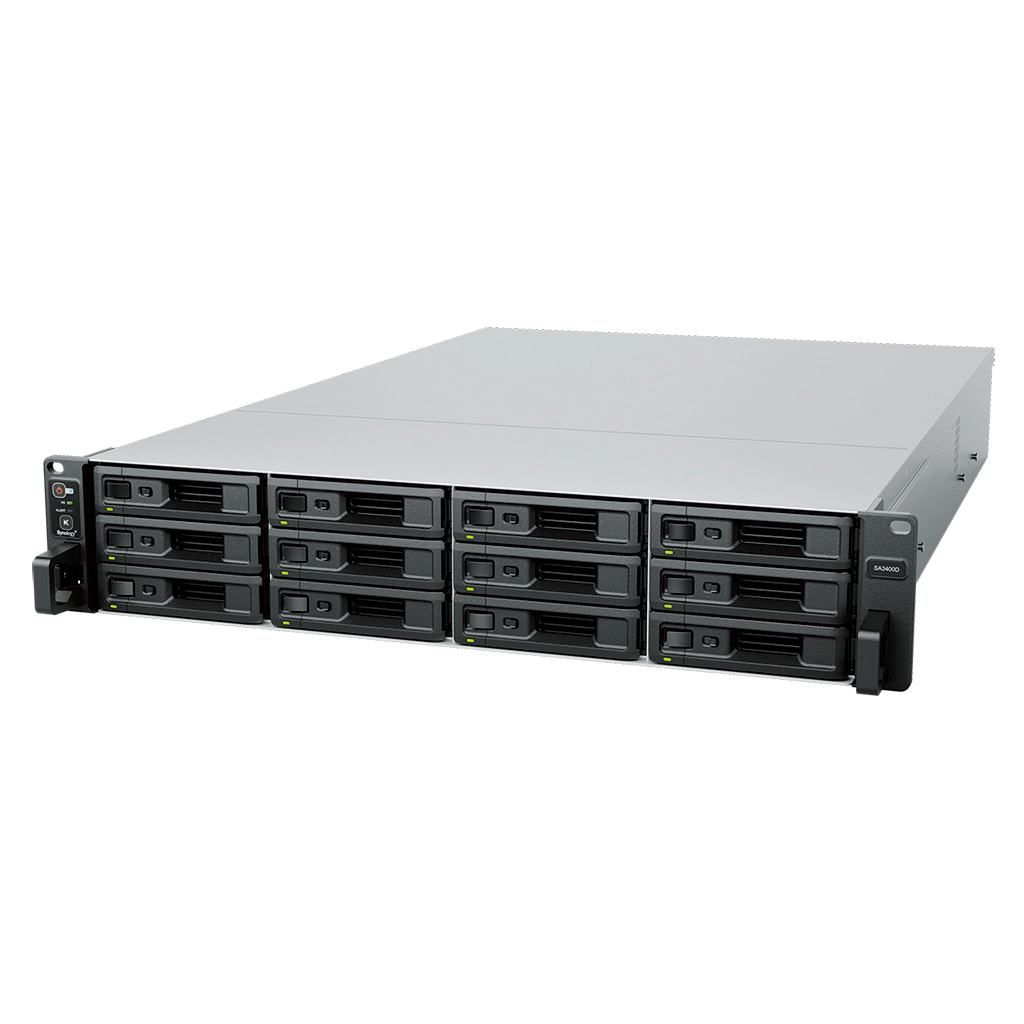
Explore this need in the finder →The Synology SA3400D is a 2U, twelve-bay NAS/SAN appliance with two active-passive storage controllers. Its main distinction from a conventional single-controller rack NAS is internal controller failover: the product page describes two independent, hot-swappable controllers and automatic minute-level failover for supported services. That availability design is separate from drive redundancy and from a backup. A RAID mirror cannot replace controller failover, and neither one protects a second copy from deletion, malware or loss of the entire site.
A dual-controller SAS platform
Synology specifies twelve native bays for dual-port SAS hard drives or SSDs, not a general SATA-drive list. The exact compatible SAS models need to be checked against the SA3400D drive list; “SAS” alone does not verify a particular disk. The base unit is listed for up to 36 total bays with two RXD1219sas shelves. Those are external expansion units, not extra internal positions or included disks. The hardware guide lists the main unit, two AC power cords and drive screws, but does not list data drives or rack rails.
The chassis has a Xeon D-1541 processor per controller, with eight cores each. The listed memory is 8 GB DDR4 ECC UDIMM per controller, expandable to 64 GB per controller. Each controller has one 10GbE and two 1GbE ports, so the system's duplicated interfaces must be planned across two independent controller modules rather than treated as a single pooled set of client links. The product specifications also show a Mini-SAS HD expansion connection and PCIe expansion per controller. Optional network cards and expansion are separate configuration decisions.
Understand storage protection in layers
Synology lists Btrfs and ext4, plus RAID 1, RAID 5, RAID 6, RAID 10 and RAID F1 among the supported layouts. RAID 1 can make a two-drive mirror; the internal active-passive controller pair addresses a different failure class. Add a separately managed backup or replication destination for recovery from corruption, deletion or site loss. The product page describes NAS file services over SMB/NFS alongside iSCSI and Fibre Channel applications, so the appropriate pool layout and host connectivity depend on whether the actual workload is file sharing, block storage or both.
The single-volume specification is 108 TB by default and up to 200 TB when 32 GB of memory is installed, subject to the manufacturer's conditions. This is a volume ceiling, not usable capacity or the total space across all disks. Drives, pool layout, metadata and the intended service profile determine usable space. Synology's product page also advertises up to 864 TB raw with two expansion shelves; that is a manufacturer ceiling under a particular hardware configuration, not a promise of usable capacity or an included system.
Installation is an infrastructure decision
The SA3400D measures 88 × 482 × 724 mm in its listed rack dimensions, weighs 19.7 kg before drives and occupies 2U. It is specified for a four-post 19-inch rack with RKS-02 rails sold separately. Reserve room for the chassis depth, shelf depth, controller extraction, cables, cooling and servicing; plan the rack's power feeds and airflow as well. Synology lists a five-year limited warranty, but the purchase-date terms and seller offer still need confirmation.
Expansion uses the RXD1219sas and model-specific cabling. Both controllers need the correct path to each expansion unit; the manual's topology should be followed rather than assuming a shelf is a universal plug-in. Verify compatible drive models, memory, interface cards, firmware and the precise seller bundle before purchase. Expansion shelves are powered storage components with their own rack and failure considerations, not simple capacity extenders that remove the need for backup planning.
Who should evaluate it?
The SA3400D is relevant to a business that values shared-storage availability, two controller modules and a combined NAS/SAN feature set in a 2U rack platform. It should be compared with single-controller SA models when the core need is bay count, media flexibility or a larger shelf ceiling; the SA3610 and SA3410 list SATA media and up to 96 total bays, while the SA3400D's listed route is SAS and 36 bays. It is also distinct from the smaller-core SA3200D: both have dual controllers, but the SA3400D's D-1541 has eight cores per controller compared with the SA3200D's four-core D-1521.
This assessment follows Synology's model-specific product page, data sheet and hardware instructions; we did not install or benchmark the system. It is not a desktop appliance, does not include data drives in the documented package and is not a complete backup strategy by itself. Confirm rack fit, compatible SAS drives, expansion layout, memory, network design, warranty coverage and restoration procedures before treating its headline availability features as a fit for a real workload.
Key specifications
Key details at a glance
| Internal drive bays | 12 bays |
|---|---|
| Documented internal drive media | 3.5-inch dual-port SAS HDD / 2.5-inch dual-port SAS SSD |
| Built-in Ethernet ports | 2 × 1GbE RJ-45 per controller / 1 × 10GbE RJ-45 per controller |
| Fastest individual Ethernet port | 10 Gbps |
| Installed system memory | 8 GB |
| Maximum listed memory | 64 GB |
| Listed storage arrangements | RAID F1 / Basic / JBOD / RAID 0 / RAID 1 / RAID 5 / RAID 6 / RAID 10 |
| Internal file systems | Btrfs / ext4 |
| Maximum listed single-volume size | 200 TB |
| Dimensions (H × W × D) | 88 × 482 × 724 mm (H × W × D); 2U |
| Weight | 19.7 kg |
| Hardware warranty | 5 years |
| Data drives included in listed package | No |
| Maximum total drive bays with listed expansion | 36 bays |
| Expansion-unit note | Up to two RXD1219sas expansion units are listed (36 total bays); shelves are sold separately. |
| Listed expansion unit | RXD1219sas |
| Processor | Intel Xeon D-1541 (one per controller) |
| CPU cores | 8 |
| CPU threads | 16 |
| Installed memory type | DDR4 ECC UDIMM per controller |
| Single-volume limit condition | The listed single-volume limit is 108 TB by default and up to 200 TB with 32 GB or more memory, subject to Synology conditions. This is a conditional maximum volume size, not usable-capacity promise. |
Use the exact model’s instructions for operating limits, supplied equipment and version differences.
Sources for this review
Sources for this assessment
- Synology US NAS product list (captured directory response)
- Synology SA3400D US product page
- Synology SA3400D English datasheet
- Synology SA3400D Hardware Installation Guide: package and system overview
- Synology SA3400D Hardware Installation Guide: setup and expansion
- Synology America SA3400D launch announcement
Check your setup before choosing a NAS
Use the finder to check bay count, the network link you need, and whether a documented two-drive redundant arrangement is essential.