
Your needs, this model
Does it fit your priorities?
Does RS826RP+ have more internal bays than RS826+?
No. Both have four native hot-swap SATA bays, and both can reach eight with a separate RX426. The RP suffix changes the power design, not the bay count: it adds dual redundant supplies and the chassis is 26 mm deeper with ears and 1.6 kg heavier.
Explore this need in the finder →Is the RS826RP+ ready for 10GbE without an add-in card?
No. The rear panel has four built-in 1GbE ports. Synology documents faster 10/25GbE networking through compatible add-in cards; those are optional components and require a capable switch, client and cables. Do not count the four gigabit links as one faster port.
Explore this need in the finder →Can two drives in RS826RP+ provide data redundancy if a drive fails?
Yes, as a planned configuration: Synology lists RAID 1 and SHR, so two compatible SATA drives can form a supported two-drive redundant arrangement. The redundant PSU protects against a power-supply failure, not a drive failure; keep a separate restore-tested backup for deletion or whole-system loss.
Explore this need in the finder →A four-bay 1U system for edge racks
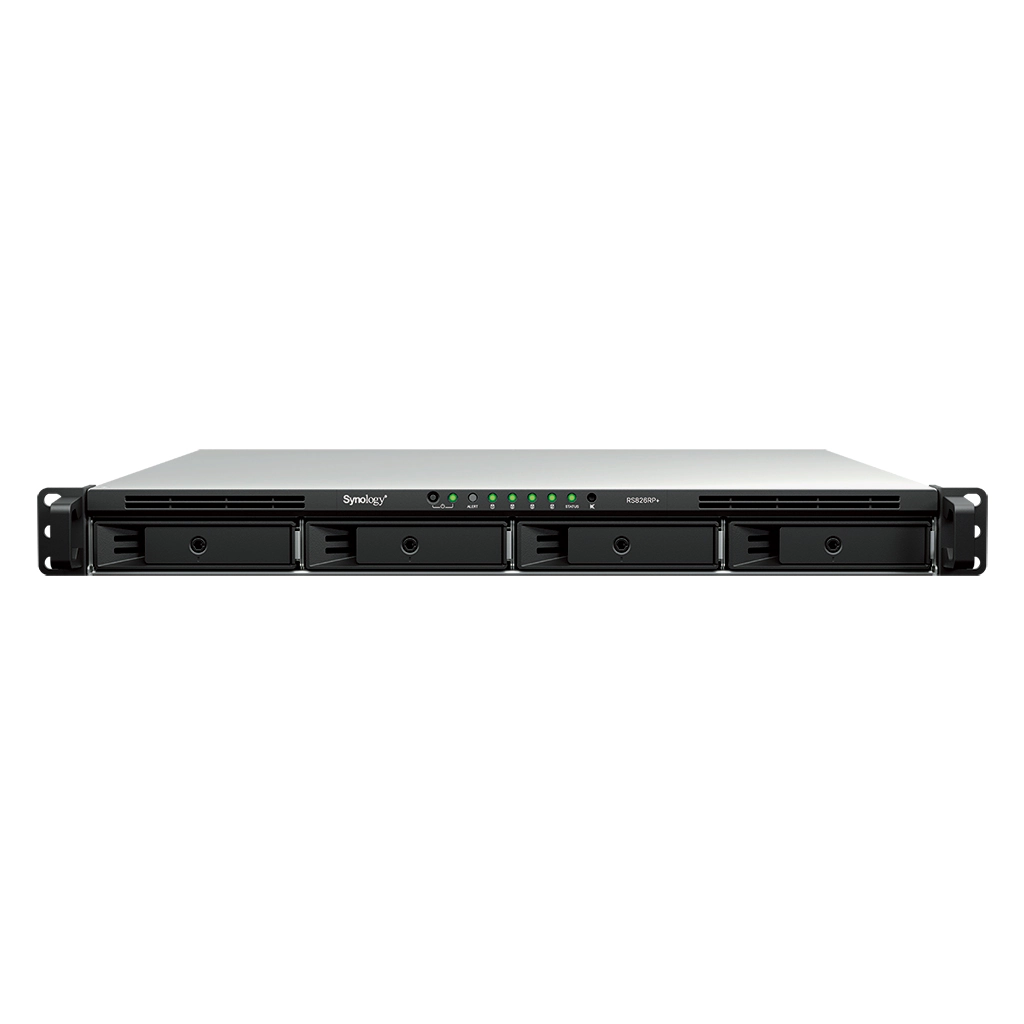
RS826RP+ is a one-rack-unit, four-bay network-attached storage system for a branch office or other compact rack deployment. Its four native hot-swappable SATA trays support compatible 3.5-inch HDDs or 2.5-inch SATA SSDs. Synology lists RAID 1 and SHR among the supported modes, so two compatible drives can form a documented redundant arrangement. Drives are not included in the base hardware; they must be selected from the compatibility list and installed into the intended pool. RAID helps with a defined drive failure, but not deletion, malware or loss of the whole rack.
The product can grow to eight positions with a separate RX426 expansion unit. This is important when comparing the four-bay chassis with eight-bay RackStations: an external shelf does not turn the base enclosure into an eight-native-bay model. Check that the RX426, its cable, rack location and power are part of the plan rather than assuming they are in the NAS box.
Redundant power in a deeper RP chassis
The RP variant has two redundant 150-watt supplies. That addresses a different interruption risk from mirrored drives: a second supply can keep the system powered if one supply or its feed fails, but it cannot recover lost or corrupted files. A mirror can help maintain access through a supported member-drive failure, but it cannot keep the NAS running through a failed single supply. If both forms of continuity matter, they need to be specified separately; a tested independent backup is still needed for recovery.
Synology lists the RP chassis at 44 × 480 × 518.6 mm with ears and 8.0 kg. The standard RS826+ is 26 mm shallower with ears and 1.6 kg lighter, but uses one 150-watt supply. These units are 1U, but the depth and weight difference still matter to cabinet rails, rack support, clearance, airflow and door closure. Both require a compatible four-post 19-inch rack and separately sold RKM114 or RKS-02 rails according to the family specification. The RS826RP+ package manual lists two AC power cords; verify the exact seller’s bundle and the intended PSU feeds.
Gigabit ports with optional network upgrades
Four 1GbE RJ-45 ports are built in. Synology documents optional 10/25GbE networking through compatible cards in the PCIe slot. The 1GbE figure is therefore the right base-model answer for a buyer asking about one built-in port; an optional card is not the same as a port that is already present. Four built-in ports also do not promise one client a 4Gbps copy. Check the switch, client adapter and cable path, and distinguish link aggregation from single-flow throughput.
The underlying compute platform is an AMD Ryzen V1500B with four cores at 2.2 GHz, 4 GB DDR4 ECC SODIMM and two memory slots. Synology lists support up to 32 GB with its compatibility and module guidance. The product supports Btrfs and ext4 internal file systems and standard business storage features. Compatible M.2 NVMe cache is possible using a separate PCIe adapter and drives, but there are no integrated M.2 slots. The adapter competes for the expansion position with networking upgrades, so define which job matters before buying add-in hardware.
What the performance figures do—and do not—say
Synology advertises sequential read/write results above 2,000/1,300 MB/s, based on its own testing. That is not a guarantee for a real deployment and is not a measurement from this review. An actual file copy depends on installed disks, RAID layout, number of clients, files, network and background work. For an existing gigabit office network, the built-in ports may be the limit long before the system’s headline storage throughput.
The U.S. model page lists 41.2 dB(A) idle noise under a specific manufacturer setup with the system fully installed with Synology SATA drives and microphones one metre from the front and rear. This is useful as a comparison point, not a prediction of sound at every rack or a claim that we measured it. The page’s test conditions, fan mode, cabinet and drive type all affect what a nearby office hears. If the NAS will be near desks, consider its location and whether the storage workload needs a rack system at all.
Who should shortlist the RP model?
This is a fit when four native bays, 1U rack height, a two-drive mirror plan and redundant power are all useful. It is less compelling when the planned network must have built-in 2.5GbE, when the rack cannot accept its 518.6 mm depth or when a single supply is acceptable and lower published noise is a priority. The standard RS826+ preserves the same four-bay, 1U, 1GbE and RX426 path without dual supplies; the RS1221RP+ offers eight native bays but is a larger 2U system and uses RX418 instead of RX426.
Synology’s U.S. status record observed October 29, 2026 lists the RS826RP+ as Generally Available, with Full DSM updates, Full Technical Support and a three-year manufacturer warranty. The October 2026 U.S. release page provides the branch-office context and states the models’ performance and expansion, but its dates are internally inconsistent: it says the announcement is August 12 and availability starts June 3, 2026. This review does not infer a corrected date or seller availability. Check exact model suffix, drives, expansion, NIC, rail and cord package, and save a separate copy of important data.
Primary references: Synology’s U.S. RS826RP+ / RS826+ page, the RS826RP+ datasheet, its product manual, the U.S. announcement and the U.S. Product Support Status. This is an assessment of published documentation, not ownership or a hands-on test.
Key specifications
Key details at a glance
| Internal drive bays | 4 bays |
|---|---|
| Documented internal drive media | 3.5-inch SATA HDD / 2.5-inch SATA SSD |
| Built-in Ethernet ports | 4 × 1GbE RJ-45 data ports |
| Fastest individual Ethernet port | 1 Gbps |
| Installed system memory | 4 GB |
| Maximum listed memory | 32 GB |
| Listed storage arrangements | Synology Hybrid RAID / Basic / JBOD / RAID 0 / RAID 1 / RAID 5 / RAID 6 / RAID 10 |
| Internal file systems | Btrfs / ext4 |
| Maximum listed single-volume size | 108 TB |
| Dimensions (H × W × D) | 44 × 480 × 518.6 mm (H × W × D, with server ears) |
| Weight | 8 kg |
| Manufacturer's idle noise figure | 41.2 dB(A) |
| Hardware warranty | 3 years |
| Data drives included in listed package | No |
| M.2 NVMe slots | 0 |
| Maximum total drive bays with listed expansion | 8 bays |
| Expansion-unit note | 4 native SATA bays plus a separate RX426; not part of the base chassis. |
| Listed expansion unit | RX426 × 1 (sold separately) |
| Processor | AMD Ryzen V1500B |
| CPU cores | 4 |
| CPU threads | 8 |
| Installed memory type | DDR4 ECC SODIMM |
| Single-volume limit condition | The datasheet lists 108 TB maximum single volume by default; a 200 TB volume requires at least 32 GB RAM. Neither figure is raw or usable capacity. |
Use the exact model’s instructions for operating limits, supplied equipment and version differences.
Sources for this review
Sources for this assessment
- Synology U.S.-language product-list observation
- Synology U.S. RackStation RS826RP+/RS826+ product page
- Synology RackStation RS826RP+ English datasheet
- Synology RackStation RS826RP+ hardware installation guide
- Synology U.S. Product Support Status
- Synology U.S. RackStation RS826(RP)+ launch announcement
- Synology RS826RP+ exact-model product-gallery image, sort 1
Check your setup before choosing a NAS
Use the finder to check bay count, the network link you need, and whether a documented two-drive redundant arrangement is essential.