
Your needs, this model
Does it fit your priorities?
How many internal drive positions are on RS826+?
Four hot-swappable native SATA positions are built into the 1U enclosure. A separate RX426 adds four positions for eight total bays; that shelf does not change the base chassis’s four internal bays and is not part of the base package.
Explore this need in the finder →Can RS826+ provide an individual built-in 2.5GbE port?
No. It has four built-in 1GbE RJ-45 ports. A compatible optional PCIe NIC can add faster networking, but the base model remains a gigabit system until that separate card is installed and the switch/client path is upgraded.
Explore this need in the finder →Does RS826+ have a two-drive mirror and redundant power?
The manufacturer lists RAID 1 and SHR, supporting a two-drive redundant data arrangement. The standard RS826+ has one 150 W power supply, not a redundant PSU. The 1U RS826RP+ is the power-redundant variant; neither RAID nor a second PSU is a substitute for a separate backup.
Explore this need in the finder →Four native bays in a compact 1U enclosure
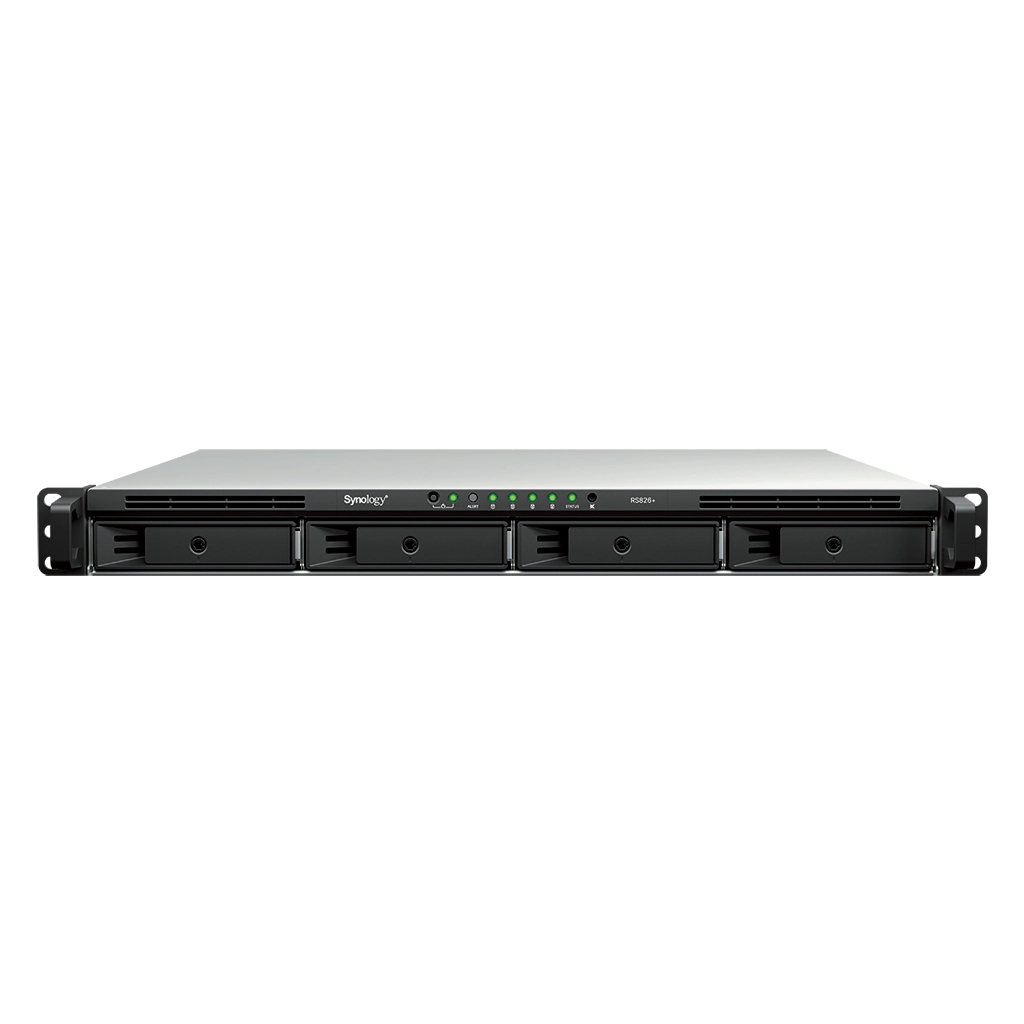
RS826+ is a four-bay rack NAS designed for a small office, branch or edge location that wants local file sharing and backup in a single rack unit. Its four hot-swappable positions are for compatible 3.5-inch SATA hard drives or 2.5-inch SATA SSDs. Synology documents RAID 1 and SHR, which supports a two-drive mirror when configured with compatible drives. The base enclosure does not include drives; check the exact model’s support list and package before planning capacity.
Synology lists an expansion path to eight bays using one RX426. That unit is an external shelf and a separate purchase, not a hidden increase in the number of internal positions. If the base four bays are sufficient today, still verify where the expansion unit would sit, how it connects and whether the rack has separate room and power for it. The RS826 family uses RX426; the eight-bay RS1221 family lists RX418 instead, so do not transfer an accessory assumption from a similar model name.
The standard version has one power supply
The RS826+ uses one 150-watt supply. Its sibling, RS826RP+, adds redundant power supplies and a deeper chassis. Choose the standard version when the reduction in depth and single-supply arrangement are acceptable; do not treat its RAID mirror as a substitute for PSU redundancy. A separate two-drive mirror can help a volume continue after a supported drive failure. A second PSU helps address a power-supply failure. Neither protects files from deletion, malware, theft or a damaged NAS, so a separate backup and restore test are still part of a complete plan.
With rack ears, Synology gives dimensions of 44 × 480 × 492.6 mm and weight of 6.4 kg. The RP model is 518.6 mm deep and 8.0 kg. Both are 1U and use a 19-inch four-post rack with separately sold RKM114 or RKS-02 rail kits. Measure usable depth, rear cabling, cooling and rack load rather than comparing only the 1U label. Synology’s published idle-noise value for RS826+ is 26.5 dB(A), with its fully installed system and SATA drives at one metre in its stated test environment. That number is a vendor test result, not our measurement or a guarantee in another room.
Four built-in gigabit ports, with a PCIe upgrade path
The base unit has four 1GbE RJ-45 ports. Synology lists compatible 10GbE and 25GbE network adapters, but the card is optional. If a faster built-in port is a hard requirement, RS826+ does not meet it; if the network is currently gigabit, its four ports may fit the actual path. Port counts do not sum to a faster single-client copy rate. Confirm compatible switch ports, client adapters, cabling and the networking mode rather than adding link ratings.
The hardware uses an AMD Ryzen V1500B processor with four 2.2-GHz cores, 4 GB DDR4 ECC SODIMM, two memory slots and an official maximum of 32 GB subject to Synology’s memory-module notes. Internal filesystems include Btrfs and ext4, and the supported storage modes include SHR and RAID 1. M.2 NVMe caching is supported through a compatible adapter card, not built-in M.2 positions. The same PCIe slot may be important if the plan includes an upgraded NIC. The drives, M.2 adapter, cache SSDs, network card, RX426 and rail hardware should all be treated as separate unless a particular seller package lists them.
Capacity and performance need context
The datasheet lists 108 TB as the standard maximum single-volume size and allows a 200 TB volume only with at least 32 GB of memory. These are system limits, not raw drive capacity or an estimate of free space. Drive size, RAID layout, filesystem overhead and the number of populated bays all affect the user-available result. Two mirrored drives provide approximately the usable capacity of one member drive before overhead; adding capacity later depends on the chosen pool and exact Synology instructions.
Synology states sequential read/write throughput above 2,000/1,300 MB/s from its internal testing. That should not be read as an expected gigabit file copy: the network path, disks, RAID configuration and workload can each be slower. This assessment did not benchmark the unit. For an office that already owns a gigabit switch and client adapters, port speed may be more relevant than a headline sequential result.
When the RS826+ is the better family choice
Shortlist this standard model when four native bays, 1U height and a four-gigabit-port base make sense, and one power supply is acceptable. It is shallower and lighter than RS826RP+, and Synology reports a lower idle-noise figure in its own test, but that difference comes with a single supply rather than redundant power. If a supply failure must not interrupt the service, compare RS826RP+ and confirm that its extra 26 mm of depth and heavier chassis fit. If eight native bays are essential rather than a separate shelf, the RS1221+ is the family with eight internal positions, though it is 2U and still gigabit at the base ports.
The U.S. support-status record observed October 29, 2026 lists RS826+ as Generally Available with Full DSM updates, Full Technical Support and a three-year manufacturer warranty. The U.S. launch page describes the new models for edge/remote use, but says announced August 12, 2026 and availability starting June 3, an internal date conflict. This review does not guess which date is correct and does not claim a retailer has stock. Verify the exact model suffix, seller package, warranty, drive list, RX426, card compatibility and rail requirements.
Primary references: Synology’s U.S. RS826RP+ / RS826+ page, the RS826+ datasheet, the product manual, Synology’s U.S. announcement and its U.S. Product Support Status. This is a source-based review, not a hands-on test or ownership report.
Key specifications
Key details at a glance
| Internal drive bays | 4 bays |
|---|---|
| Documented internal drive media | 3.5-inch SATA HDD / 2.5-inch SATA SSD |
| Built-in Ethernet ports | 4 × 1GbE RJ-45 data ports |
| Fastest individual Ethernet port | 1 Gbps |
| Installed system memory | 4 GB |
| Maximum listed memory | 32 GB |
| Listed storage arrangements | Synology Hybrid RAID / Basic / JBOD / RAID 0 / RAID 1 / RAID 5 / RAID 6 / RAID 10 |
| Internal file systems | Btrfs / ext4 |
| Maximum listed single-volume size | 108 TB |
| Dimensions (H × W × D) | 44 × 480 × 492.6 mm (H × W × D, with server ears) |
| Weight | 6.4 kg |
| Manufacturer's idle noise figure | 26.5 dB(A) |
| Hardware warranty | 3 years |
| Data drives included in listed package | No |
| M.2 NVMe slots | 0 |
| Maximum total drive bays with listed expansion | 8 bays |
| Expansion-unit note | 4 native SATA bays plus a separate RX426; not part of the base chassis. |
| Listed expansion unit | RX426 × 1 (sold separately) |
| Processor | AMD Ryzen V1500B |
| CPU cores | 4 |
| CPU threads | 8 |
| Installed memory type | DDR4 ECC SODIMM |
| Single-volume limit condition | The datasheet lists 108 TB maximum single volume by default; a 200 TB volume requires at least 32 GB RAM. Neither figure is raw or usable capacity. |
Use the exact model’s instructions for operating limits, supplied equipment and version differences.
Sources for this review
Sources for this assessment
- Synology U.S.-language product-list observation
- Synology U.S. RackStation RS826RP+/RS826+ product page
- Synology RackStation RS826+ English datasheet
- Synology RackStation RS826+ hardware installation guide
- Synology U.S. Product Support Status
- Synology U.S. RackStation RS826(RP)+ launch announcement
- Synology RS826+ exact-model product-gallery image, sort 1
Check your setup before choosing a NAS
Use the finder to check bay count, the network link you need, and whether a documented two-drive redundant arrangement is essential.