
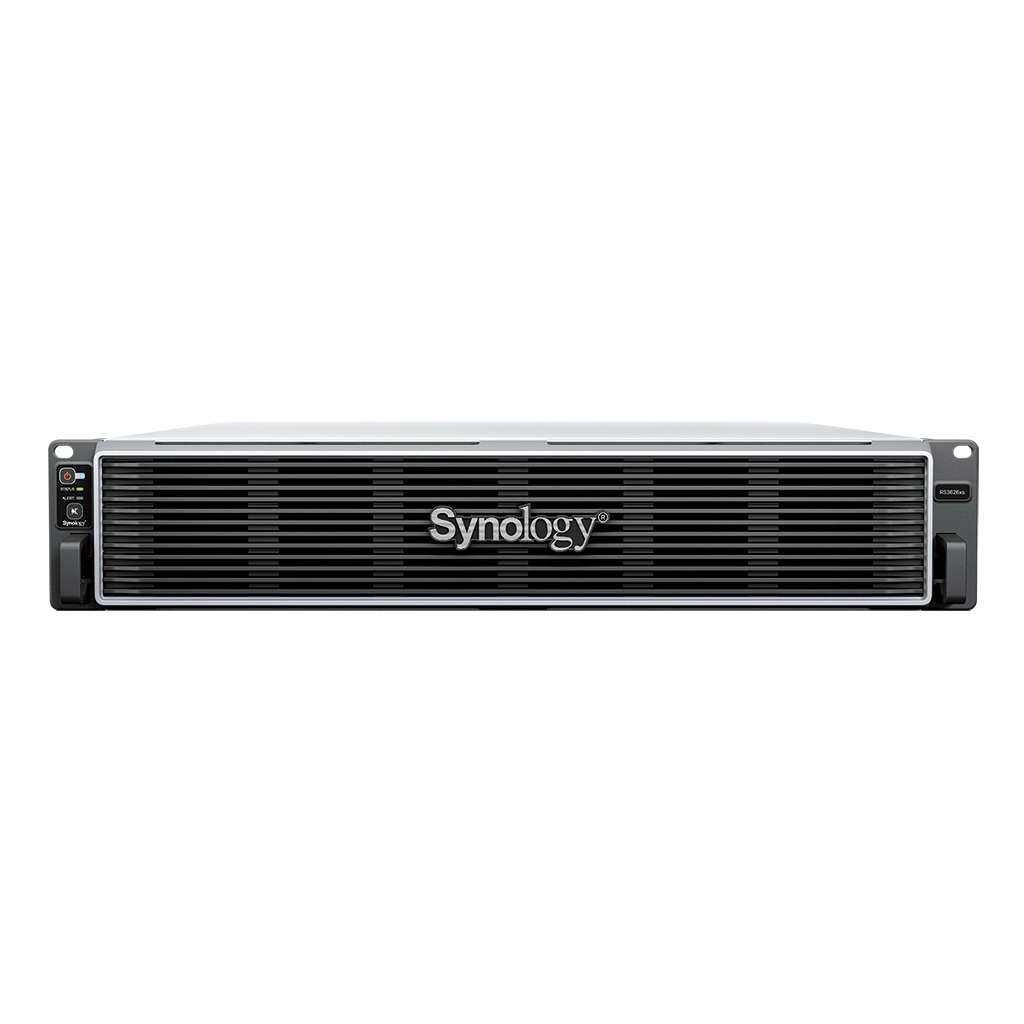
Your needs, this model
Does it fit your priorities?
Are all 36 drive positions in the RS3626xs chassis?
No. The RS3626xs has twelve native SATA positions. Up to 36 total requires two separately purchased RX1225RP shelves; check exact drive and shelf compatibility and the rack-space plan.
Explore this need in the finder →Does the dedicated 1GbE management jack serve files?
No. The documented built-in data links are two 10GbE RJ-45 ports; the 1GbE out-of-band management port is for remote administration, not a third file-serving connection. Link rate alone does not predict file-transfer speed.
Explore this need in the finder →Can two drives be mirrored, and is that a backup?
Synology lists RAID 1, so two compatible native SATA drives can form a mirror. A mirror can help with a drive failure but does not restore deleted data or protect against malware, theft, or loss of the whole system; keep an independent backup.
Explore this need in the finder →A 12-bay system with a separate management path
The RackStation RS3626xs is a 2U rack NAS with twelve native SATA positions, two built-in 10GbE data ports and a dedicated 1GbE out-of-band management connection. Its strongest case is a planned business deployment that needs a dozen internal drive bays and faster built-in networking without making an add-in card part of the initial design. It is not a desk NAS: the four-post rack, airflow, power distribution and access for servicing are part of the system decision.
Synology also describes expansion to 36 total positions. That figure means twelve bays in the main unit plus two separate RX1225RP expansion shelves. The shelves, drives and sliding rail kit are not listed as standard package contents. Count the chassis bays separately from optional expansion and check current compatibility for the exact shelf, drive and cable configuration.
Newer platform, modest starting memory
The RS3626xs uses a six-core Intel Xeon D-1726 and ships with 8 GB of DDR4 ECC UDIMM memory. Six slots support a listed maximum of 48 GB. This is a different resource profile from the nearby RS4826xs+: both have twelve native positions and built-in dual 10GbE, but the RS4826xs+ uses an eight-core Xeon D-1739, starts with 16 GB of ECC RDIMM and lists a 96 GB ceiling. Those specifications identify genuine differences; they do not establish a universal performance winner for every service or workload.
The newer RS3626xs also has two Gen4 x8 PCIe slots and Mini-SAS HD shelf links. The older RS3621xs+ has two Gen3 x8 slots, Infiniband expansion connections, four 1GbE ports in addition to its two 10GbE ports, and an eight-core Xeon D-1541. Expansion shelves and adapter compatibility differ between generations, so an existing hardware plan should be checked model by model rather than carried across based on the shared RackStation name.
Read the network ports correctly
The two 10GbE RJ-45 connections are the documented built-in data ports. A third RJ-45 connection is reserved for out-of-band management; it provides an administration path when the appliance is powered down, not another file-serving interface. A buyer who expects three data ports from the product-page diagrams would be counting the management jack incorrectly.
Nor does a 10GbE port promise 10 gigabits per second of file throughput. The client network adapter, switch, cabling, link negotiation, storage layout, drives and concurrent work all shape the end-to-end path. The manufacturer lists optional adapters and SSD-cache configurations, but those are separate components that must be checked for compatibility and package inclusion. Link aggregation can serve redundancy or balancing goals, but does not make a single client transfer equal the sum of multiple ports.
Storage layout, volume ceiling and recovery
The model supports DSM file services such as SMB and NFS and lists RAID 1, so two compatible SATA data drives can form a mirror. A mirrored pair may reduce disruption after one drive fails; it does not protect the files from accidental deletion, compromised credentials, malware, damage to the whole rack or a failed backup process. Plan a separate copy on another device or site and periodically test a restore.
Synology lists Btrfs for internal drives. The current product specification gives a 200 TB maximum single volume with at least 32 GB of memory and a 108 TB tier otherwise. These are conditional platform limits, not formatted usable-capacity estimates. Drive size, RAID layout, filesystem metadata and storage-pool design change the usable result. A system that will begin with the 8 GB baseline should not be treated as if every listed volume ceiling were already available.
Rack, power and package checks
The specified enclosure is 88 × 482 × 724 mm, or 2U, and weighs 14.5 kg before a buyer’s installed drives and accessories. Synology specifies a four-post 19-inch rack and lists its RKS-02 sliding rails separately. Check rack depth, rail compatibility, service clearance, exhaust flow and how the unit will be lifted into place. The published specification lists redundant 550 W supplies, but the seller’s package and the facility’s independent power feeds remain separate checks.
The U.S. support-status table observed for this review lists the RS3626xs as Generally Available with Full DSM updates, Full technical support and a five-year warranty. Those manufacturer fields are useful lifecycle context, not evidence of any dealer’s inventory, price, delivery condition or warranty eligibility. No retail package suffix or seller-specific drive bundle was established here.
Assessment
The RS3626xs is best assessed as a twelve-bay rack platform with built-in 10GbE, separate management, a 36-position expansion path and a relatively restrained memory starting point. That combination can fit a managed storage room with a compatible rack and a clear upgrade plan. Its costs and operating requirements are disproportionate for ordinary home file sharing, while a buyer who needs greater memory headroom should compare it carefully with the RS4826xs+ rather than using bay count alone. This is a documentation-based assessment of manufacturer specifications and installation guidance; no hands-on setup or throughput test was performed.
Primary references: Synology U.S. RS3626xs product specifications, the English datasheet, the hardware installation guide, and the U.S. Product Support Status.
Key specifications
Key details at a glance
| Internal drive bays | 12 bays |
|---|---|
| Documented internal drive media | 3.5-inch SATA HDD / 2.5-inch SATA SSD |
| Built-in Ethernet ports | 2 × 10GbE RJ-45 data ports / 1 × 1GbE dedicated out-of-band management port (not a data port) |
| Fastest individual Ethernet port | 10 Gbps |
| Installed system memory | 8 GB |
| Maximum listed memory | 48 GB |
| Listed storage arrangements | RAID F1 / Basic / JBOD / RAID 0 / RAID 1 / RAID 5 / RAID 6 / RAID 10 |
| Internal file systems | Btrfs |
| Maximum listed single-volume size | 200 TB |
| Dimensions (H × W × D) | 88 × 482 × 724 mm (H × W × D); 2U |
| Weight | 14.5 kg |
| Hardware warranty | 5 years |
| Data drives included in listed package | No |
| Maximum total drive bays with listed expansion | 36 bays |
| Expansion-unit note | Two separately purchased RX1225RP units can expand the 12 native bays to 36 total; 36 is not the base chassis count. |
| Listed expansion unit | RX1225RP × 2 |
| Processor | Intel Xeon D-1726 |
| CPU cores | 6 |
| CPU threads | 12 |
| Installed memory type | DDR4 ECC UDIMM |
| Single-volume limit condition | Synology lists a 200 TB maximum single volume with at least 32 GB memory and a 108 TB tier otherwise. These are conditional maximums, not usable-capacity guarantees. |
Use the exact model’s instructions for operating limits, supplied equipment and version differences.
Sources for this review
Sources for this assessment
Check your setup before choosing a NAS
Use the finder to check bay count, the network link you need, and whether a documented two-drive redundant arrangement is essential.