
Your needs, this model
Does it fit your priorities?
How many native bays does the RS3621xs+ include?
It has twelve native SATA bays. Up to 36 total requires two separately purchased RX1217 or RX1217RP shelves; external expansion positions do not count as chassis bays.
Explore this need in the finder →How is the RS3621xs+ different from the RS3621RPxs?
The RS3621xs+ has an eight-core Xeon D-1541, four 1GbE ports plus two built-in 10GbE data ports, and 2U redundant power. The RS3621RPxs has a six-core D-1531 and four built-in 1GbE ports only; an add-in network card is a separate configuration.
Explore this need in the finder →What PSU revision should a used RS3621xs+ have?
Synology ties 500 W modules to serials whose fifth-to-seventh digits are SZR and 550 W modules to UUR/VR1 units. Its PCN says use the same wattage in the redundant pair. Check the chassis serial and installed part before ordering a replacement.
Explore this need in the finder →A 12-bay RackStation with dual built-in 10GbE
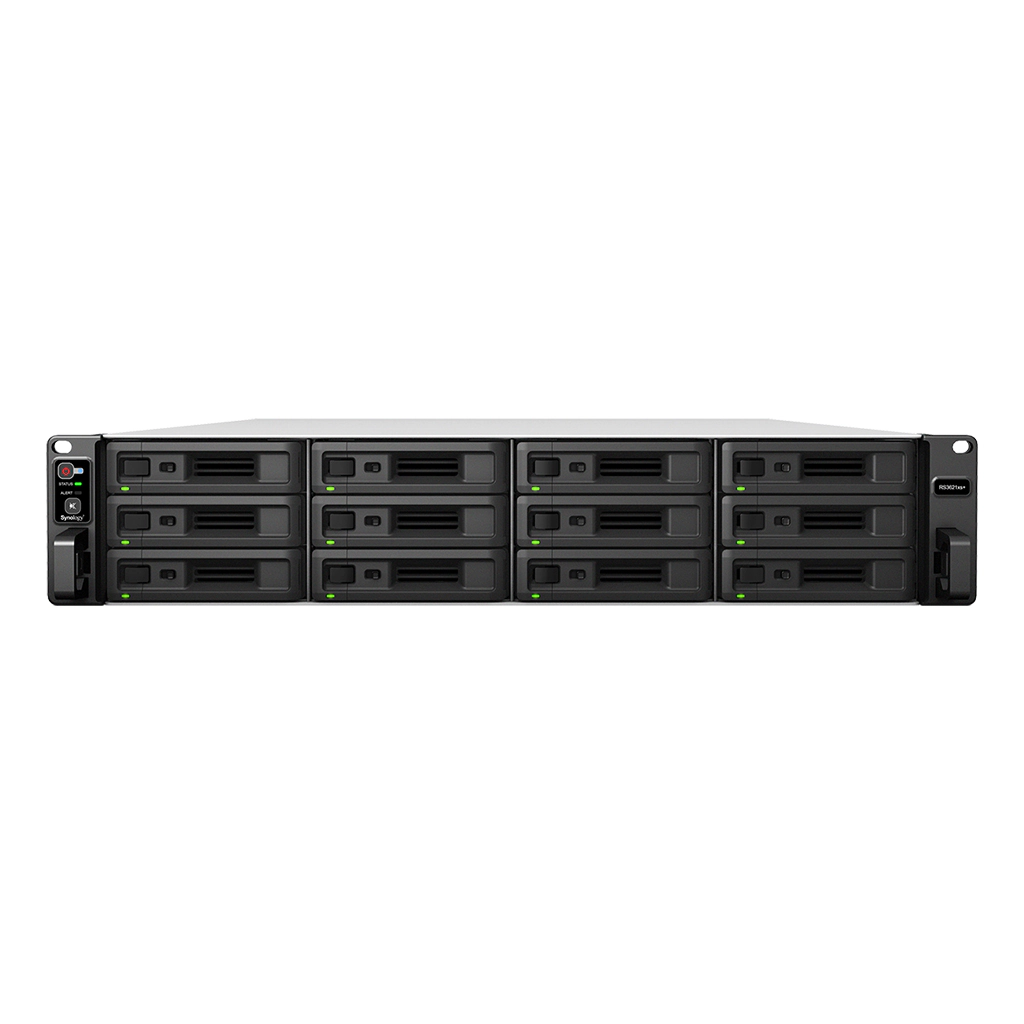
The RS3621xs+ is a 2U, twelve-bay NAS for a rack-based deployment. Its built-in data ports include two 10GbE RJ-45 connections and four 1GbE connections, and the chassis has redundant power supplies. Synology lists expansion to 36 total drive positions with two RX1217 or RX1217RP shelves. The base system still has twelve bays: the shelves are separate equipment that adds rack space, power, cabling and drive-compatibility work.
This model can be confused with the RS3621RPxs because the names share the same product family. They have the same 12-bay, 2U form and redundant power, but their network and processor specifications differ. The RS3621xs+ uses an eight-core Xeon D-1541 and has two built-in 10GbE ports; the RPxs uses a six-core D-1531 and lists four built-in 1GbE ports only. An optional network card may be available for the RPxs, but it is not a built-in capability or an included package assumption.
Memory, expansion and generation fit
Synology specifies an 8 GB starting configuration of DDR4 ECC UDIMM memory, four slots and a 64 GB maximum. The platform is expandable, but an upgrade is a separate hardware and validation decision. For volumes above 108 TB, the product specification lists at least 32 GB of memory; a 1 PB single volume is tied to 64 GB and RAID 6 groups, with other conditions. These limits should be read as configuration-dependent software ceilings, not a promise of usable capacity from the base memory configuration.
Two PCIe Gen3 x8 slots provide optional expansion, while the two external shelf ports use Infiniband. That expansion interface is not Ethernet, and the NAS’s network-port count should not be conflated with its shelf connection. The newer RS3626xs has a different expansion architecture: Gen4 slots and Mini-SAS HD shelf links, built-in dual 10GbE plus a separate out-of-band management port, and an eight-gigabyte ECC UDIMM ceiling of 48 GB. The older RS3621xs+ retains an eight-core processor and four 1GbE data ports alongside its dual 10GbE, but its model-specific compatibility list and expansion topology matter for existing deployments.
Storage choices and data protection
The twelve native bays accept the SATA drive types listed by Synology, and the system supports SMB and NFS file sharing. Its supported RAID types include RAID 1. A pair of compatible internal data drives can therefore be planned as a mirror, with the trade-off that one bay in the pair is used for redundancy rather than additional independent capacity. A RAID mirror can help keep a volume available after a single drive failure, but it does not restore a deleted file or shield data from theft, ransomware or loss of the appliance. Include an independent backup destination and verify recovery procedures.
Synology lists Btrfs and ext4 for internal volumes. Capacity planning should account for RAID overhead, filesystem metadata and future growth rather than applying a raw drive total to the volume limit. Any target beyond the lower listed tiers depends on both the memory installed and the chosen RAID arrangement. Validate supported drive models and the intended DSM configuration before committing to the hardware.
A serial-number check for replacement power supplies
The RS3621xs+ uses redundant power, but Synology documents a hardware revision that affects PSU replacement. The fifth-to-seventh digits of the chassis serial identify the revision: SZR units use 500 W modules, while UUR and VR1 units use 550 W modules. Manufacturer Product Change Notice PCN-008 says to pair modules with the same wattage. For a used unit or a service replacement, ask for the serial and inspect the installed module rather than ordering a part based only on the model name.
The 2U chassis is specified for a four-post 19-inch rack, and the RKS-02 rail kit is listed separately. Check the rail kit, rack depth, airflow, front-service access and dual-power feed plan. The manufacturer’s standard package lists two AC cords but not data drives or expansion shelves; an individual seller may offer a different package, which must be verified independently.
Lifecycle and buying context
Synology’s U.S. Product Support Status page observed for this review marks the RS3621xs+ Generally Available, with Full DSM updates, Full technical support and a five-year warranty. This is manufacturer support context, not proof that a specific retailer has stock or that a used, imported or bundled system qualifies for the manufacturer warranty. Confirm regional terms and seller return coverage directly in the actual offer.
Assessment
The RS3621xs+ stands out in this group for combining twelve native SATA bays, dual built-in 10GbE, four additional gigabit data ports and redundant power in a 2U chassis. Its age is visible in the Gen3 and Infiniband expansion design, and it is a poor choice to make by name alone if the RS3621RPxs is also under consideration. It is a stronger candidate where the exact ports, compatible shelves, memory plan and PSU revision line up with an established rack design. This review interprets manufacturer documentation; it does not report a hands-on test, ownership or measured performance.
Primary references: the Synology U.S. RS3621xs+ product specifications, English datasheet, hardware installation guide, PCN-008 PSU revision notice, and U.S. Product Support Status.
Key specifications
Key details at a glance
| Internal drive bays | 12 bays |
|---|---|
| Documented internal drive media | 3.5-inch SATA HDD / 2.5-inch SATA SSD |
| Built-in Ethernet ports | 4 × 1GbE RJ-45 data ports / 2 × 10GbE RJ-45 data ports |
| Fastest individual Ethernet port | 10 Gbps |
| Installed system memory | 8 GB |
| Maximum listed memory | 64 GB |
| Listed storage arrangements | RAID F1 / Basic / JBOD / RAID 0 / RAID 1 / RAID 5 / RAID 6 / RAID 10 |
| Internal file systems | Btrfs / ext4 |
| Maximum listed single-volume size | 1000 TB |
| Dimensions (H × W × D) | 88 × 482 × 724 mm (H × W × D); 2U |
| Weight | 14.5 kg |
| Hardware warranty | 5 years |
| Data drives included in listed package | No |
| Maximum total drive bays with listed expansion | 36 bays |
| Expansion-unit note | Two separate RX1217 or RX1217RP shelves can extend the 12 native bays to 36 total. |
| Listed expansion unit | RX1217 or RX1217RP × 2 |
| Processor | Intel Xeon D-1541 |
| CPU cores | 8 |
| CPU threads | 16 |
| Installed memory type | DDR4 ECC UDIMM |
| Single-volume limit condition | Synology lists 108 TB at the base memory tier, 200 TB with at least 32 GB, and 1 PB only for RAID 6 groups with 64 GB memory and additional conditions. Actual usable capacity varies with drives, RAID and filesystem. |
Use the exact model’s instructions for operating limits, supplied equipment and version differences.
Sources for this review
Sources for this assessment
- Synology U.S. NAS product list, captured directory response
- Synology U.S. RackStation RS3621xs+ product page
- Synology RackStation RS3621xs+ English datasheet
- Synology RackStation RS3621xs+ Hardware Installation Guide
- Synology U.S. Product Support Status row observation, cycle 13
- Synology PCN-008 for RS3621xs+ and RS3621RPxs PSU revisions
Check your setup before choosing a NAS
Use the finder to narrow documented desk/shelf or rack formats, internal-bay minimums, a single Ethernet-port rating and optional redundancy requirements.