
Your needs, this model
Does it fit your priorities?
Does the RS3621RPxs have built-in 10GbE?
No. Its listed built-in LAN is four 1GbE RJ-45 ports. Synology lists optional network interface cards for the two PCIe slots, but those are separate parts and do not change the built-in-port specification.
Explore this need in the finder →What does the 36-drive expansion figure include?
Twelve positions are native to the RS3621RPxs. Reaching 36 requires two compatible RX1217 or RX1217RP shelves, plus the physical rack space and supported drive configuration.
Explore this need in the finder →How can I identify a compatible replacement PSU?
Synology ties 500 W modules to serials whose fifth-to-seventh digits are SYR and 550 W modules to UTR/VR2 units. PCN-008 says to use same-wattage modules together. Check the serial and installed PSU before buying a replacement.
Explore this need in the finder →Redundant power, but only gigabit in the base network
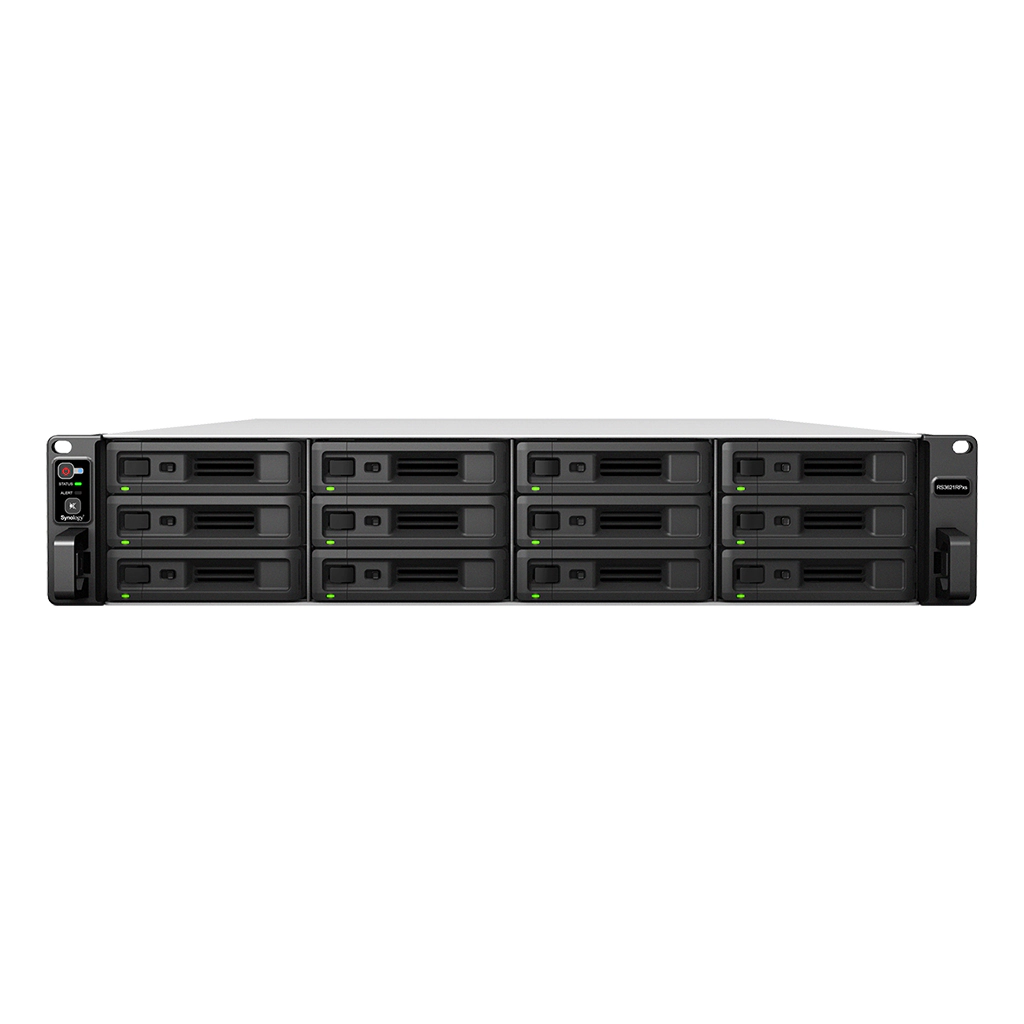
The RackStation RS3621RPxs is a 2U, twelve-bay NAS with redundant power supplies and four built-in 1GbE RJ-45 data ports. Its name is close to RS3621xs+, but the “RPxs” configuration is materially different: it uses a six-core Intel Xeon D-1531 and does not list any built-in 10GbE port. Synology lists compatible add-in network cards for its PCIe slots, but a separate card is not included in the base-port count or guaranteed to be part of a seller’s package.
The device can expand from twelve native bays to 36 positions using two RX1217 or RX1217RP shelves. This is a storage-growth route, not a 36-bay base unit. Those shelves connect through Infiniband ports; the connection is distinct from Ethernet networking. Include shelves, compatible drives, rack space, power and cable routing in a full design rather than treating the expansion figure as free capacity.
Compute, memory and expansion cards
The processor is a six-core, twelve-thread Xeon D-1531 running at a specified 2.2 GHz base and 2.7 GHz turbo frequency. The system starts with 8 GB of DDR4 ECC UDIMM across four slots and has a listed maximum of 64 GB. Two Gen3 x8 PCIe slots let an installer evaluate separate network or storage cards, subject to Synology’s current compatibility list and the specific workload. These slots do not make an add-in feature part of the standard package.
Built-in networking is the decisive distinction for a buyer comparing it with RS3621xs+. That model adds two native 10GbE ports and uses an eight-core Xeon D-1541; the RPxs retains four gigabit ports and the six-core D-1531, while both have twelve bays and redundant power. A 10GbE add-in card could alter the deployed configuration, but the buyer should verify the exact supported card, firmware, slot use and offer contents. Port line rate also does not predict file throughput: clients, switches, cables, storage layout and concurrent workloads affect the whole path.
RAID options and recovery expectations
Synology lists RAID 1 for this model, so two compatible native SATA drives can be configured as a mirror. The documented supported filesystems include Btrfs and ext4. A mirror can help preserve service after one drive fails, but it is not a second independent copy. A backup stored only on the same appliance remains exposed to deletion, compromised access, physical damage or an event affecting the entire system. Plan a separate destination and a recovery test.
Synology’s volume figures are conditional. The product page lists a 108 TB tier at the base memory level, 200 TB when at least 32 GB is installed, and a 1 PB single volume only for RAID 6 groups with 64 GB memory and further requirements. None of these numbers equals formatted usable capacity, and the 1 PB case is not the same as a two-drive RAID 1 plan. Calculate from the actual drives and layout, then check the software conditions for the intended workload.
PSU revision and rack installation
Redundant supplies are a real advantage over a one-PSU system, but exact replacement parts depend on the unit’s serial-number revision. Synology’s PCN-008 maps the fifth-to-seventh serial digits to the supply: SYR units use 500 W modules, while UTR or VR2 units use 550 W modules. The notice calls for modules of the same wattage to be used together. For used hardware or maintenance, record the serial and check the installed PSU before sourcing a replacement.
Synology specifies a four-post 19-inch rack and lists the RKS-02 sliding rails separately. The 2U chassis weighs 14.5 kg before drives and should be planned for safe installation, rail support, service clearance, cooling and suitable power distribution. The standard product page lists AC cords but no data drives. Do not assume that a seller’s photo shows an included drive set, rack kit, expansion shelf or network adapter.
U.S. status and fit
The U.S. manufacturer status view observed for this review lists the RS3621RPxs as Generally Available, with Full DSM updates, Full technical support and a five-year warranty. The status is not evidence of current reseller stock or the warranty status of a specific used unit. Verify the actual region, seller’s package, return terms and manufacturer coverage before treating an offer as a supported deployment path.
Assessment
The RS3621RPxs makes sense to evaluate when twelve internal bays, dual PSU redundancy and a built-in gigabit network are sufficient, or when a verified add-in network plan is already part of the rack design. It is less suitable when native 10GbE is a requirement; the similarly named RS3621xs+ has that capability out of the box. Compared with the RS3618xs, the RPxs adds a newer six-core processor and redundant PSUs while keeping the same broad 12-bay and four-gigabit-port pattern. This is a documentation-based assessment, not a report of hands-on installation or testing.
Primary references: Synology U.S. RS3621RPxs product specifications, the English datasheet, its hardware installation guide, the PCN-008 PSU revision notice, and the U.S. Product Support Status.
Key specifications
Key details at a glance
| Internal drive bays | 12 bays |
|---|---|
| Documented internal drive media | 3.5-inch SATA HDD / 2.5-inch SATA SSD |
| Built-in Ethernet ports | 4 × 1GbE RJ-45 data ports |
| Fastest individual Ethernet port | 1 Gbps |
| Installed system memory | 8 GB |
| Maximum listed memory | 64 GB |
| Listed storage arrangements | RAID F1 / Basic / JBOD / RAID 0 / RAID 1 / RAID 5 / RAID 6 / RAID 10 |
| Internal file systems | Btrfs / ext4 |
| Maximum listed single-volume size | 1000 TB |
| Dimensions (H × W × D) | 88 × 482 × 724 mm (H × W × D); 2U |
| Weight | 14.5 kg |
| Hardware warranty | 5 years |
| Data drives included in listed package | No |
| Maximum total drive bays with listed expansion | 36 bays |
| Expansion-unit note | Two RX1217 or RX1217RP shelves, separately purchased, can expand the 12 native positions to 36 total. |
| Listed expansion unit | RX1217 or RX1217RP × 2 |
| Processor | Intel Xeon D-1531 |
| CPU cores | 6 |
| CPU threads | 12 |
| Installed memory type | DDR4 ECC UDIMM |
| Single-volume limit condition | Synology lists 108 TB at the base memory tier, 200 TB with at least 32 GB, and 1 PB only for RAID 6 groups with 64 GB memory and additional conditions. Actual usable capacity varies with drives, RAID and filesystem. |
Use the exact model’s instructions for operating limits, supplied equipment and version differences.
Sources for this review
Sources for this assessment
- Synology U.S. NAS product list, captured directory response
- Synology U.S. RackStation RS3621RPxs product page
- Synology RackStation RS3621RPxs English datasheet
- Synology RackStation RS3621RPxs Hardware Installation Guide
- Synology U.S. Product Support Status row observation, cycle 13
- Synology PCN-008 for RS3621xs+ and RS3621RPxs PSU revisions
Check your setup before choosing a NAS
Use the finder to narrow documented desk/shelf or rack formats, internal-bay minimums, a single Ethernet-port rating and optional redundancy requirements.