
Your needs, this model
Does it fit your priorities?
Can the RS3618xs provide built-in 10GbE?
No. Its four built-in data ports are 1GbE. It has PCIe expansion slots for a separately chosen compatible network card, but an optional card is not part of the built-in-port capability or any specific seller package.
Explore this need in the finder →Does this model have redundant power supplies?
No. The RS3618xs lists one 500 W supply, unlike the redundant-PSU RS3621xs+ and RS3621RPxs. If a single power-supply failure is an availability concern, this difference is material.
Explore this need in the finder →How does it compare with the RS3621RPxs?
Both are 12-bay 2U systems with four built-in gigabit ports and Infiniband expansion, but RS3618xs uses a four-core Xeon D-1521 and one PSU. RS3621RPxs has a six-core D-1531 and redundant PSUs. Verify the exact unit revision, support and package rather than treating the model names as equivalent.
Explore this need in the finder →A 12-bay system from an earlier RackStation generation
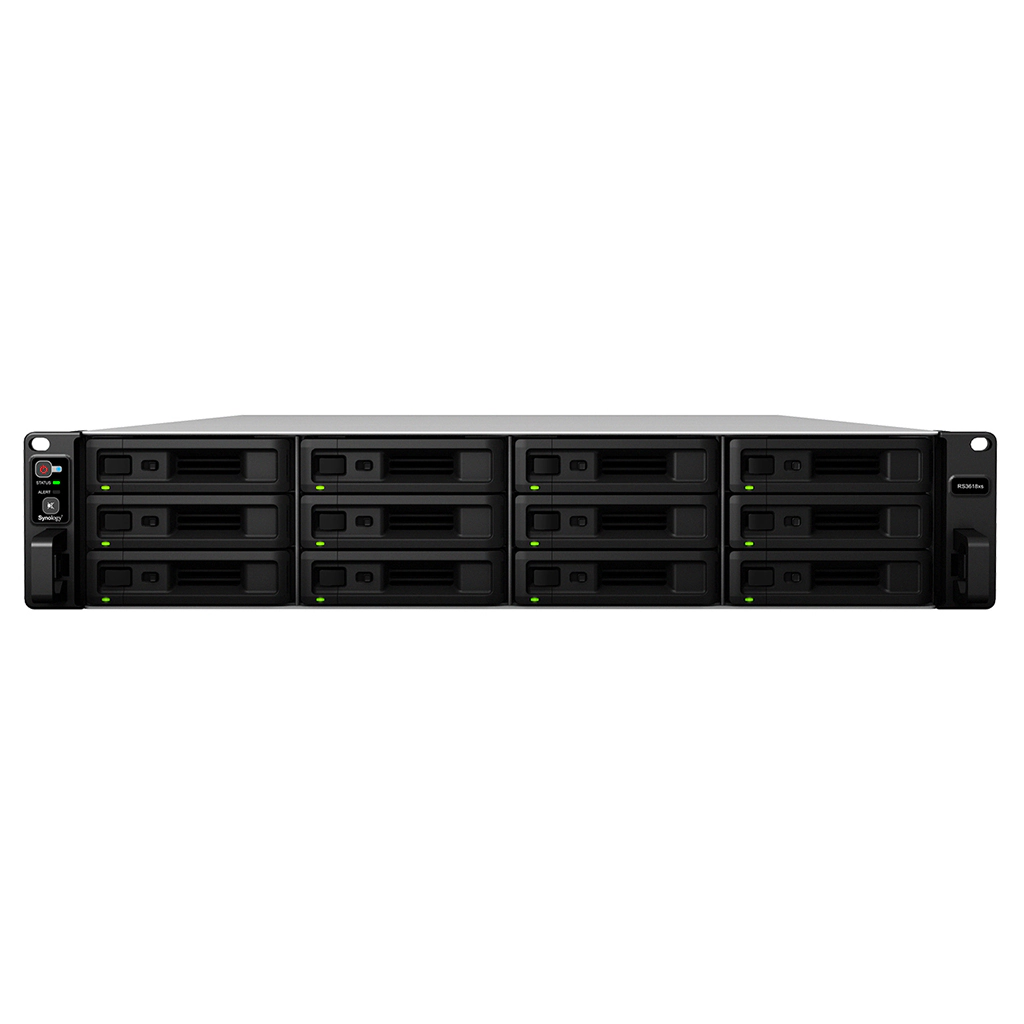
The RS3618xs remains listed on Synology’s U.S. product page as a twelve-bay, 2U network storage system. It uses an Intel Xeon D-1521 quad-core processor, starts with 8 GB of DDR4 ECC UDIMM memory and has a listed 64 GB maximum across four slots. The basic capacity remains substantial, but its age appears in the network and power design: four built-in 1GbE ports and a single 500 W supply, rather than native 10GbE or redundant PSUs.
That makes it a product to assess against an existing infrastructure plan, not a generic alternative to every newer 12-bay rack NAS. A buyer who needs built-in 10GbE should not interpret optional PCIe expansion as an included port. The two Gen3 x8 slots can support separately selected cards, but the model-specific compatibility list, remaining slot resources, package and intended network path need to be verified.
Native bays and expansion are separate things
The chassis has twelve native SATA positions for supported 3.5-inch hard drives or 2.5-inch HDDs and SSDs. Synology lists expansion to 36 total positions with two RX1217 or RX1217RP units. Those external shelves connect through Infiniband expansion ports, which are not Ethernet ports. Count twelve as the capacity inside the base chassis and add the cost, rack units, power, cables and compatibility checks for any expansion units.
The 2U enclosure is specified at 88 × 482 × 724 mm and 14.5 kg before drives, with a four-post 19-inch rack requirement. The RKS-02 rails are sold separately. Plan rail compatibility, rack depth, lift and service access, front-to-back airflow and a stable power connection. The standard manufacturer package lists the main unit and accessories but does not include data drives; a seller’s bundle should be examined independently.
Storage services and data protection
The RS3618xs supports SMB and NFS file services, lists Btrfs and ext4 for internal volumes and includes RAID 1 among its supported arrangements. Two compatible SATA drives can therefore be planned as a mirror. That arrangement may help keep a volume available when one member drive fails, but it does not protect against accidental deletion, malware, stolen credentials, theft or damage to the whole NAS. Keep a separate backup copy on another device or site and test that data can be restored.
Capacity claims in the manufacturer specification are tied to memory, RAID and other conditions. Synology lists a 108 TB tier at the base memory level, a 200 TB single volume with at least 32 GB, and a 1 PB volume only for RAID 6 groups with 64 GB memory plus further conditions. Those are software maximums, not the capacity a buyer will see after formatting and redundancy. The relevant number depends on drive sizes, layout, filesystem and the intended recovery policy.
The power-supply trade-off
The model’s single 500 W PSU is a material limitation for deployments that require power redundancy. A UPS can help with some input-power events, but it does not turn the RS3618xs into a dual-supply chassis. If a supply failure must not interrupt storage service, compare a system with redundant PSUs or design the replacement and recovery process around that single point of failure.
Synology’s current U.S. Product Support Status table observed for this review lists the RS3618xs as Generally Available, with Full DSM updates, Full technical support and a five-year warranty. That status is useful context despite the 2018 model generation; it is not proof a dealer has stock, nor a guarantee that a used, imported or bundled unit retains manufacturer warranty coverage. Confirm the serial, region, actual seller package and return conditions.
How it compares with RS3621RPxs
The RS3621RPxs has the same twelve native bays, 2U shape, four built-in gigabit ports and Infiniband expansion theme. It moves to a six-core Xeon D-1531 and dual PSUs. The RS3618xs stays on the four-core D-1521 and one PSU. Both lack built-in 10GbE; Synology lists optional network cards, but specific model and package support must be checked. This comparison matters more than the small difference in model names because it changes compute class and the power-failure design.
The manufacturer’s support and specification pages document file services, RAID and hardware, but they do not establish a particular retailer’s offer contents. A claimed drive count, rail kit, network card, expansion shelf or revised PSU should be confirmed as an exact item before purchase. No price, inventory, seller rating or customer history is asserted here.
Assessment
The RS3618xs is most defensible where an existing installation, compatibility requirement or managed procurement path specifically calls for its platform. It offers twelve internal bays and flexible PCIe expansion, but the built-in network is gigabit and the power supply is not redundant. For a new deployment, compare it against the RS3621RPxs and RS3621xs+ using native port needs, PSU redundancy, supported drive models, memory plan, shelves and total rack fit rather than relying on bay count alone. This is an interpretation of manufacturer documents, not a hands-on setup, ownership claim or measured benchmark.
Primary references: Synology U.S. RS3618xs product specifications, the English datasheet, its hardware installation guide, and Synology’s U.S. Product Support Status.
Key specifications
Key details at a glance
| Internal drive bays | 12 bays |
|---|---|
| Documented internal drive media | 3.5-inch SATA HDD / 2.5-inch SATA SSD |
| Built-in Ethernet ports | 4 × 1GbE RJ-45 data ports |
| Fastest individual Ethernet port | 1 Gbps |
| Installed system memory | 8 GB |
| Maximum listed memory | 64 GB |
| Listed storage arrangements | RAID F1 / Basic / JBOD / RAID 0 / RAID 1 / RAID 5 / RAID 6 / RAID 10 |
| Internal file systems | Btrfs / ext4 |
| Maximum listed single-volume size | 1000 TB |
| Dimensions (H × W × D) | 88 × 482 × 724 mm (H × W × D); 2U |
| Weight | 14.5 kg |
| Hardware warranty | 5 years |
| Data drives included in listed package | No |
| Maximum total drive bays with listed expansion | 36 bays |
| Expansion-unit note | Two separately purchased RX1217 or RX1217RP units can expand the 12 native bays to 36 total. |
| Listed expansion unit | RX1217 or RX1217RP × 2 |
| Processor | Intel Xeon D-1521 |
| CPU cores | 4 |
| CPU threads | 8 |
| Installed memory type | DDR4 ECC UDIMM |
| Single-volume limit condition | The manufacturer lists 108 TB at the base memory tier, 200 TB with at least 32 GB, and a 1 PB RAID 6 volume only under further conditions. These are conditional software limits, not usable-capacity guarantees. |
Use the exact model’s instructions for operating limits, supplied equipment and version differences.
Sources for this review
Sources for this assessment
Check your setup before choosing a NAS
Use the finder to check bay count, the network link you need, and whether a documented two-drive redundant arrangement is essential.