
Your needs, this model
Does it fit your priorities?
Are the advertised 24 bays internal to the RS2423+ chassis?
No. The RS2423+ has twelve native SATA bays. Synology's 24-bay maximum uses one separately purchased RX1223RP expansion unit; optional M.2 or network hardware does not add internal SATA bays.
Explore this need in the finder →Does the RS2423+ have built-in 10GbE?
Yes. Its supported hardware lists one 10GbE RJ-45 data port and two 1GbE RJ-45 data ports. This distinguishes its built-in link from optional 10/25GbE adapter choices; actual transfer speed depends on the rest of the path and workload.
Explore this need in the finder →Can a two-drive mirror protect a volume, and what about power redundancy?
The RS2423+ supports RAID 1, so two compatible native SATA drives can be mirrored. That is storage-drive redundancy, not power-supply redundancy: this model lists one 500-watt supply. The mirror still cannot replace an independent backup.
Explore this need in the finder →Plan around the twelve native bays
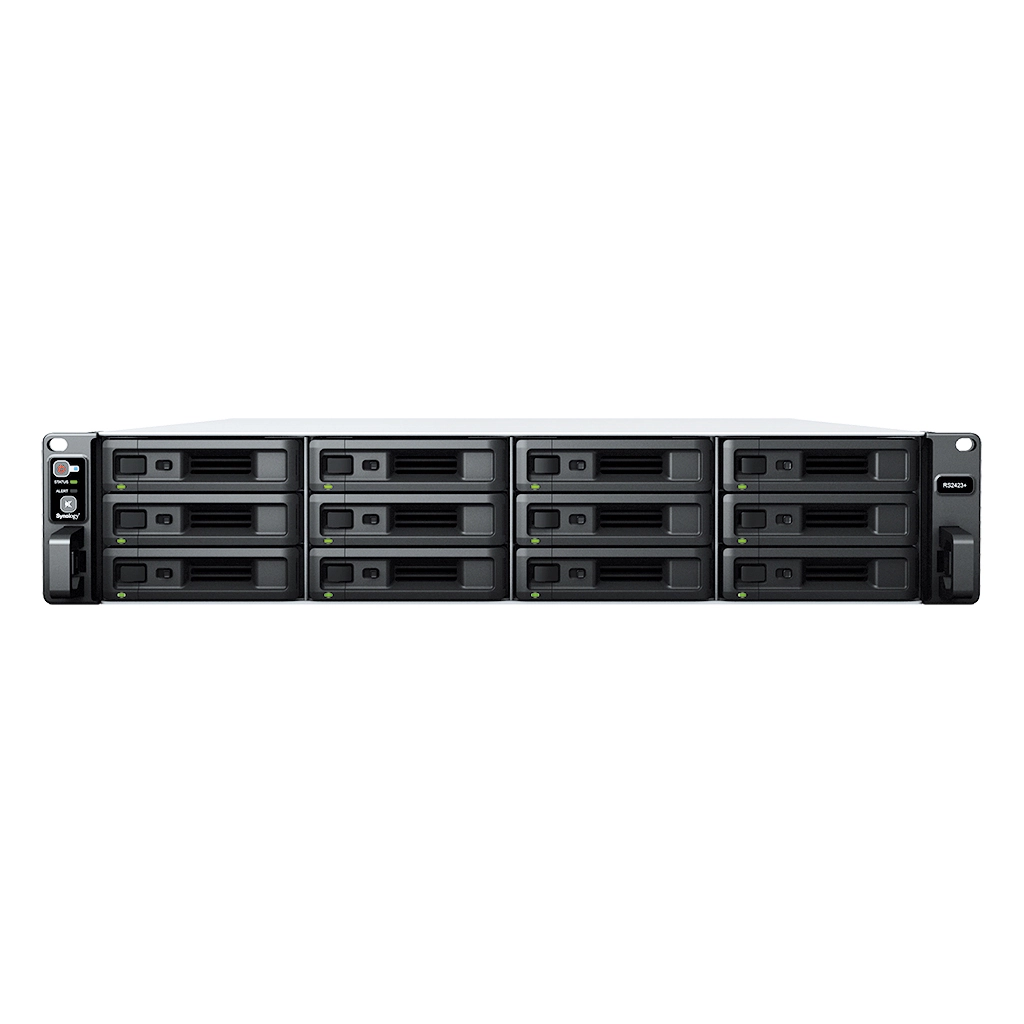
RS2423+ is a 2U RackStation built around twelve internal SATA drive trays. It supports compatible 3.5-inch hard drives or 2.5-inch SATA SSDs, giving an office or branch NAS more room for separate user shares, backup versions and surveillance footage than a small two- or four-bay desktop unit. The often-quoted 24-drive maximum is conditional: it requires the separately sold RX1223RP expansion enclosure, which adds twelve positions outside the main chassis. The base NAS remains twelve-bay hardware, and the expansion shelf adds its own cost, rack footprint, cabling and power.
Synology's listed dimensions are 88 × 482 × 552 mm with rack ears and 11.5 kg before drives. The system is intended for a four-post 19-inch rack, with the RKS-02 sliding rail kit sold separately. Measure the cabinet's usable depth, not only the nominal rack size, and reserve clearance for cables and airflow. A 2U business NAS is not a drop-in replacement for a desktop enclosure even if both can share files.
One fast port, two ordinary gigabit ports
The RS2423+ has one built-in 10GbE RJ-45 data port plus two 1GbE ports. This is a useful distinction from a system with only 2.5GbE, but it is still a single 10GbE connection—not three high-speed ports. A 10GbE link only matters when the switch, client adapter and cabling can negotiate it; storage layout, concurrent work and software also affect file movement. Synology's model page lists an expansion slot and compatible 10/25GbE cards, but those are optional upgrades, not included ports.
The manufacturer advertises sequential read/write throughput above 3,500/1,700 MB/s under its own test conditions. I did not repeat that benchmark. Real results depend on the configuration and workload, so the number is context for the hardware rather than a guarantee that a laptop will copy files at that rate. The model also supports link aggregation, but combining two network links is not the same as giving one ordinary client a single 2Gbps lane.
Shared storage, supported redundancy and memory
The documented AMD Ryzen V1780B processor has four cores and eight threads. RS2423+ starts with 8 GB DDR4 ECC UDIMM memory and has two slots with a listed 32 GB maximum. Synology identifies SMB and NFS file services, Btrfs and ext4 internal filesystems, and a range of storage modes including Synology Hybrid RAID and RAID 1/5/6/10. Two compatible drives can be configured as a RAID 1 mirror; larger supported layouts can balance capacity and fault tolerance differently.
Do not treat that flexibility as a substitute for deciding what must be recoverable. A mirror can help keep service available through one supported drive failure, while a separate backup covers more risks such as deletion, ransomware, loss of the entire chassis or a faulty administrative change. List the endpoints to back up, where the second copy will live and how a restore will be tested before filling all twelve bays. Check the exact drive model against Synology's compatibility list; a marketing maximum is not formatted usable capacity.
Choose the power configuration intentionally
The non-RP RS2423+ is the simpler member of the two-model family. Synology lists one 500W supply, no redundant power supply and one AC power cord. Its standard package list includes the main unit, accessory pack and quick installation guide, but not hard drives, rack rails or the optional RX1223RP. If a supply failure must not take the NAS down, compare the RS2423RP+II: it has redundant hot-swappable 550W supplies and two listed power cords. That version is heavier, and current documents give it a longer depth; its old hardware guide conflicts on that dimension, so verify the exact unit before planning rack fit.
Synology's U.S. status record observed October 29, 2026 marks RS2423+ Generally Available, with Full DSM updates, Full Technical Support and a three-year manufacturer warranty. This is not an inventory check or a promise about a reseller's bundle. Confirm the full model suffix, whether drives are included, and which rails, NICs and expansion hardware actually ship.
Assessment
RS2423+ is a plausible fit when a rack-based team needs twelve native bays and one built-in 10GbE port but does not require redundant PSU hardware. Its 2U footprint and optional expansion can support a planned shared-storage or backup design, while the single PSU and need for external backups are real boundaries. A home buyer seeking simple storage may be better served by a smaller unit; a high-availability deployment should compare power paths and rack dimensions rather than assuming that bay count alone defines resilience. This review analyzes Synology's published documentation; it does not claim hands-on testing or ownership.
Primary references: the Synology U.S. RS2423+ product page, its English datasheet, installation guide and U.S. Product Support Status.
Key specifications
Key details at a glance
| Internal drive bays | 12 bays |
|---|---|
| Documented internal drive media | 3.5-inch SATA HDD / 2.5-inch SATA SSD |
| Built-in Ethernet ports | 1 × 10GbE RJ-45 data port / 2 × 1GbE RJ-45 data ports |
| Fastest individual Ethernet port | 10 Gbps |
| Installed system memory | 8 GB |
| Maximum listed memory | 32 GB |
| Listed storage arrangements | Synology Hybrid RAID / Basic / JBOD / RAID 0 / RAID 1 / RAID 5 / RAID 6 / RAID 10 |
| Internal file systems | Btrfs / ext4 |
| Dimensions (H × W × D) | 88 × 482 × 552 mm (H × W × D) |
| Weight | 11.5 kg |
| Hardware warranty | 3 years |
| Data drives included in listed package | No |
| Maximum total drive bays with listed expansion | 24 bays |
| Expansion-unit note | Twelve native SATA positions plus one separate RX1223RP expansion unit; the shelf is not part of the base chassis. |
| Listed expansion unit | RX1223RP × 1 (sold separately) |
| Processor | AMD Ryzen V1780B |
| CPU cores | 4 |
| CPU threads | 8 |
| Installed memory type | DDR4 ECC UDIMM |
Use the exact model’s instructions for operating limits, supplied equipment and version differences.
Sources for this review
Sources for this assessment
Check your setup before choosing a NAS
Use the finder to check bay count, the network link you need, and whether a documented two-drive redundant arrangement is essential.