
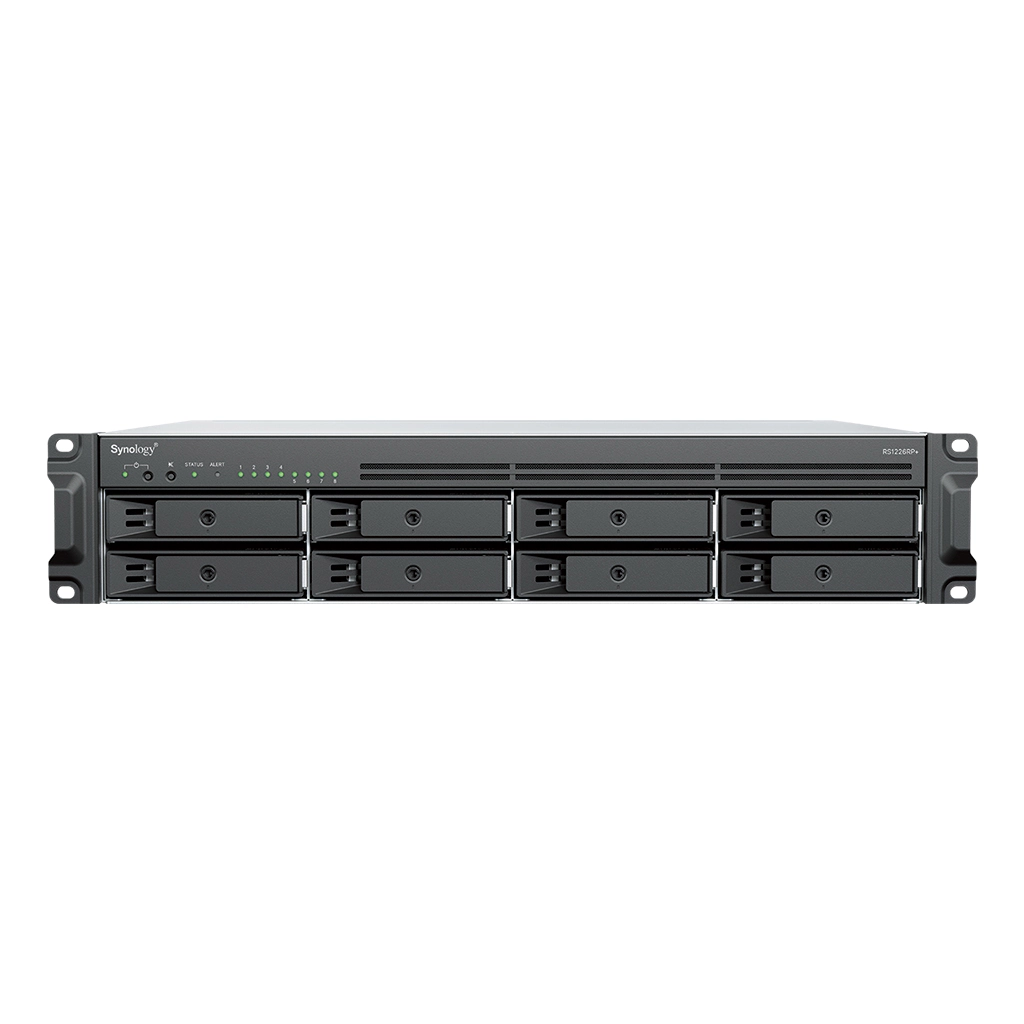
Your needs, this model
Does it fit your priorities?
Does the RS1226RP+ have eight internal data-drive bays?
Yes. It has eight native SATA positions for compatible 3.5-inch HDDs or 2.5-inch SATA SSDs. The two built-in M.2 NVMe slots are separate cache positions, while a twelfth bay is reached only with a separately sold RX426 expansion unit.
Explore this need in the finder →Does built-in 2.5GbE satisfy a single-port 2.5Gbps requirement?
Yes, the model lists two individual 2.5GbE RJ-45 ports. The matcher counts the fastest built-in individual port; optional 10/25GbE NICs are not included in that figure. The entire path must support the desired rate for a fast transfer.
Explore this need in the finder →What redundancy does RS1226RP+ provide?
The product supports RAID 1 for a two-drive mirror and separately has redundant hot-swappable 550-watt power supplies. These protect against different failure types; neither is a substitute for an independent, restorable backup.
Explore this need in the finder →An eight-bay rack NAS with redundant power
RS1226RP+ is a 2U RackStation for a branch office or small business that wants a modest rack footprint, eight native drive positions and power-supply redundancy. It accepts compatible 3.5-inch SATA hard drives or 2.5-inch SATA SSDs. Synology lists a maximum of twelve drive bays, but that total includes the separately purchased four-bay RX426 expansion unit. The main enclosure still has eight SATA trays. Its two internal M.2 2280 NVMe positions are separate cache slots, not extra data bays, and the manufacturer does not list them as hot-swappable.
Rack depth matters when comparing the two RS1226 versions. The RP+ measures 88.3 × 481.9 × 398.4 mm with ears and weighs 8.9 kg. Synology lists four-post 19-inch rack installation with RKS-02 rails sold separately. It is still described as short-depth, but it extends 91.8 mm farther back than the non-RP RS1226+; check the cabinet's actual usable depth, rear cable bend, airflow and service clearance. A chassis that physically fits but blocks the rack door or exhaust path is not a workable fit.
2.5GbE is built in; faster networking is optional
The base model has two 2.5GbE RJ-45 Ethernet ports. A minimum requirement of one built-in 2.5GbE port is met, but the two port ratings should not be added together as though one client can get a single 5Gbps connection. The product page lists optional 10GbE and 25GbE adapters. Those require separate compatible hardware and setup, so they are a possible upgrade path—not the factory built-in port rating used by the finder.
A fast link is only one part of a fast file path. The switch or router, client, adapter, cable, drive layout, RAID, file size and concurrent tasks all affect performance. Synology advertises sequential read/write speeds above 2,300/1,500 MB/s for this generation based on its own testing. That is vendor test context, not a result I measured or a promise for an unspecified network and workload.
Drive redundancy and power redundancy solve different failures
Synology lists RAID 1 and SHR among its supported storage options, so two compatible data drives can form a mirrored arrangement. That can help the volume stay available if one supported drive fails, with reduced usable capacity compared with adding both disk sizes. It does not guard against deleting a folder, malware, theft or losing the whole NAS. Keep a second copy on separate hardware or another protected destination and test restoring it.
The “RP” model adds a distinct power feature: its 550W supplies are redundant and hot-swappable, and the listed base package has two AC cords. Two supplies can reduce downtime after one supply fails only if the power design supports that recovery. Connecting both to the same vulnerable circuit still leaves a common point of failure. For some racks the non-RP RS1226+ may be preferable: it is shorter and lighter, but uses a single 250W supply instead.
Memory, package and operating plan
The product starts with 4 GB DDR4 ECC SODIMM memory, has two slots and lists 32 GB as the maximum. Its AMD Ryzen V1500B has four cores and runs at 2.2GHz. Synology recommends checking its compatible memory list and notes that non-Synology memory can affect warranty or technical-support terms. The system lists Btrfs for internal drives and DSM file protocols such as SMB and NFS. That is enough to assess it as a NAS, but workload capacity depends on the number of clients, backup history and applications, not only the processor name.
The manufacturer's datasheet lists the main unit, accessory pack and two AC power cords as package contents. It does not list data drives, the RX426, the optional NIC or rack rails. The U.S. support-status table observed October 29, 2026 marks RS1226RP+ Generally Available, with Full DSM updates, Full Technical Support and a three-year manufacturer warranty. Those fields do not indicate a reseller's present stock or what is included in an offer; check the exact model suffix, diskless/bundle terms, power cords, rails and return policy.
Assessment
RS1226RP+ is worth comparing when eight internal bays, built-in 2.5GbE and redundant PSU hardware are all useful in a managed four-post rack. It is less compelling when rack depth is tight, the drives and network are only gigabit, or a single PSU is acceptable at a lower footprint. The extra power hardware does not replace drive redundancy or backup, and the 12-bay headline depends on a separate expansion purchase. This is a documentation-based assessment of the exact RS1226RP+ model, not a hands-on installation or performance test.
Primary references: the Synology U.S. RS1226RP+ / RS1226+ page, the RS1226RP+ datasheet, hardware installation guide and the U.S. Product Support Status.
Key specifications
Key details at a glance
| Internal drive bays | 8 bays |
|---|---|
| Documented internal drive media | 3.5-inch SATA HDD / 2.5-inch SATA SSD |
| Built-in Ethernet ports | 2 × 2.5GbE RJ-45 data ports |
| Fastest individual Ethernet port | 2.5 Gbps |
| Installed system memory | 4 GB |
| Maximum listed memory | 32 GB |
| Listed storage arrangements | Synology Hybrid RAID / Basic / JBOD / RAID 0 / RAID 1 / RAID 5 / RAID 6 / RAID 10 |
| Internal file systems | Btrfs |
| Dimensions (H × W × D) | 88.3 × 481.9 × 398.4 mm (H × W × D with server ears) |
| Weight | 8.9 kg |
| Hardware warranty | 3 years |
| Data drives included in listed package | No |
| M.2 NVMe slots | 2 |
| Maximum total drive bays with listed expansion | 12 bays |
| Expansion-unit note | Eight native SATA bays plus a separate four-bay RX426; the expansion shelf is not internal to the base chassis. |
| Listed expansion unit | RX426 × 1 (sold separately) |
| Processor | AMD Ryzen V1500B |
| CPU cores | 4 |
| CPU threads | 8 |
| Installed memory type | DDR4 ECC SODIMM |
Use the exact model’s instructions for operating limits, supplied equipment and version differences.
Sources for this review
Sources for this assessment
- Synology U.S.-language product-list observation
- Synology U.S. RackStation RS1226RP+ / RS1226+ product page
- Synology RackStation RS1226RP+ English datasheet
- Synology RackStation RS1226RP+ hardware installation guide
- Synology U.S. Product Support Status
- Synology U.S. RS1226+ and RS1226RP+ launch announcement
Check your setup before choosing a NAS
Use the finder to narrow documented desk/shelf or rack formats, internal-bay minimums, a single Ethernet-port rating and optional redundancy requirements.