
Your needs, this model
Does it fit your priorities?
Are the M.2 slots included in the RS1226+'s eight drive bays?
No. Its eight native bays take compatible SATA data drives. The two M.2 2280 NVMe positions are separate cache slots and are not listed as hot-swappable; a separate RX426 expansion unit adds four more SATA bays.
Explore this need in the finder →Does the RS1226+ satisfy a single built-in 2.5GbE port minimum?
Yes. The exact model lists two built-in 2.5GbE RJ-45 data ports. Optional 10GbE or 25GbE adapters do not count as built-in capability; the network path and workload govern real throughput.
Explore this need in the finder →Does the RS1226+ include redundant power or a supported mirror?
Synology lists RAID 1, so two compatible native SATA drives may be mirrored. The standard RS1226+ has one 250-watt supply and does not list redundant power; this is the difference from the RS1226RP+ variant. An internal mirror remains separate from a tested backup copy.
Explore this need in the finder →Eight native bays in a compact rack enclosure
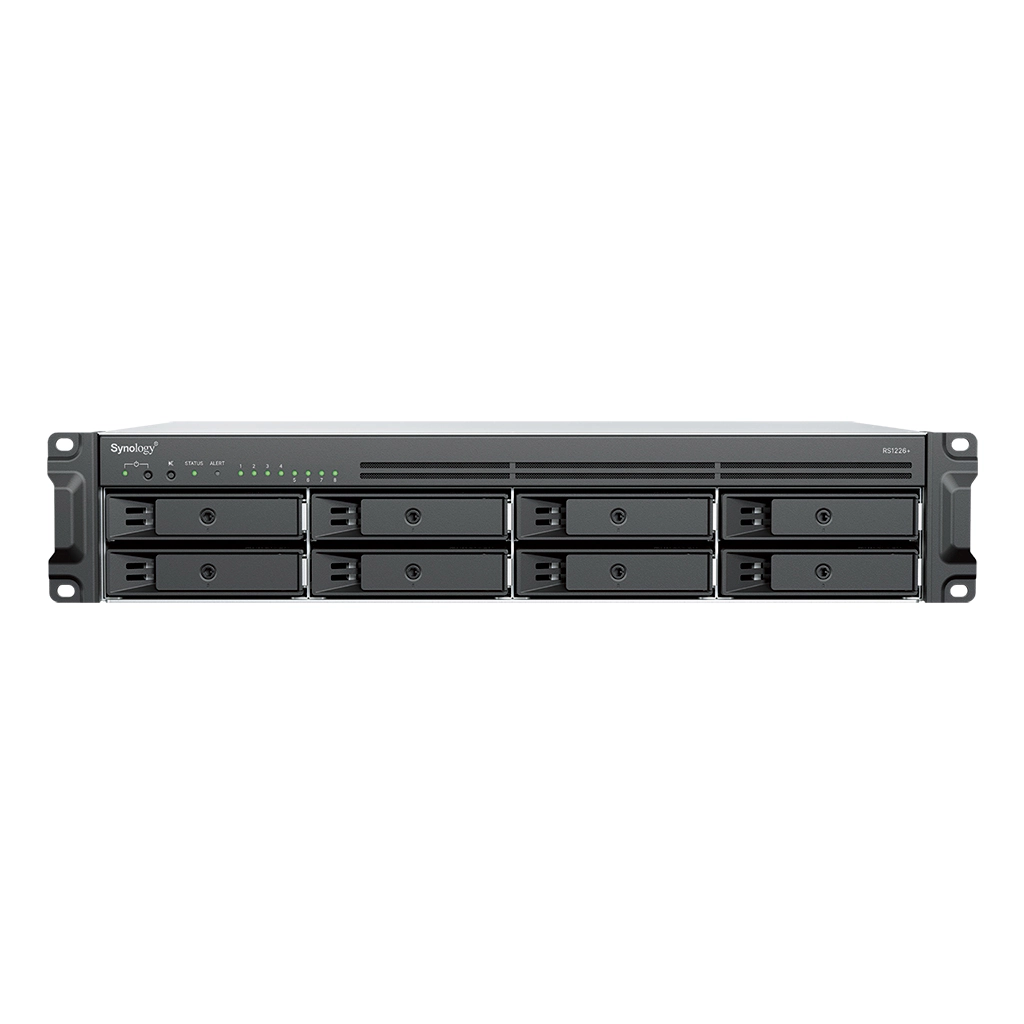
The RS1226+ is an eight-bay 2U NAS built for a branch office or a small team that wants shared storage in a rack without choosing a deeper redundant-power chassis. Its native SATA trays accept compatible 3.5-inch HDDs or 2.5-inch SATA SSDs. Synology lists expansion to twelve total bays with one RX426, but the shelf is a separate purchase; the base enclosure still has eight positions. Two integrated M.2 2280 NVMe slots are documented for cache, not as additional hot-swappable data bays.
At 88 × 482 × 306.6 mm with ears and 6.8 kg, this is the shorter and lighter model in the RS1226 family. Synology lists a four-post 19-inch rack with separately sold RKM114 or RKS-02 rails and also direct mounting on a two-post 19-inch rack. Measure usable rack depth and allow room for cabling and cooling; the front-to-back dimension does not include all the practical clearance a deployed NAS needs.
Two 2.5GbE ports, with a single supply
The product has two built-in 2.5GbE RJ-45 ports. That meets a requirement for one individual 2.5GbE connection, but port labels cannot simply be added to promise one client a 5Gbps file transfer. Switches, adapters, cables, storage performance and workload all matter. Synology lists optional 10GbE and 25GbE cards, but those are separate additions and do not change the built-in port rating.
Power is the other major model distinction. RS1226+ has one 250W supply, so it does not offer the redundant hot-swappable PSU arrangement of RS1226RP+. Synology's standard package list includes one AC power cord and one C13-to-C14 power cord, in addition to the main unit and accessory pack. If an external rack PDU is used, confirm which cord fits the actual power source; do not assume the package is two interchangeable wall cords.
Shared files, RAID and the difference between cache and capacity
The hardware uses an AMD Ryzen V1500B four-core processor and arrives with 4 GB of DDR4 ECC SODIMM memory. Synology lists two memory slots and a maximum of 32 GB, subject to the model's supported modules and warranty notes. The datasheet lists internal Btrfs, SMB and NFS file service, plus supported RAID choices including SHR and RAID 1. A two-drive mirror can help maintain a volume through one supported member-drive failure; it will not protect against a mistaken deletion, ransomware, theft or losing the whole NAS. Keep an independent, restorable backup.
The separate M.2 positions are described for NVMe cache and are not hot-swappable. They are not equivalent to using a front SATA bay for a data drive, and they should not be added to the eight internal bays in a capacity plan. Synology says an RX426 expansion unit adds four SATA bays, but that unit also needs rack space, power and an expansion connection. Verify drive compatibility and the exact shelf before ordering.
Synology advertises sequential read/write throughput above 2,300/1,500 MB/s for this new RS1226 family. The manufacturer provides the testing context; this assessment did not perform a benchmark. A quoted sequential result is not a promise for small random files, a wireless client or a network limited to gigabit equipment.
When the RS1226+ is the better variant
Compared with RS1226RP+, the regular Plus model retains eight bays, the same two built-in 2.5GbE ports, M.2 cache support and 4 GB ECC memory baseline. It trades the RP+'s redundant 550W supplies for a single 250W unit, weighs 2.1 kg less, and is 91.8 mm shallower with ears. That distinction can make the short chassis a better fit where the rack is constrained and one power supply is acceptable. If one supply failing must not interrupt service, the RP+ is the relevant alternative; adding a RAID mirror does not create power redundancy.
The U.S. support-status table observed October 29, 2026 lists RS1226+ as Generally Available, with Full DSM updates, Full Technical Support and a three-year manufacturer warranty. That is not a statement about a seller's stock or an offer's package. Check the exact SKU/suffix, compatible drives, included cords, rail hardware, optional expansion unit and return terms before committing.
Assessment
RS1226+ is a practical comparison point for a small managed rack that needs eight native bays, 2.5GbE and a shorter depth, without redundant power supplies. Its 2U format, single supply and optional expansion should be evaluated against the buyer's facilities and backup plan, not reduced to a maximum-capacity claim. It may be unnecessary for a home setup with no rack, and its 2.5GbE link will be wasted if the rest of the path remains gigabit. This is a source-based review of published specifications, not a report of personal use, installation or testing.
Primary references: Synology's U.S. RS1226RP+ / RS1226+ page, the RS1226+ datasheet, its hardware guide and Synology's U.S. Product Support Status.
Key specifications
Key details at a glance
| Internal drive bays | 8 bays |
|---|---|
| Documented internal drive media | 3.5-inch SATA HDD / 2.5-inch SATA SSD |
| Built-in Ethernet ports | 2 × 2.5GbE RJ-45 data ports |
| Fastest individual Ethernet port | 2.5 Gbps |
| Installed system memory | 4 GB |
| Maximum listed memory | 32 GB |
| Listed storage arrangements | Synology Hybrid RAID / Basic / JBOD / RAID 0 / RAID 1 / RAID 5 / RAID 6 / RAID 10 |
| Internal file systems | Btrfs |
| Dimensions (H × W × D) | 88 × 482 × 306.6 mm (H × W × D with server ears) |
| Weight | 6.8 kg |
| Hardware warranty | 3 years |
| Data drives included in listed package | No |
| M.2 NVMe slots | 2 |
| Maximum total drive bays with listed expansion | 12 bays |
| Expansion-unit note | Eight native SATA bays plus a separate four-bay RX426; the expansion shelf is not internal to the base chassis. |
| Listed expansion unit | RX426 × 1 (sold separately) |
| Processor | AMD Ryzen V1500B |
| CPU cores | 4 |
| CPU threads | 8 |
| Installed memory type | DDR4 ECC SODIMM |
Use the exact model’s instructions for operating limits, supplied equipment and version differences.
Sources for this review
Sources for this assessment
Check your setup before choosing a NAS
Use the finder to check bay count, the network link you need, and whether a documented two-drive redundant arrangement is essential.