
Your needs, this model
Does it fit your priorities?
How many native data bays does RS1221+ have, and what does expansion add?
Synology documents eight hot-swap SATA positions in the base chassis. One separate RX418 can add four positions for a twelve-bay maximum. A compatible PCIe M.2 adapter is an add-in cache option, not four or more native drive bays; verify the exact expansion and drive list before ordering.
Explore this need in the finder →Does RS1221+ have a built-in multigig Ethernet port?
No. It has four built-in 1GbE RJ-45 ports. Optional 10GbE or 25GbE PCIe adapters are a separate purchase and do not change the built-in-port result; the switch, client and cables must support any faster upgrade.
Explore this need in the finder →Is RS1221+ suitable when both drive redundancy and redundant power are required?
It documents RAID 1 and two-drive SHR fault tolerance, so a compatible two-drive mirror is supported. The standard RS1221+ has one 250 W power supply, not redundant PSUs. If you require redundant power, compare RS1221RP+; regardless of PSU choice, a mirror is not a separate backup.
Explore this need in the finder →Eight native bays in a compact 2U chassis
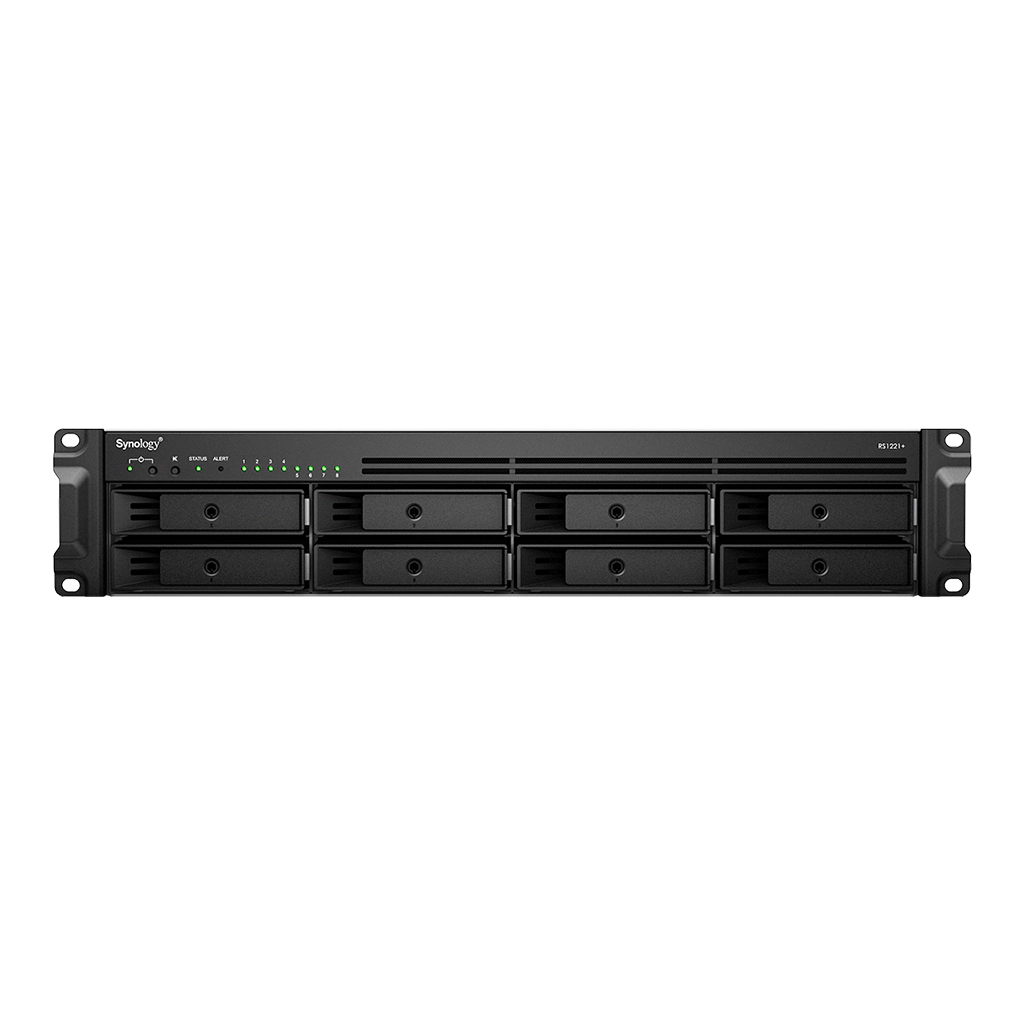
The RS1221+ is an eight-bay rack NAS aimed at small offices or branch deployments that want central storage and backup services without a conventional deep 2U chassis. Its eight hot-swappable trays accept supported 3.5-inch SATA hard drives or 2.5-inch SATA HDDs and SSDs. Synology lists expansion to twelve total bays with one RX418, but the shelf is separate; the base RS1221+ remains an eight-bay unit. Check drive identifiers against the exact compatibility list, and plan for data drives and rail hardware as separate purchases unless the seller specifies otherwise.
Its distinguishing practical advantage over the RS1221RP+ is depth and weight. With ears, Synology lists 88 × 482 × 306.6 mm and 6.9 kg for this standard version, versus 407.5 mm deep and 8.4 kg for the RP unit. The non-RP product page lists four-post mounting with RKM114 or RKS-02 rails and direct two-post installation. Rails are sold separately. A short chassis may ease placement in a shallow rack, but usable depth, rear cable bends, ventilation and rack load limits still need to be checked at the installation site.
Single power supply, with four 1GbE ports
RS1221+ uses one 250-watt power supply. The RP suffix adds redundant supplies, so choose the standard version only when service continuity through a single supply failure is not a required feature. The distinction matters even if both models use RAID: drive redundancy cannot compensate for a failed power supply. The product package list for the standard model includes one AC cord and one C13-to-C14 cord; that differs from the RP version’s two AC cords. Confirm how the included cords match the intended PDU or outlet and verify the seller’s package.
Four built-in RJ-45 ports are rated at 1GbE each. Synology documents compatible 10GbE and 25GbE adapters as optional PCIe upgrades, not built-in ports. If 2.5GbE or faster is a must, compare the installed card and entire wired network path rather than counting the four gigabit links together. The exact product family is also distinct from the newer RS1226+ family, whose standard model includes 2.5GbE ports; a multigig requirement may justify considering that newer platform, but it is not this model’s built-in feature.
Compute and storage features
The V1500B processor has four cores at 2.2 GHz. The RS1221+ ships with 4 GB of DDR4 ECC SODIMM memory, has two memory slots and a listed 32 GB maximum. Synology cautions that memory compatibility and warranty/support treatment can depend on using its validated modules. The documented storage modes include SHR, RAID 1, RAID 5, RAID 6 and RAID 10, while internal volumes can use Btrfs or ext4. A two-drive RAID 1 arrangement is supported, but it uses two drives to store one mirrored set and remains only one layer of data protection.
Unlike some newer DiskStation models, this chassis does not have integrated M.2 slots. Synology documents SSD cache via compatible SATA SSDs or M.2 NVMe drives installed on a compatible PCIe adapter card. The card and drives are additional components, not included bay capacity. The PCIe slot is also the upgrade path for faster Ethernet, so confirm card compatibility and the intended use before assuming both cache and a faster NIC can be installed in one expansion slot.
Synology’s datasheet lists a 108 TB maximum single volume, but this is a system ceiling under its stated configuration rather than a capacity promise. The supported RAID level, drive sizes, metadata and number of populated bays affect usable space. Synology also publishes a sequential read/write claim above 2,315/1,147 MB/s for the family based on internal testing. This assessment did not test throughput; a gigabit client link, small-file workload or slow switch can be the limiting factor well before a vendor’s sequential benchmark.
When this standard version makes sense
Consider RS1221+ when eight native bays and a short rack depth are more important than redundant power, and one built-in gigabit link is enough for the intended path. Its standard operating plan can combine two compatible SATA drives in a mirror, with the remaining bays available for the chosen configuration, but the exact pool expansion process should be confirmed before staging disks. If power redundancy is a hard requirement, RS1221RP+ is the related choice, with a deeper chassis. If four bays and a 1U rack height are enough, RS826+ is smaller vertically but uses a different RX426 expansion unit and is still gigabit at the ports.
Synology’s U.S. Product Support Status observed October 29, 2026 lists RS1221+ as Generally Available, with Full DSM updates, Full Technical Support and a three-year hardware warranty. This is not a guarantee that a retailer has stock or that a bundle preserves the same terms. Check the complete model suffix, supported drives, exact included cords, rail requirements, available rack depth, any add-in card and the plan for an off-device backup before ordering.
Assessment
The RS1221+ combines eight native SATA positions, ECC memory, Btrfs/RAID choices and a particularly short 2U footprint in a well-defined business NAS platform. Its limitations are just as concrete: one supply, four built-in gigabit ports and no integrated M.2 positions. Optional expansion can extend the system, but it increases the number of compatibility and installation decisions. This is a documentation-based review, not a report of personal ownership or a test result.
Primary references: Synology’s U.S. RS1221RP+ / RS1221+ page, the RS1221+ datasheet, its hardware guide, the launch announcement and Synology’s U.S. Product Support Status.
Key specifications
Key details at a glance
| Internal drive bays | 8 bays |
|---|---|
| Documented internal drive media | 3.5-inch SATA HDD / 2.5-inch SATA HDD / 2.5-inch SATA SSD |
| Built-in Ethernet ports | 4 × 1GbE RJ-45 data ports |
| Fastest individual Ethernet port | 1 Gbps |
| Installed system memory | 4 GB |
| Maximum listed memory | 32 GB |
| Listed storage arrangements | Synology Hybrid RAID / Basic / JBOD / RAID 0 / RAID 1 / RAID 5 / RAID 6 / RAID 10 |
| Internal file systems | Btrfs / ext4 |
| Maximum listed single-volume size | 108 TB |
| Dimensions (H × W × D) | 88 × 482 × 306.6 mm (H × W × D, with server ears) |
| Weight | 6.9 kg |
| Manufacturer's idle noise figure | 37.8 dB(A) |
| Hardware warranty | 3 years |
| Data drives included in listed package | No |
| M.2 NVMe slots | 0 |
| Maximum total drive bays with listed expansion | 12 bays |
| Expansion-unit note | 8 native SATA bays plus a separate RX418; not part of the base chassis. |
| Listed expansion unit | RX418 × 1 (sold separately) |
| Processor | AMD Ryzen V1500B |
| CPU cores | 4 |
| CPU threads | 8 |
| Installed memory type | DDR4 ECC SODIMM |
| Single-volume limit condition | The datasheet lists 108 TB maximum single volume. Usable storage and the volume limit depend on drive configuration; this is not raw or user-available capacity. |
Use the exact model’s instructions for operating limits, supplied equipment and version differences.
Sources for this review
Sources for this assessment
- Synology U.S.-language product-list observation
- Synology U.S. RackStation RS1221RP+/RS1221+ product page
- Synology RackStation RS1221+ English datasheet
- Synology RackStation RS1221+ hardware installation guide
- Synology U.S. Product Support Status
- Synology U.S. RackStation RS1221+ and RS1221RP+ launch announcement
- Synology RS1221+ exact-model product-gallery image, sort 1
Check your setup before choosing a NAS
Use the finder to check bay count, the network link you need, and whether a documented two-drive redundant arrangement is essential.