
Your needs, this model
Does it fit your priorities?
How many native data-bay positions does the RS11626xs+ provide?
It has twenty native storage positions: sixteen for 3.5-inch SATA HDDs or 2.5-inch SATA SSDs, plus four dedicated 2.5-inch SATA SSD positions. The two preinstalled M.2 NVMe drives run DSM and are not additional general-purpose bays.
Explore this need in the finder →Is the 116-bay figure available in the base chassis?
No. Twenty positions are native to the RS11626xs+. Up to 116 total requires as many as eight separately purchased RX1222sas shelves and the compatible cabling/topology; check current drive and expansion compatibility.
Explore this need in the finder →Does a two-drive mirror replace a separate backup?
No. Synology lists RAID 1, so two compatible internal data drives can mirror one another. That can help with a single drive failure but does not recover accidental deletion, malware or loss of the whole site; maintain a separate backup.
Explore this need in the finder →Where it fits
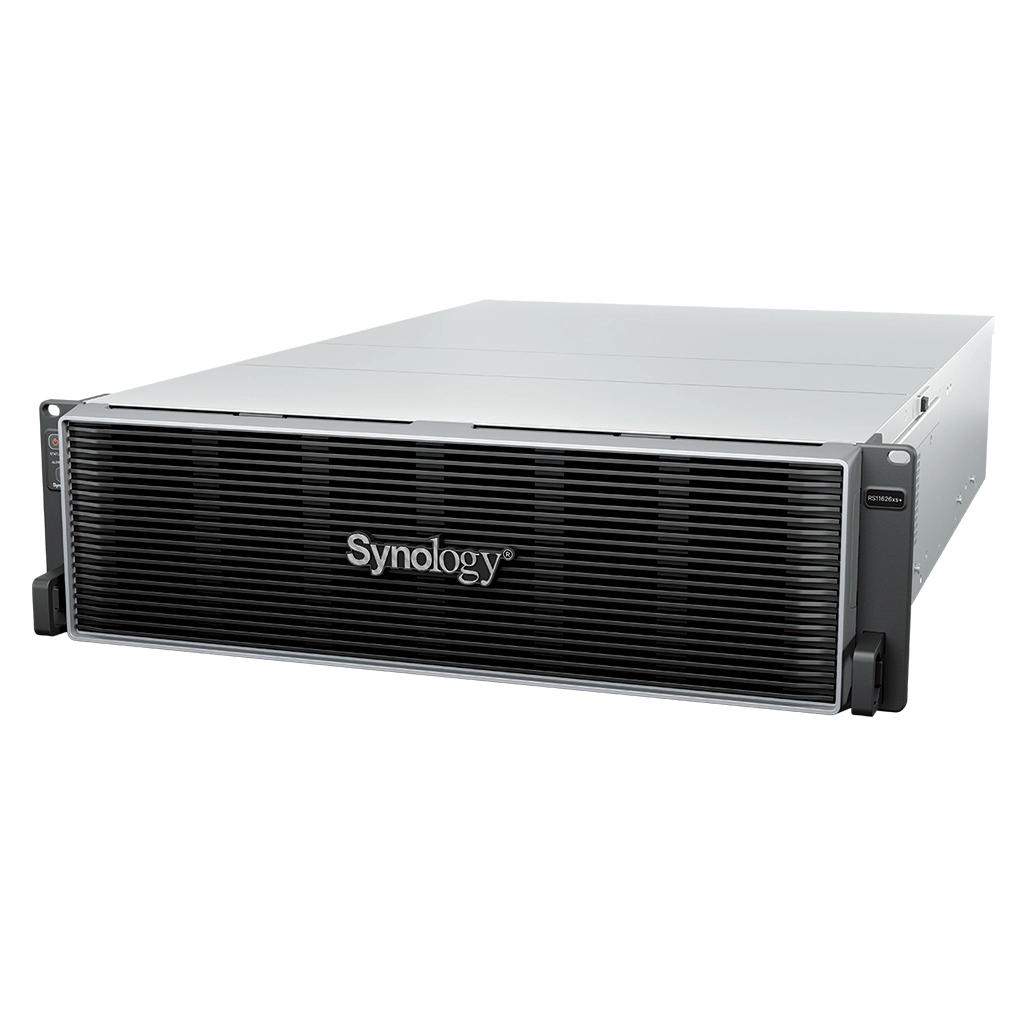
The RackStation RS11626xs+ is a specialized, high-capacity enterprise NAS, not a general-purpose home server. Its defining feature is not simply a large bay count: Synology combines twenty native storage positions with a separate pair of preinstalled M.2 NVMe system drives, dual 10GbE, redundant power and a documented path to multiple expansion shelves. That combination is relevant to organizations planning a sizeable shared-storage platform, virtualization or backup infrastructure and a rack environment that can support it.
Twenty native bays, with two different jobs
Synology specifies sixteen bays for 3.5-inch SATA hard drives or 2.5-inch SATA SSDs, plus four dedicated 2.5-inch SATA SSD bays. The four SSD positions can be used for compatible SSD cache or a separate SSD volume. Separately, two M.2 NVMe SSDs are preinstalled as system drives and run DSM in a mirrored arrangement. Those system drives are not two more general-purpose front bays, and the product page does not establish that they can be repurposed as an ordinary user storage pool. The distinction matters when planning usable storage and when checking what is actually supplied: the M.2 system pair is documented as installed, but the data drives are not included in the standard package.
The base configuration therefore begins with twenty internal storage bays, not the larger number in the expansion headline. Synology lists expansion to 116 total drive positions using as many as eight RX1222sas shelves, sold separately. The hardware guide describes multipath and fan-out layouts and says to verify the exact compatible expansion arrangement. A shelf is an additional equipment, cabling, rack-space and support-planning decision; it does not turn the chassis into a 116-bay unit.
Enterprise compute and the network path
The RS11626xs+ uses an AMD EPYC 7303 with sixteen cores and thirty-two threads. Its starting memory is 64 GB of DDR4 ECC RDIMM, with sixteen slots and a listed ceiling of 1,024 GB. That is a different class of configuration from the eight-core, 16 GB RS6426xs+ and RS4826xs+. It can be a meaningful distinction for workloads that need substantial memory or parallel compute, but published specifications alone do not establish how a particular application will perform.
Two built-in 10GbE RJ-45 ports provide the main wired data links. A separate 1GbE management port is for out-of-band administration, not a third ordinary file-transfer connection. Link aggregation, failover and faster adapter options still depend on compatible switches, client interfaces, cabling and configuration. A 10GbE marking is a port rate, not a promise that every file copy will run at that speed.
Capacity, redundancy and tradeoffs
The model supports DSM file services as well as block-storage and virtualization uses. Synology lists RAID 1 among its supported layouts, so two compatible internal data drives can be assigned as a mirror where that is appropriate. That arrangement can help with one drive failure; it cannot recover files deleted by mistake, protect against malware or replace a separate backup. Synology also documents pairing two RS11626xs+ units for High Availability, which is a distinct, additional system-level design rather than an automatic property of the single appliance.
The manufacturer describes more than 2.6 PB of raw expansion capacity with eight shelves, calculated with specified large drives. Raw capacity is not usable capacity: RAID layout, filesystem overhead, drive compatibility and spare space all change what remains available. The listed single-volume maximum is conditional as well, including a RAID 6-only 1 PB tier. Treat these as architecture limits to verify against the exact DSM and memory configuration, not as a capacity forecast.
At 3U and about 19.7 kg before a full drive population, this is equipment for a properly sized four-post rack, airflow and power plan. The RKS-02 sliding rail kit is separate. The system's size, drive count and vendor-tested noise figure make it a poor fit for a living room or an improvised shelf, even if the intended file workload is modest.
What to verify before choosing it
Confirm whether the need truly requires twenty native bays, the four dedicated SSD positions and the EPYC/RDIMM memory platform. Check full drive model codes against the current RS11626xs+ compatibility list, and budget separately for data drives, rack rails, any RX1222sas shelves, inter-shelf cabling and faster network adapters. Ask the seller to identify the exact unit and package; the available sources do not establish a reseller SKU, included data-drive bundle, current price or stock. For an installation that will rely on the expansion ceiling, map out the supported multipath topology and rack capacity before ordering.
Assessment
The RS11626xs+ stands apart from the other reviewed RackStations through its twenty native bays, preinstalled mirrored M.2 system drives, 16-core EPYC CPU and 64 GB memory baseline, with a much larger documented expansion ceiling. The RS6426xs+ is a less memory- and core-intensive 16-bay alternative; the RS4826xs+ reduces the base to twelve bays in 2U. The older RS4021xs+ also has sixteen bays but uses a different expansion interface and smaller memory ceiling. For the RS11626xs+, the strongest reason to proceed is a deliberate enterprise design that needs its exact combination—not simply the appeal of a large maximum-bay figure.
Key specifications
Key details at a glance
| Internal drive bays | 20 bays |
|---|---|
| Documented internal drive media | 3.5-inch SATA HDD / 2.5-inch SATA SSD |
| Built-in Ethernet ports | 2 × 10GbE RJ-45 data ports / 1 × 1GbE RJ-45 out-of-band management port (not a data port) |
| Fastest individual Ethernet port | 10 Gbps |
| Installed system memory | 64 GB |
| Maximum listed memory | 1024 GB |
| Listed storage arrangements | RAID F1 / Basic / JBOD / RAID 0 / RAID 1 / RAID 5 / RAID 6 / RAID 10 |
| Internal file systems | Btrfs |
| USB 3.2 Gen 1 ports | 2 |
| Maximum listed single-volume size | 1000 TB |
| Dimensions (H × W × D) | 132.3 × 482 × 724 mm (H × W × D, with server ears); 3U |
| Weight | 19.68 kg |
| Manufacturer's idle noise figure | 52.9 dB(A) |
| Hardware warranty | 5 years |
| Data drives included in listed package | No |
| System drives included (not data-bay drives) | 2 × M.2 NVMe SSD, preinstalled as mirrored DSM system drives |
| M.2 NVMe slots | 2 |
| Maximum total drive bays with listed expansion | 116 bays |
| Expansion-unit note | Up to eight RX1222sas expansion units are listed for 116 total positions; the shelves and additional cabling are separate. Follow the model guide's compatible multipath/fan-out topology. |
| Listed expansion unit | RX1222sas × 8 |
| Processor | AMD EPYC 7303 |
| CPU cores | 16 |
| CPU threads | 32 |
| Installed memory type | DDR4 ECC RDIMM |
| Single-volume limit condition | Synology lists 1 PB only for RAID 6 groups and lists lower 200 TB and 108 TB tiers. Volumes above 108 TB require at least 32 GB memory; the manufacturer notes additional conditions for 1 PB. Actual usable capacity varies with drives, RAID and filesystem. |
Use the exact model’s instructions for operating limits, supplied equipment and version differences.
Sources for this review
Sources for this assessment
- Synology U.S. NAS product list, captured directory response
- Synology U.S. RackStation RS11626xs+ product page
- Synology RS11626xs+ English datasheet
- RS11626xs+ Product Manual, chapter 1: package and hardware overview
- RS11626xs+ Product Manual, chapter 2: installation and expansion topology
- Synology America launch announcement for RS11626xs+
- Synology U.S. Product Support Status (rendered table observation)
- Hand-recorded row observation from Synology U.S. Product Support Status
Check your setup before choosing a NAS
Use the finder to narrow documented desk/shelf or rack formats, internal-bay minimums, a single Ethernet-port rating and optional redundancy requirements.