
Your needs, this model
Does it fit your priorities?
What drives should I budget for the PAS7700?
Synology lists 48 hot-swappable 2.5-inch U.3 NVMe SSD positions, and the hardware-guide package contents do not list drives. Check each exact SSD model against the current PAS7700 compatibility list and budget the SSDs separately; do not substitute SATA, SAS or an M.2 NVMe module based on a similar-looking connector or another Synology model.
Explore this need in the finder →Does the two-controller design satisfy a two-drive mirror requirement?
No. The two controllers are an availability architecture, not a two-drive mirror. Synology lists RAID 5, RAID 6 and RAID TP for this model, not RAID 1 or SHR-1. If a two-drive mirrored arrangement is essential, this model does not meet that exact requirement; the listed larger RAID groups still do not replace a separate backup.
Explore this need in the finder →Can I install it on a typical 120 V office circuit?
Do not assume so: Synology specifies 200–240 V AC input. Ask the facilities team to verify the available circuit, connectors, power distribution, redundancy and cooling before ordering. Its listed 1,253.76 W typical and 1,460.64 W full-load consumption are manufacturer test figures, not a measured value for a particular installation.
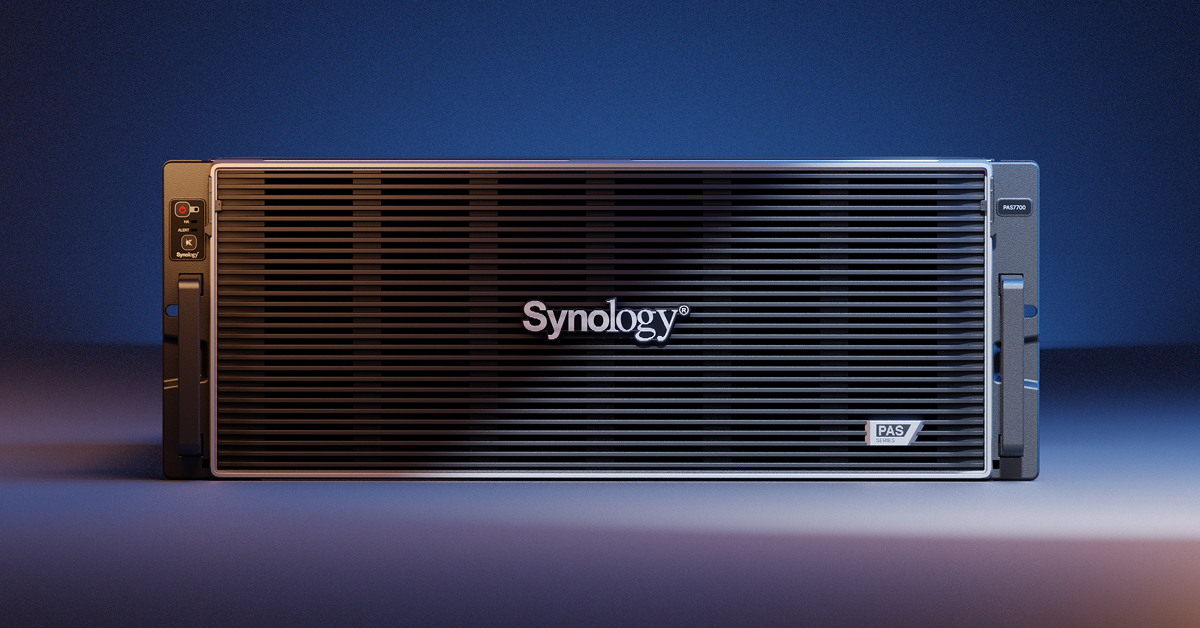
Explore this need in the finder →This is a documentation-based assessment, not a hands-on review. The PAS7700 is NAS-capable, but it is not a conventional home NAS with an unusually large drive count: Synology positions it as a dual-controller enterprise primary-storage system. Its unusually specific requirements—48 U.3 NVMe bays, a 4U rack chassis, dual 10GbE links per controller, and 200–240 V AC input—make infrastructure fit at least as important as capacity.
File storage is one part of a larger enterprise platform
The exact US product page lists SMB and NFS file protocols alongside iSCSI, Fibre Channel and NVMe protocols, so the PAS7700 is a network-attached storage appliance as well as a block-storage platform. Its target is high-performance enterprise primary storage, not simply shared folders and personal backups. Organizations serving different clients from one system should still plan access controls, network design and administration.
Synology lists two controller modules, each with an AMD EPYC 7443P 24-core processor and 64 GB of DDR4 ECC registered memory. That is a per-controller specification. The page describes active-active operation and non-disruptive firmware updates; these vendor-described resilience features do not prove every failure or maintenance event is invisible to applications. Confirm failover behavior for the intended software and workload.
Forty-eight NVMe bays, with a demanding drive plan
The chassis has 48 hot-swappable positions for 2.5-inch U.3 NVMe SSDs. The installation guide's package list includes the main unit, an accessory pack, two C19-to-C20 power cords, a CDFP cable, a front cover, cable ties and 2.5-inch drive screws—but no SSDs. Treat the listed system as diskless and budget for compatible enterprise drives separately. Synology cautions that it guarantees full functionality, reliability and performance only for drives on its compatibility list; confirm each complete drive model and its supported role before ordering dozens of units.
With seven PAX224 expansion units, Synology lists up to 216 total drive bays. That is an expansion ceiling, not the base chassis count, and the seven units are optional equipment. The product page lists RAID 5, RAID 6 and RAID TP; it does not list a two-drive mirror arrangement. RAID 6 or RAID TP can be part of a fault-tolerant array, but that is not the same as a two-drive mirror and it does not make a second independent backup. Preserve a separate backup and recovery design even when the storage pool has drive-failure tolerance.
Maximum single-volume size is listed as 200 TB with 32 GB memory, or 1 PB with 64 GB for RAID 6 and RAID TP groups. The installed memory meets that stated condition, but the 1 PB limit is not a usable-capacity promise: drive mix, supported configuration, RAID overhead and filesystem all matter.
Fast ports are only useful as part of a fast path
Each controller lists two RJ-45 10GbE ports for data networking and a separate 1GbE out-of-band management port. The 1GbE management connection is not a third high-speed storage path. The product page's higher aggregate-connectivity language should not be mistaken for a single client receiving that rate from the base ports: usable throughput depends on the NICs, switches, cables, multipathing or link design, client equipment and workload. Map the full path before paying for a system whose headline value depends on low-latency, high-concurrency access.
The PAS7700 clears a 24-bay-and-10GbE finder scenario, but those numbers alone do not make it a sensible fit. Its native positions take U.3 NVMe SSDs, the package is diskless, and its enterprise architecture brings facility and administration needs that a numeric finder cannot represent.
Rack, power and room planning are essential
The 4U chassis weighs 38.2 kg and measures 175.8 × 480.5 × 771 mm (height × width × depth) with server ears. Synology specifies a four-post 19-inch rack and lists the RKS-02 rail kit in package contents. Check depth, clearance, loaded weight and safe installation before delivery.
Synology specifies 200–240 V AC input, dual 2700 W supplies, 1,253.76 W typical consumption and 1,460.64 W at full loading. Do not assume an ordinary 120 V receptacle is suitable; have facilities verify circuits, connectors, power redundancy and cooling. These are manufacturer figures, not an energy forecast. The 66.1 dB(A) noise value is also not our room measurement; plan location and acoustic isolation. This is not a quiet home-office appliance.
Who should evaluate it—and who should look elsewhere
An IT team consolidating file and block workloads or building an all-flash primary-storage tier has a reason to evaluate its 48 NVMe positions, dual controllers and expansion path. Synology lists a five-year hardware warranty, but that does not establish a support contract, installation service or recovery outcome; confirm the exact regional terms.
For a household, archive, small office or first NAS, the 4U footprint, high-voltage power, heat, noise, compatible-SSD bill and enterprise administration are likely unnecessary. A two-drive desktop NAS is not a performance equivalent, but may be the right class for shared files and scheduled backups.
Checks before ordering
Confirm the exact PAS7700 offer, current US support terms and seller package; the product page does not establish stock or price. Check every U.3 drive against the compatibility list, then document the RAID 6 or RAID TP layout, usable-capacity target and separate recovery copy. Verify the 200–240 V circuit, rack, airflow, cooling, 10GbE path, controller-failover design and staff responsibilities. Fit depends on the installation, not just the bay count.
Key specifications
Key details at a glance
| Internal drive bays | 48 bays |
|---|---|
| Documented internal drive media | 2.5-inch U.3 NVMe SSD |
| Built-in Ethernet ports | 2 × 10GbE RJ-45 data ports per controller / 1 × 1GbE RJ-45 out-of-band management port per controller (not a storage data port) |
| Fastest individual Ethernet port | 10 Gbps |
| Installed system memory | 64 GB |
| Maximum listed memory | 1024 GB |
| Listed storage arrangements | RAID 5 / RAID 6 / RAID TP |
| Internal file systems | Btrfs |
| Maximum listed single-volume size | 1000 TB |
| Dimensions (H × W × D) | 175.8 × 480.5 × 771 (with server ears) |
| Weight | 38.2 kg |
| Manufacturer's idle noise figure | 66.1 dB(A) |
| Hardware warranty | 5 years |
| Data drives included in listed package | No |
| Maximum total drive bays with listed expansion | 216 bays |
| Expansion-unit note | 48 base bays; up to 216 total with seven separate PAX224 expansion units. |
| Listed expansion unit | PAX224 |
| Processor | AMD EPYC 7443P (per controller) |
| CPU cores | 24 |
| Installed memory type | DDR4 ECC RDIMM (per controller) |
| Single-volume limit condition | Synology lists 200 TB with 32 GB memory, or 1 PB with 64 GB for RAID 6 and RAID TP groups; the drive count, array, filesystem, supported configuration and overhead affect usable capacity. |
Use the exact model’s instructions for operating limits, supplied equipment and version differences.
Sources for this review
Sources for this assessment
Check your setup before choosing a NAS
Use the finder to check bay count, the network link you need, and whether a documented two-drive redundant arrangement is essential.