
Your needs, this model
Does it fit your priorities?
What fits the FS2500 internal bays?
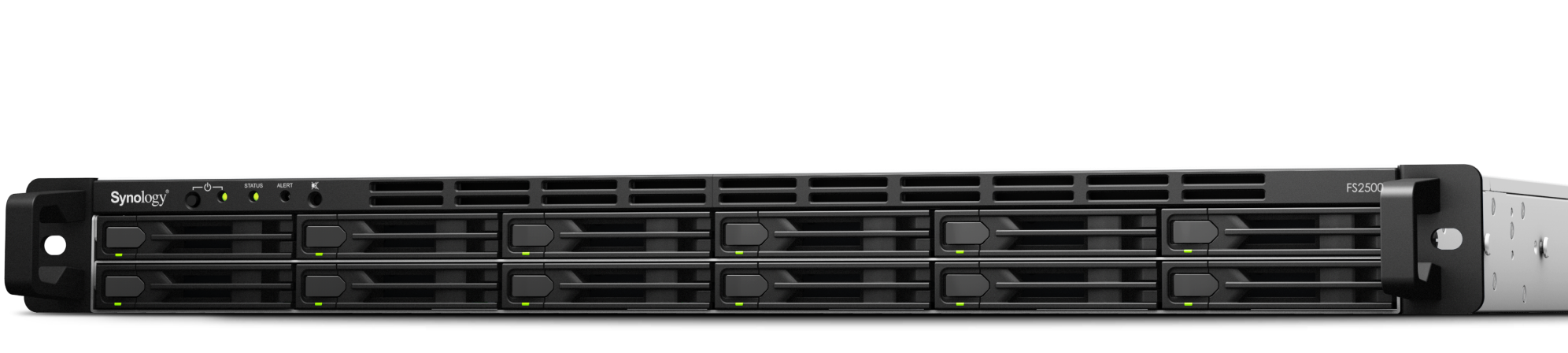
The exact product page specifies twelve hot-swappable 2.5-inch SATA SSD positions. The chassis package does not list SSDs; check every full model code against Synology’s FS2500 drive compatibility list.
Explore this need in the finder →Can its network interface meet a 10GbE requirement?
Yes, the FS2500 includes two built-in 10GbE RJ-45 ports and two 1GbE ports. That is link-rate capability; the switch, client, cabling, drive layout and workload still govern actual transfers.
Explore this need in the finder →Does the FS2500 come ready to mount in a rack?
It is a 1U, four-post rack chassis, but the RKS-01 sliding rail kit is listed separately and the drive package is diskless. Check rack depth, clearance, cooling and the seller’s exact contents.
Explore this need in the finder →The FS2500 is a 1U, 12-bay FlashStation designed for small and midsize business storage, not a desktop NAS. Its compact rack height does not make it a consumer plug-in appliance: the chassis needs compatible 2.5-inch SATA SSDs, rack space, airflow, network planning and a separate backup strategy. It stands out among the observed FlashStation models by combining twelve SATA-SSD positions with two built-in 10GbE ports in a 1U enclosure.
Plan around SATA SSDs and twelve native bays
Synology specifies twelve hot-swappable 2.5-inch SATA SSD positions, and its package list does not include those storage drives. Check each proposed drive’s exact model against the FS2500 compatibility list; the physical fit alone does not establish supported operation. The model supports Btrfs and ext4 internally and lists RAID F1, Basic, JBOD, RAID 0, RAID 1, RAID 5, RAID 6 and RAID 10. RAID 1 can make a two-drive mirror, but it does not protect against a lost NAS or compromised files. Decide how the SSD pool will be arranged, then add a separate backup target and a tested restore plan.
The listed single-volume maximum is 108 TB. Treat that as a software/configuration limit, not a capacity recommendation or a promise that twelve drives produce that much usable space. Drive capacities, RAID overhead, filesystem metadata and snapshots all affect what remains available. Synology also requires compatible components, so do not substitute a drive or add-in card based only on connector type.
Network ports and optional cards
Four built-in Ethernet data ports are listed: two 10GbE and two 1GbE RJ-45. The fastest native link is therefore 10GbE. One PCIe Gen3 x8 slot with an x4 link supports compatible expansion cards, including optional 25/40GbE networking. An add-in card is a separate decision and purchase, not a built-in port. Reaching a higher network rate also requires a suitable switch, cable, client and workload; nominal port speed should not be confused with file-copy performance.
The processor is a four-core AMD Ryzen V1780B. The FS2500 ships with 8 GB of DDR4 ECC UDIMM memory and has a listed maximum of 32 GB across two slots. Those facts matter when the NAS will also host business applications, virtual machines or other DSM services. Synology’s public page promotes a 1U platform with built-in 10GbE and low-latency storage; those descriptions do not remove the need to size memory and storage for the actual workload.
Rack fit, sound and service support
The chassis measures 44 × 481.9 × 555.9 mm and weighs 8.3 kg. Synology specifies a four-post 19-inch rack and lists the RKS-01 sliding rail kit as sold separately. Measure rack depth and clearance before ordering, and plan for airflow and maintenance access. The official noise figure is 57.6 dB(A) in a test with Synology SSDs installed and the system idle. It is a warning to keep a rack appliance away from a quiet living area, not a measurement of every rack, drive or load.
Synology lists a 74.83-watt access-state power figure and a five-year limited warranty. Its US support-status table currently shows the FS2500 as generally available with full DSM updates and technical support. That information describes manufacturer status, not seller inventory or the terms of a specific offer. The package contents list two AC power cords and an accessory pack; do not assume the drives or rail hardware are bundled.
How it differs from other FlashStations
The FS2500 is smaller in bay count and rack height than the 24-bay FS3600, FS3420 and FS3410. Its 12 positions remain native internal bays; optional network cards do not increase them, and no external drive-shelf expansion path is listed for this model. Compared with the compact FS200T, it uses a 1U rack chassis with twelve SATA SSD bays and dual 10GbE ports, while the FS200T is a six-bay desktop system with 2.5GbE and 1GbE networking.
For a business that genuinely needs a dozen compatible SATA SSDs, a 10GbE path and rack installation in a shallow single unit, the FS2500 is a focused option to evaluate. It is not automatically the right choice for a home user, a SAS drive plan, or a buyer hoping for included storage. Before selecting an offer, confirm its exact model and diskless status, drive compatibility, the separate RKS-01 rail kit, network path, installed memory needs, warranty terms and where an independent backup copy will live.
Key specifications
Key details at a glance
| Internal drive bays | 12 bays |
|---|---|
| Documented internal drive media | 2.5-inch SATA SSD |
| Built-in Ethernet ports | 2 × 10GbE RJ-45 data ports / 2 × 1GbE RJ-45 data ports |
| Fastest individual Ethernet port | 10 Gbps |
| Installed system memory | 8 GB |
| Maximum listed memory | 32 GB |
| Listed storage arrangements | Synology Hybrid RAID / Basic / JBOD / RAID 0 / RAID 1 / RAID 5 / RAID 6 / RAID 10 |
| Internal file systems | Btrfs / ext4 |
| USB 3.2 Gen 1 ports | 2 |
| Maximum listed single-volume size | 108 TB |
| Dimensions (H × W × D) | 44 × 481.9 × 555.9 (H × W × D) |
| Weight | 8.3 kg |
| Manufacturer's idle noise figure | 57.6 dB(A) |
| Hardware warranty | 5 years |
| Data drives included in listed package | No |
| Expansion-unit note | No drive-shelf bay expansion is listed for FS2500; the PCIe slot is an optional card path, not added internal drive positions. |
| Processor | AMD Ryzen V1780B |
| CPU cores | 4 |
| CPU threads | 8 |
| Installed memory type | DDR4 ECC UDIMM |
| Single-volume limit condition | Synology lists 108 TB maximum per internal volume; usable capacity depends on compatible SSDs, RAID and metadata. |
Use the exact model’s instructions for operating limits, supplied equipment and version differences.
Sources for this review
Sources for this assessment
Check your setup before choosing a NAS
Use the finder to check bay count, the network link you need, and whether a documented two-drive redundant arrangement is essential.