
Your needs, this model
Does it fit your priorities?
Does DVA7400 work as a NAS as well as a camera recorder?
Synology's US product FAQ says the DVA series supports most features found on other Synology NAS and can access Package Center. The DVA7400 spec also lists SMB, NFS, FTP and WebDAV file protocols. That makes it a NAS-capable NVR, not a claim that every DiskStation feature or third-party package works identically; confirm the exact file-sharing and backup packages you rely on.
Explore this need in the finder →Are 100 camera licenses included with DVA7400?
No. Synology lists support for up to 100 IP cameras, but the included default is two Surveillance Device Licenses. Additional cameras and surveillance devices require additional licenses. The usable camera count and analytics load also depend on camera format, recording settings, installed drives and other active work.
Explore this need in the finder →What are the main setup checks for the DVA7400?
Plan a ventilated 2U rack, two power connections, compatible SATA drives, a 10GbE-capable wired path if you need the built-in faster ports, and the correct camera licenses. The product page lists the unit, accessory pack, two AC cords and quick-install guide; it does not list drives or cameras. Confirm rail hardware and every disk/camera model against the exact compatibility resources before ordering.
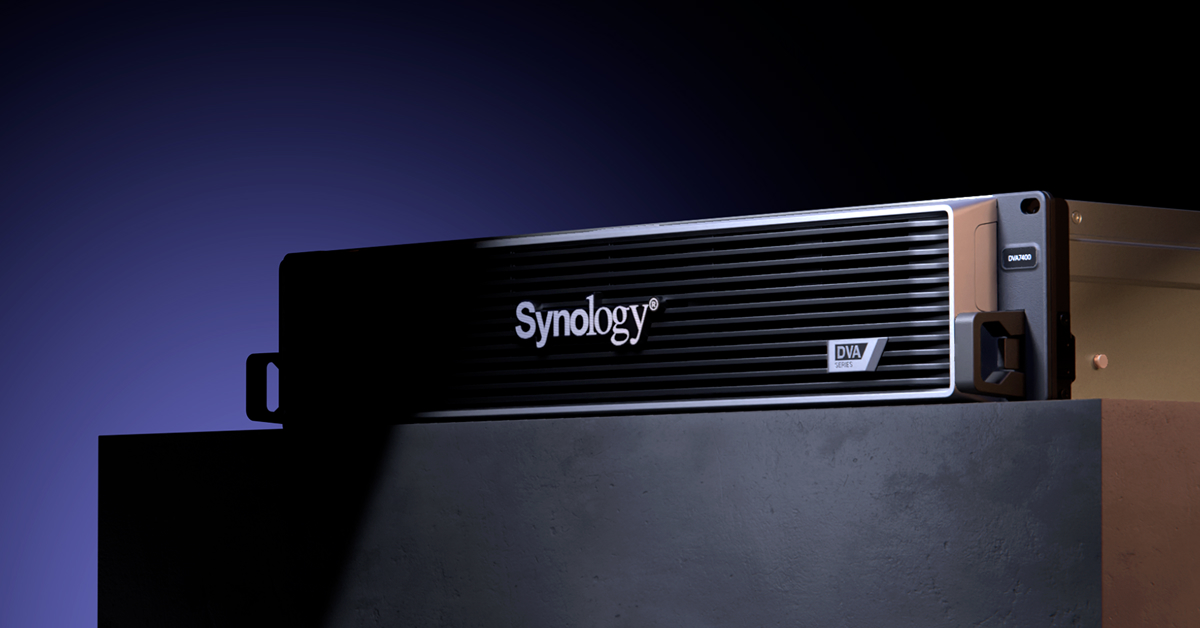
Explore this need in the finder →This is a documentation-based assessment, not a hands-on review. Synology identifies the DVA7400 as a 12-bay rackmount network video recorder, then adds a useful qualification: DVA-series appliances support most—not all—of the features found on its other NAS systems. That makes the DVA7400 a surveillance-first storage appliance with NAS capabilities, not a general-purpose NAS dressed up with an extra camera app.
A surveillance-first system that can also serve files
The model is aimed at dense monitoring deployments: the product page lists support for up to 100 IP cameras and 40 simultaneous real-time analytics tasks. Its published file services include SMB, NFS, FTP and WebDAV, while Btrfs is listed for the internal drives. For an organization that wants footage retention and some regular file services on the same machine, the combination is relevant. The manufacturer does not claim that every DSM feature or Package Center add-on runs on every DVA configuration, so a buyer should validate the exact backup, collaboration and retention packages before treating it as interchangeable with a DiskStation.
The processor is an AMD V1780B quad-core part, and the standard memory listing is 16 GB of DDR4 ECC UDIMM with a stated maximum of 32 GB. That is a different class of hardware and deployment from the compact, non-ECC DVA1622. Published camera and account limits are configuration ceilings, not promises of responsiveness under every workload.
Twelve bays and two built-in 10GbE data ports
The chassis provides twelve SATA positions for 3.5-inch hard drives or 2.5-inch SATA SSDs. Drives are sold separately; the listed package contains the unit, an accessory pack, two power cords and a quick-install guide. Its two 10GbE RJ-45 data ports sit alongside a separate out-of-band management port. A 10GbE link only helps if the switch, cabling, client and workload can use it.
Synology lists Basic, SHR, RAID 0, RAID 1, RAID 5, RAID 6 and RAID 10. A two-drive RAID 1 mirror is a real option; larger pools may use other supported layouts. Plan the disk count, layout, compatibility and resulting usable capacity together. A mirror can keep a service operating through a single drive failure, but it does not create a second independent copy. A separate backup or off-site retention plan is still needed.
The listed maximum single-volume size is 108 TB, with 200 TB also stated when the system has 32 GB of memory. That conditional figure should not be read as usable capacity from a twelve-disk pool: actual capacity is reduced by the array layout and filesystem, and the maximum depends on the chosen drives. Synology's specification also describes dual power supplies and replaceable fans, useful serviceability details for a rack, but not substitutes for a power-protection and recovery plan.
Camera counts and licenses need a separate budget
The upper limit is not the included camera count. Synology lists two default Surveillance Device Licenses and says additional cameras require extra licenses. The page's maximum of 100 IP cameras therefore describes a system ceiling under supported conditions, not a 100-camera bundle. It also lists up to 40 real-time analytics tasks, but codec, resolution, drive performance, enabled features and concurrent services affect the actual workload. Ask the installer to map the intended camera models and recording settings to the current compatibility list and system limits before buying hardware.
Some newer advertised functions also need careful checking. The product page states that Semantic Video Search would not be available at initial release and would be enabled in a future update. That wording does not establish that the update is currently installed or available in a particular region. Treat it as a feature to verify in current software documentation, rather than as an assured reason to choose the appliance.
Where it fits—and where it is too much
A campus, warehouse or multi-site operator that needs a rack-mounted recording hub, local AI analysis, high-bandwidth file access and many drive positions has a coherent reason to evaluate this model. Its Surveillance Station integration and multi-site management address a different problem from choosing a two- or four-bay home NAS. Privacy, retention and access-control policy still depend on the deployment.
For a quiet home office, a simple file share or a small camera setup, the DVA7400 may be an awkward fit. It is a 2U rack appliance weighing 12.24 kg, and Synology's stated 51.8 dB(A) noise figure was measured with installed SATA SSDs in the idle state under a specified one-meter test setup. Its published access power figure is 131.12 W under manufacturer test conditions. These are useful planning references, not promises for every rack or a prediction of the energy bill. Rack space, airflow, power, drive cost and acoustic isolation deserve attention before considering the headline camera capacity.
DVA7400 versus the smaller DVA1622
The DVA1622 is a two-bay desktop unit with one 1GbE port, 6 GB of non-ECC memory and HDMI for a directly attached display. It includes eight camera licenses and supports up to 16 camera feeds with additional licenses, a more modest home or shop scale. DVA7400 instead brings twelve bays, dual 10GbE data ports, ECC memory and a much higher surveillance ceiling, along with more rack, storage and licensing work. This is a difference in operating scale and package economics, not merely a faster version of the same home NAS.
Checks before ordering
Confirm that the exact listing is DVA7400 rather than another NVR, that the enclosure is diskless or bundled exactly as stated, and whether the seller includes any rail hardware. Match every intended drive and camera model to Synology's current compatibility information; verify the number of paid licenses, analytics workload, retention target and needed NAS packages. Decide what array will be built and where its independent backup will live. Finally, check the rack's depth, ventilation, power circuits and noise tolerance. The manufacturer's figures describe a capable surveillance appliance, but they do not validate an individual camera system or guarantee a particular network transfer rate.
Key specifications
Key details at a glance
| Internal drive bays | 12 bays |
|---|---|
| Documented internal drive media | 3.5-inch SATA HDD / 2.5-inch SATA SSD |
| Built-in Ethernet ports | 2 × 10GbE RJ-45 |
| Fastest individual Ethernet port | 10 Gbps |
| Installed system memory | 16 GB |
| Maximum listed memory | 32 GB |
| Listed storage arrangements | Synology Hybrid RAID / Basic / JBOD / RAID 0 / RAID 1 / RAID 5 / RAID 6 / RAID 10 |
| Internal file systems | Btrfs |
| USB 3.2 Gen 1 ports | 2 |
| Maximum listed single-volume size | 200 TB |
| Dimensions (H × W × D) | 88 × 482 × 578 |
| Weight | 12.24 kg |
| Manufacturer's idle noise figure | 51.8 dB(A) |
| Hardware warranty | 3 years |
| Data drives included in listed package | No |
| Processor | AMD V1780B |
| CPU cores | 4 |
| Installed memory type | DDR4 ECC UDIMM |
| Single-volume limit condition | The 200 TB single-volume maximum requires 32 GB of memory; 108 TB is also listed. |
Use the exact model’s instructions for operating limits, supplied equipment and version differences.
Sources for this review
Sources for this assessment
Check your setup before choosing a NAS
Use the finder to check bay count, the network link you need, and whether a documented two-drive redundant arrangement is essential.