
Your needs, this model
Does it fit your priorities?
What does an eight-bay count mean on TVS-h877AX-R5-16G-US?
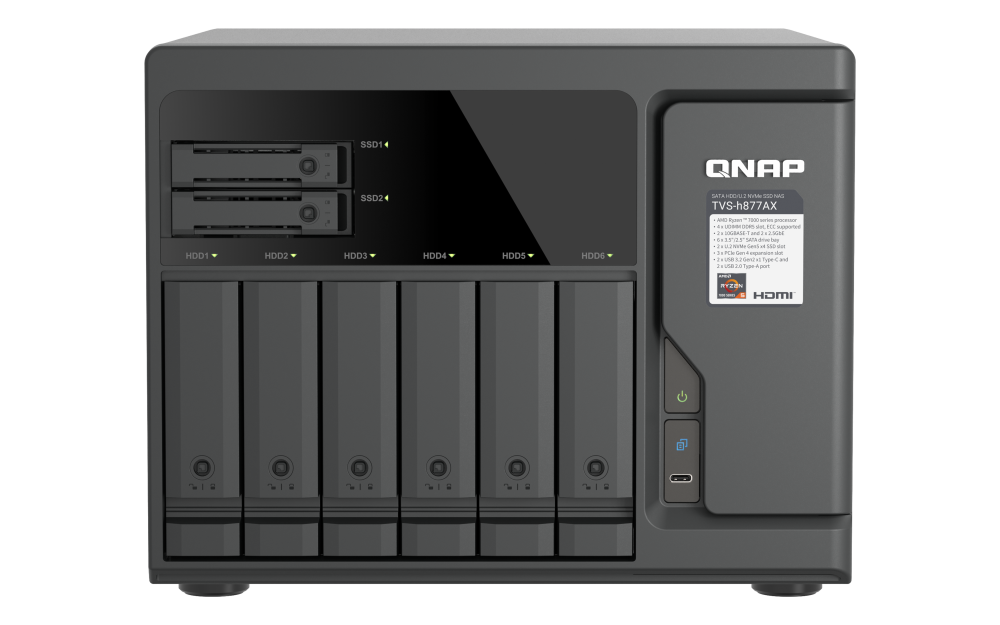
QNAP's exact U.S. selector lists six 3.5-inch SATA positions plus two separate 2.5-inch U.2 NVMe PCIe Gen 4 x4 positions. The larger positions support the listed 3.5-inch SATA HDDs or 2.5-inch SATA SSDs; the smaller positions require U.2 NVMe PCIe Gen 4 or Gen 5 drives. U.2 drives must be installed before startup for post-boot hot swapping. Eight counts physical positions, not interchangeable media, included drives or usable capacity; confirm each intended drive and firmware in QNAP's compatibility list.
Explore this need in the finder →Does its built-in Ethernet satisfy a 10-Gbps single-port floor?
Yes. QNAP lists two built-in 10GBASE-T ports, so one port meets a 10-Gbps link-rating minimum. The next configured half-step, 10.5 Gbps, is above the fastest built-in port. Optional 25GbE needs a separately selected compatible adapter and PCIe slot planning; two 10GbE ports are not one 20Gbps connection, and port rating is not measured file-transfer speed.
Explore this need in the finder →Can this profile be configured for two-drive redundancy?
QNAP's exact QTS and QuTS hero selector tables each list RAID 1 for the eight-position model, and QNAP's setup guidance says the administrator selects the disks and RAID type when creating a pool. Choose one OS and two separately selected compatible SATA drives in the six larger positions, then create the mirror. The manufacturer package list includes no data drives or configured array. Verify the exact drives first; RAID 1 is not a separate backup.
Explore this need in the finder →Does choosing to include earlier models change this assessment?
No. The QNAP U.S. product page and exact Official Store title identify the TVS-h877AX-R5-16G-US profile as a current-reference package in this review. The history setting does not change its eight mixed SATA/U.2 positions, one-port 10GbE maximum or owner-configured RAID requirement. It also says nothing about a seller's current stock or box additions.
Explore this need in the finder →The TVS-h877AX-R5-16G-US is a desktop hybrid NAS with a less uniform layout than its eight-position label suggests. QNAP's U.S. selector identifies one R5-16G hardware profile, and the Official Store uses the exact -US model suffix. This assessment follows those documents; it is not a hands-on test, and the seller's live offer state or any added bundle is not a product specification.
The eight positions are two different drive plans
QNAP lists six 3.5-inch SATA positions and two separate 2.5-inch U.2 NVMe positions. The larger bays are specified for SATA hard drives or SATA solid-state drives. The two U.2 slots require U.2 NVMe SSDs using PCIe Gen 4 or Gen 5. That split matters more than the headline count: a buyer cannot treat all eight slots as universal trays or assume one set of drives fits every position. No exact compatible drive-and-firmware rows were verified for this assessment, so check QNAP's model-filtered list for each intended drive before ordering.
There is also a service wrinkle. QNAP says U.2 drives must be installed before the NAS starts if they are to be hot-swapped after startup. An U.2 SSD first inserted while the machine is running needs shutdown before it can be replaced. Plan the initial U.2 installation and any future service around that rule; do not infer that every bay has identical hot-swap behavior from the front-panel appearance.
One memory package, two alternative operating systems
The reviewed R5-16G profile lists 16 GB of DDR5 UDIMM memory, described on QNAP's product page as a single non-ECC module as equipped. The hardware selector lists four memory slots, up to 192 GB, and optional ECC support; it also calls for matched DDR5 modules in dual-DIMM configurations. Those ceilings are not proof that a particular upgrade kit is supported, so verify the exact module and delivered hardware revision before upgrading. QNAP's feature copy calls the processor a Ryzen 5 PRO 7000-series part, while the selector says Ryzen 5 7000 series; both describe six cores, twelve threads and up to 5.1 GHz, but neither source resolves an exact CPU SKU.
The selector presents QTS with EXT4 and QuTS hero with ZFS as separate choices. Both software tables list RAID 1 for this eight-position model, but the operating systems are alternatives, not simultaneous plans. QNAP's setup guidance describes the administrator selecting disks and a RAID type when building a storage pool, so a mirror is something the buyer configures with two compatible drives. The package list includes the NAS, a 10GBASE-T cable, power cord, screws, tray keys and a quick-start guide—not data drives or a factory-created array. A mirror may help with a drive failure; it is not an independent backup against deletion, malware, theft or loss of the whole chassis.
Fast built-in networking does not make the whole path fast
There are two built-in 10GBASE-T ports and two 2.5GbE ports. For someone who needs a single built-in port rated at 10 Gbps, the base profile meets that threshold. A 25GbE connection is optional through a compatible expansion card, not a built-in port. The three PCIe Gen 4 slots give the system room to add network or other cards, but the manufacturer describes shared slot-width constraints and card-size limits; check the exact card and slot combination before committing to an expansion plan.
Port line rates are not transfer guarantees. A 10GbE workflow still needs a compatible client, switch or direct link, suitable cabling, correctly configured storage, and a workload that can use the path. QNAP's showcased lab figures use an upgraded-memory test system, three optional 25GbE adapters, named SSDs, a particular operating system and a defined workload. Those figures illustrate a configured test, not what the diskless R5-16G package will deliver in a different setup.
Compared with the larger TVS hybrid towers
The TVS-h877AX has six SATA plus two U.2 positions. QNAP's TVS-h1277AX uses eight SATA plus four U.2 positions, while the TVS-h1677AX uses twelve SATA plus four U.2 positions. Their family layouts therefore suit different media mixes and growth plans, even where the product pages share a Ryzen/DDR5, 10GbE and PCIe-generation theme. The h877AX is the smaller documented chassis in this group at 8.86 × 11.53 × 12.59 inches and 19.58 lb net. Those are enclosure measurements, not the clearance needed to route cables, pull trays or keep airflow unobstructed.
That comparison cuts both ways: if most of the planned capacity is in conventional SATA disks, the h1277AX or h1677AX offers more of those larger positions. If the intended workload specifically benefits from the h877AX's two U.2 Gen 4 x4 slots, six larger SATA positions may be an appropriate compromise. The choice should follow the actual drive list and expected growth, not just a total-bay number.
Who should put it on a shortlist?
Consider this configuration when the desktop footprint, two built-in 10GbE ports, DDR5 platform and deliberate SATA/U.2 mix all fit the plan—and when someone is prepared to select compatible drives, choose one operating system, create storage, and maintain a separate backup. It is a poor fit for a buyer who expects eight interchangeable SATA bays, a supplied drive set, preconfigured redundancy or built-in 25GbE. Before purchase, confirm the exact TVS-h877AX-R5-16G-US suffix, the actual seller package, QNAP's drive/firmware rows, the U.2 installation procedure, memory-module support and the capacity of the whole network path. No price or availability claim is made here.
Key specifications
Key details at a glance
| Internal drive bays | 8 bays |
|---|---|
| Documented internal drive media | 3.5-inch SATA hard disk drives in the six 3.5-inch positions / 2.5-inch SATA solid-state drives in the six 3.5-inch positions / 2.5-inch U.2 NVMe solid-state drives using PCIe Gen 4 or Gen 5 in the two U.2 positions |
| Built-in Ethernet ports | 2 x built-in 10GBASE-T RJ45 / 2 x built-in 2.5GbE RJ45 |
| Fastest individual Ethernet port | 10 Gbps |
| Installed system memory | 16 GB |
| Maximum listed memory | 192 GB |
| Listed storage arrangements | QTS: RAID 1 from two selected compatible drives; the 8-bay-and-larger table also lists RAID 0, 5, 6, 10, 50 and 60 / QuTS hero: RAID 1 from two selected compatible drives; the 8-bay-and-larger table also lists RAID 0, 5, 6, 10, 50, 60, Triple Mirror and Triple Parity |
| Internal file systems | EXT4 (QTS alternative) / ZFS (QuTS hero alternative) |
| Hardware warranty | 5 years |
| Data drives included in listed package | No |
| Processor | AMD Ryzen 5 PRO 7000 series (QNAP product feature text); AMD Ryzen 5 7000 series (U.S. hardware selector) |
| CPU cores | 6 |
| CPU threads | 12 |
| Installed memory type | 16 GB UDIMM DDR5 (product feature text: 1 x 16 GB, non-ECC as equipped; optional ECC support listed) |
Use the exact model’s instructions for operating limits, supplied equipment and version differences.
Sources for this review
Sources for this assessment
- TVS-h877AX — QNAP U.S. product page
- TVS-h877AX-R5-16G rendered hardware, software and package selectors — QNAP U.S.
- Getting started with NAS storage — QNAP U.S.
- QNAP Compatibility List filtered to TVS-h877AX
- TVS-h877AX-R5-16G-US — QNAP U.S. Official Store
- SMB Desktop category, page 2 — QNAP U.S. Official Store
- Tower / SMB product grid — QNAP U.S.
- TVS-h877AX front image — QNAP U.S. product page

Check your setup before choosing a NAS
Use the finder to narrow documented desk/shelf or rack formats, internal-bay minimums, a single Ethernet-port rating and optional redundancy requirements.