
Your needs, this model
Does it fit your priorities?
How many native drive positions does the exact h874X i9 package have?
QNAP lists eight native 3.5-inch SATA positions. The two M.2 2280 NVMe sockets are separate from the front bays. The current selector lists SATA HDDs and 2.5-inch SATA SSDs; check exact drive models and firmware in QNAP’s compatibility list before ordering.
Explore this need in the finder →Does this h874X profile meet a 10-Gbps single-port floor?
Yes. QNAP lists two built-in 10GBASE-T ports, so one individual port meets a 10-Gbps link-rating minimum. A 10.5-Gbps single-port floor exceeds its fastest documented base port; the two jacks do not add into one 20-Gbps connection.
Explore this need in the finder →Can the owner configure a two-drive redundant arrangement?
QNAP’s eight-bay software tables include RAID 1 under either the QTS or QuTS hero profile. Choose two compatible SATA drives, select one OS and create the pool; no data drives or prebuilt mirror are listed in the standard contents. Maintain a separate backup.
Explore this need in the finder →What does the X profile add over the non-X i5/i7 packages?
The U.S. selector lists two built-in 10GBASE-T ports, a preinstalled 10GbE card, a 16-core/24-thread Core i9 selector profile and 64 GB starting memory for the X i9. The non-X i5/i7 profiles list built-in 2.5GbE and optional faster PCIe networking. The X selector is labelled “By Request”; verify the exact order and delivered terms.
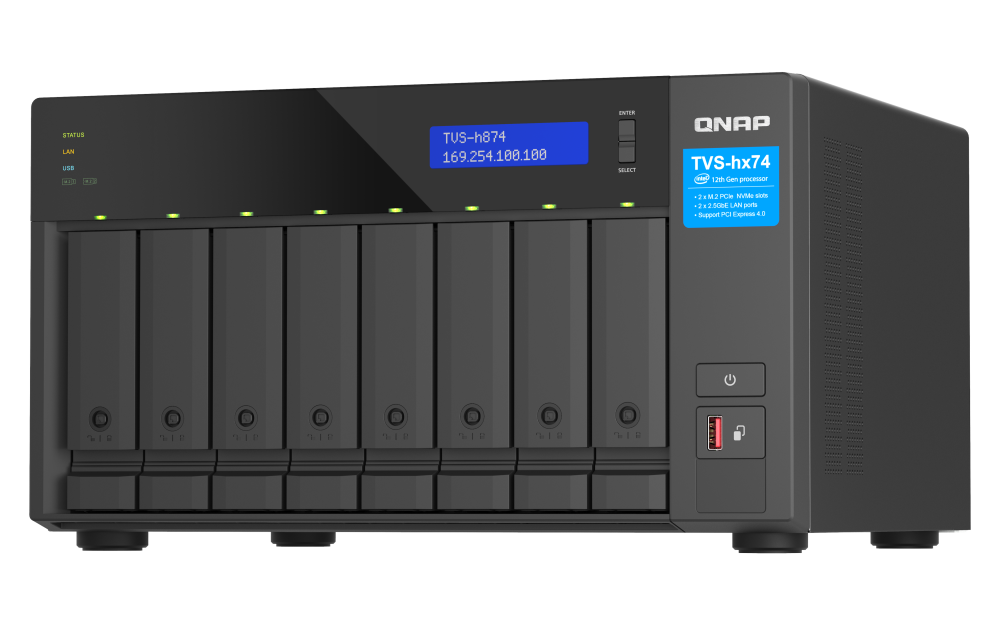
The TVS-h874X-i9-64G-US is the high-memory, built-in-10GbE member of QNAP's TVS-h874 selector family. The “X” and full i9-64G suffix matter: QNAP's U.S. selector labels this profile “By Request” and lists a 16-core/24-thread Core i9, 64 GB of DDR4 memory and two 10GBASE-T ports. The exact U.S. Store page displays the -US SKU, but neither a model page nor a search result settles present stock or the contents of a future seller offer. This is a source-based assessment, not an independent benchmark or use report.
Why the X configuration is not just an i7 upgrade
All three TVS-h874 selector profiles have eight native 3.5-inch SATA positions and two separate M.2 2280 PCIe Gen 4 x4 NVMe sockets. The i5 and i7 packages start with 32 GB and two built-in 2.5GbE ports; their faster networking is described as an optional PCIe card. The TVS-h874X-i9-64G starts with 64 GB, reaches the same 64 GB listed maximum, and includes two built-in 10GBASE-T ports alongside two 2.5GbE ports. QNAP describes the 10GbE NIC as preinstalled in a PCIe position. That is a meaningful purchase difference for a network path which needs a 10-Gbps built-in port, while the number of native SATA bays stays eight.
The hardware selector specifies an Intel Core i9 with 16 cores (8 performance and 8 efficiency) and 24 threads. QNAP's older series guide also identifies the X profile separately and lists a higher burst-frequency row, but the current selector does not give a processor part number. This is enough to distinguish the published profile; it is not a promise that a particular virtualization or video workload will perform at a given rate. No lab results or independent throughput testing are claimed here.
Eight SATA positions, two additional NVMe sockets
QNAP's current selector lists 3.5-inch SATA hard drives and 2.5-inch SATA solid-state drives in the eight front positions. It describes the two M.2 sockets separately and says M.2 SSDs are not hot-swappable. The English-U.S. guide also names 2.5-inch SATA hard drives among bay media, so confirm the exact drive and firmware on the manufacturer's compatibility list before treating that format as a supported purchase. Do not count the M.2 connectors as extra hot-swap bays or add an optional expansion enclosure to the chassis's native count.
Both QTS (EXT4) and QuTS hero (ZFS) appear as alternative software choices in QNAP's selector. Its eight-bay software tables include RAID 1 under each. An owner still has to choose a system, select two compatible drives and create the mirror; the standard guide's package list does not include data drives or a ready-made array. QNAP warns that changing between the two operating systems resets the NAS and deletes data. A mirror may help keep data available after one member failure, but it cannot replace an independent backup or recovery plan.
10GbE still needs a complete network
Either built-in 10GBASE-T jack meets a 10-Gbps minimum for one individual port. That does not make two jacks into one 20-Gbps client connection, and it does not mean a file copy will reach 10Gbps. The switch or router, peer NIC, cabling, storage arrangement and workload all remain part of the path. The 2.5GbE ports are separate interfaces with their own use cases. A 10.5-Gbps requirement for a single built-in port would be above the documented 10GbE ceiling, so do not read the second port or optional PCIe products as a 10.5-Gbps base interface.
There are two PCIe positions, with a 10GbE card preinstalled in one according to QNAP's selector. The other slot and available width must be checked against any optional storage or network card. QNAP lists two Type-A and one Type-C USB 3.2 Gen 2 ports, an HDMI 1.4b output and two M.2 sockets, but this is a desktop tower, not a rackmount chassis. Expansion choices should be confirmed together rather than treated as independent upgrades with unlimited clearance.
Check the footprint and the “By Request” identity
QNAP lists one 350W supply and a three-year standard warranty for this profile; the wattage is not a measured power-consumption result or redundant power. The selector gives HWD dimensions of 7.09 × 12.96 × 11.01 inches and says the feet are excluded, with as much as 1.18 inches of added foot-pad height depending on model. The English-U.S. guide groups the h874 X profile in a different dimensions table, so the listed chassis height does not agree cleanly across those documents. For a close shelf fit, verify the exact hardware revision and leave room for airflow and service. The “By Request” label is also a reason to confirm the exact TVS-h874X-i9-64G-US ordering identity, warranty and written contents before payment; a similar non-X SKU has different built-in networking.
The selector's net-weight figure is 16.18 lb; the English-U.S. guide's shared h874 row prints 7.06 kg (20.79 lb), whose paired units do not agree. If the shelf has a tight load limit, obtain a revision-specific weight from QNAP instead of treating either source figure as definitive.
Verdict
The TVS-h874X-i9-64G-US is the distinct fit when eight native SATA positions, two M.2 sockets, 64 GB of starting memory and a 10GbE built-in port are each relevant. Its principal advantage over the non-X i5 and i7 profiles is not a higher bay count but the preinstalled dual-10GbE path and the i9/64G specification. It retains the same key ownership tasks: validate exact disks and firmware, choose one OS, configure storage yourself, build a separate backup, and check the network end to end. The Store identity and “By Request” selector do not prove current availability or retailer additions, and no actual performance result is inferred.
Key specifications
Key details at a glance
| Internal drive bays | 8 bays |
|---|---|
| Documented internal drive media | 3.5-inch SATA HDDs in eight native positions / 2.5-inch SATA SSDs in eight native positions |
| Built-in Ethernet ports | 2 x built-in 2.5GbE RJ45 / 2 x built-in 10GBASE-T RJ45 |
| Fastest individual Ethernet port | 10 Gbps |
| Installed system memory | 64 GB |
| Maximum listed memory | 64 GB |
| Listed storage arrangements | QTS eight-bay class: RAID 1 is listed among supported layouts / QuTS hero eight-bay class: RAID 1 is listed among supported layouts |
| Internal file systems | EXT4 (QTS alternative) / ZFS (QuTS hero alternative) |
| Hardware warranty | 3 years |
| Data drives included in listed package | No |
| M.2 NVMe slots | 2 |
| Processor | Intel Core i9 selector tier; exact CPU part number not listed in the current U.S. selector |
| CPU cores | 16 |
| CPU threads | 24 |
| Installed memory type | 64 GB DDR4 SODIMM; the U.S. guide lists 2 x 32 GB |
Use the exact model’s instructions for operating limits, supplied equipment and version differences.
Sources for this review
Sources for this assessment

Check your setup before choosing a NAS
Use the finder to narrow documented desk/shelf or rack formats, internal-bay minimums, a single Ethernet-port rating and optional redundancy requirements.