
Your needs, this model
Does it fit your priorities?
How many internal drive bays does this exact i7 package have?
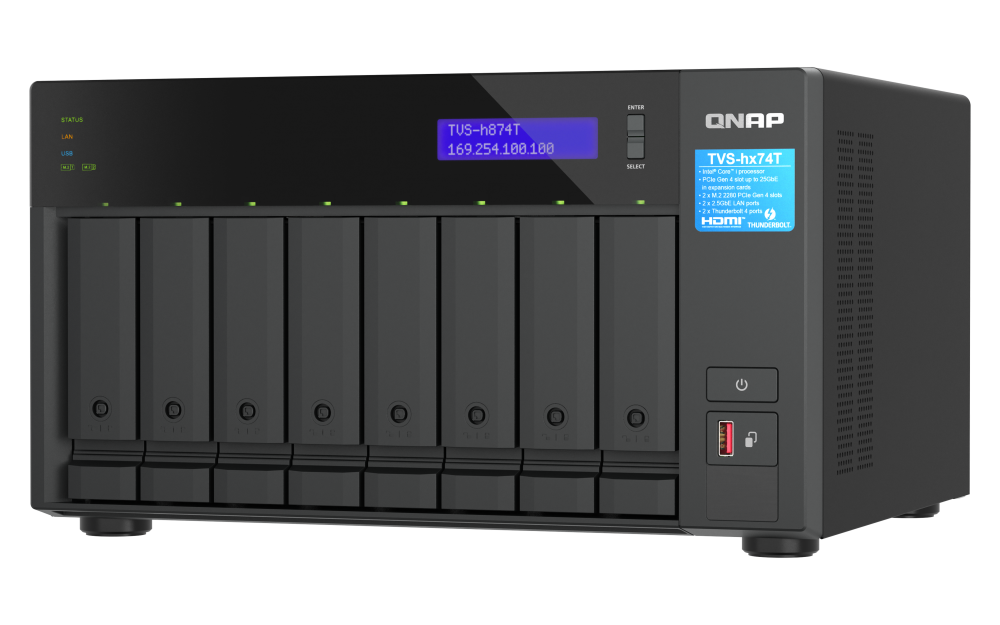
QNAP's U.S. selector lists eight native 3.5-inch SATA positions for 3.5-inch SATA HDDs or 2.5-inch SATA SSDs. The two M.2 2280 NVMe sockets are separate and are not extra hot-swappable bays. QNAP's current TVS-h874T family list names exact HDD, SATA SSD and M.2 drive/firmware entries; match the chosen part and firmware before ordering. Those rows do not establish what a reseller includes.
Explore this need in the finder →Does this package clear a 2.5GbE single-port floor?
Yes. QNAP lists two built-in 2.5GbE ports, so one individual port meets a 2.5Gbps link-rating minimum. The next half-step, 3Gbps, is above its fastest built-in Ethernet port. QNAP describes optional 10/25GbE cards, but those are separate purchases, not base ports; line rate is not file-transfer speed.
Explore this need in the finder →Can the i7-32G profile support a two-drive mirror?
QNAP's exact software selector lists RAID 1 for the eight-bay TVS-h874T in both alternative QTS and QuTS hero profiles. The owner selects two compatible native SATA drives and creates the pool; QNAP's standard package list has no data drives or prebuilt mirror. Check the selected drive model and firmware against QNAP's current TVS-h874T family list. RAID 1 can help with one member-drive failure while healthy, but it is not a separate backup.
Explore this need in the finder →What does the i7-32G suffix change compared with i9-64G?
The i7-32G package is listed with a 12-core/20-thread Intel Core i7 and 32 GB DDR4 SODIMM memory. The i9-64G has a 16-core/24-thread i9 and 64 GB. The eight SATA bays, dual 2.5GbE, two M.2 slots and Thunderbolt 4 layout are shared; both list the same 64 GB memory ceiling. There is no independent workload test proving how much faster one feels.
Explore this need in the finder →The TVS-h874T-i7-32G-US is the eight-position tower package in QNAP's Thunderbolt 4 creator NAS family. Its useful distinction is not simply the i7 label: this configuration pairs eight conventional SATA positions with two separate M.2 sockets, two Thunderbolt 4 ports and built-in 2.5GbE. This assessment follows QNAP's U.S. selector, exact U.S. Store identity and user guide; it is document-based, not a hands-on or performance test, and an official store page does not establish a live offer or a seller's additions.
Eight SATA bays, plus a separate NVMe layer
QNAP lists eight 3.5-inch SATA drive positions, accepting the listed 3.5-inch SATA hard drives or 2.5-inch SATA SSDs. Separately, the chassis has two M.2 2280 PCIe Gen 4 x4 NVMe sockets. Those M.2 sockets do not add two ordinary front trays to the eight-bay total, and the user guide says M.2 drives are not hot-swappable. The product can therefore serve a plan that uses conventional SATA storage with an NVMe tier, but it should not be treated as ten equivalent, tool-free or interchangeable drive positions. QNAP's current TVS-h874T compatibility list publishes exact model-and-firmware entries for HDDs, SATA SSDs and M.2 SSDs. Match the intended drive and firmware to that family list; a physical fit alone is not enough, and the compatibility entries do not tell you what a reseller includes.
The exact i7 package is listed with a 12-core, 20-thread Intel Core i7, split into eight performance and four efficiency cores, and 32 GB of DDR4 SODIMM memory. QNAP's English guide lists a 4.9 GHz maximum burst figure. The selector does not name an exact processor part number, so the family label should not be mistaken for a fully specified retail CPU SKU. Memory can be expanded to 64 GB according to the hardware table, but confirm supported modules and any warranty implications before planning an upgrade. The separate i9-64G-US package changes the processor tier and starts at 64 GB; it does not add bays, a faster built-in Ethernet port or a larger published memory ceiling.
Choose the storage operating system before building a pool
QNAP presents QTS with EXT4 and QuTS hero with ZFS as alternatives. Its eight-bay tables list RAID 1 for either software profile, but that is a supported setup option, not an array that comes ready in the carton. QTS documentation describes an owner-created storage pool and RAID selection; QuTS hero's pool instructions likewise require the administrator to choose disks and a RAID type. The two-disk mirror would use two separately selected compatible SATA drives from the eight positions. It offers redundancy against a covered member-drive failure while the mirror remains healthy, but it cannot replace a second backup copy against deletion, ransomware, theft or chassis damage.
The choice between QTS and QuTS hero also matters before initialization. The product guide describes both operating-system paths and warns that changing operating system can reset the NAS and erase data. Make the filesystem and application decision first, preserve a separate backup, and do not assume a built pool can be switched between EXT4 and ZFS without a destructive migration. The model's standard contents list the NAS, cable, power cord, drive screws, M.2 heatsinks and quick-start material, not data drives or a configured volume. Confirm the exact order bill of materials rather than treating a configurable store page as proof of an included drive set.
Creator connections are not one combined network speed
The built-in Ethernet interfaces are two 2.5GbE RJ45 ports, so the fastest individual Ethernet port in the base profile is rated at 2.5 Gbps. Connecting both ports does not turn one workstation link into a single 5Gbps port. Thunderbolt 4 is a distinct direct-connection workflow, not another Ethernet interface; check QNAP's supported host and device conditions rather than assuming any Thunderbolt storage enclosure will work. QNAP also documents optional higher-speed networking cards, but those are separate accessories that need exact model, slot, cable and host checks. Do not describe 10GbE or 25GbE as built in on this package.
Even a correctly negotiated 2.5GbE path is only one part of file-copy performance. The client, switch or direct connection, cabling, drive count, RAID choice, files, simultaneous workload and software settings all affect real transfers. QNAP's product page presents specified lab scenarios, but those configurations include selected drives, storage layout and optional networking; they are not independent tests of the i7-32G diskless package or a promise about a particular editing workflow.
Check the room and the exact package
There is a published-dimension disagreement worth resolving before buying for a shelf, rack, desk cutout or enclosed cabinet. QNAP's current U.S. hardware selector gives height, width and depth of 7.09 × 12.96 × 11.01 inches and says foot-pad height is excluded; the English user guide prints 7.41 × 12.96 × 11.06 inches. Both give 16.18 lb net weight, but the source discrepancy is not explained. Treat neither number as a complete airflow or service envelope: allow room for cables, cooling and tray removal, and confirm the delivered chassis measurements if fit is tight. The selector lists one 350 W power supply; that is a component rating, not measured power draw or redundant power.
Who should compare this profile?
Put the i7-32G-US on a shortlist when eight native SATA positions, two separate NVMe sockets, Thunderbolt 4 direct-connect options and a 32 GB starting memory configuration align with a creator or small-studio plan. It deserves closer scrutiny if the workflow requires built-in 10GbE, interchangeable media across all ten storage connectors, hot-swappable M.2 drives, a ready-made mirror, included disks or a guaranteed workstation transfer rate; none is established by the reviewed base profile. Before ordering, confirm the exact -US suffix and seller package, decide between QTS and QuTS hero, check drive and firmware rows, verify the entire network/Thunderbolt path, and resolve the dimension discrepancy for close placement. No price, stock level, customer rating or personal-use result is asserted here.
Key specifications
Key details at a glance
| Internal drive bays | 8 bays |
|---|---|
| Documented internal drive media | 3.5-inch SATA HDDs in eight native positions / 2.5-inch SATA SSDs in eight native positions |
| Built-in Ethernet ports | 2 x built-in 2.5GbE RJ45 |
| Fastest individual Ethernet port | 2.5 Gbps |
| Installed system memory | 32 GB |
| Maximum listed memory | 64 GB |
| Listed storage arrangements | QTS: 8-bay table lists RAID 1, RAID 5, RAID 6, RAID 10, RAID 50 and RAID 60 alongside other modes / QuTS hero: 8-bay table lists RAID 1, RAID 5, RAID 6, RAID 10, RAID 50, RAID 60, Triple Mirror and Triple Parity alongside other modes |
| Internal file systems | EXT4 (QTS alternative) / ZFS (QuTS hero alternative) |
| Hardware warranty | 3 years |
| Data drives included in listed package | No |
| M.2 NVMe slots | 2 |
| M.2 SSD storage-pool support | Yes |
| Processor | Intel Core i7 (QNAP does not identify the exact processor part number) |
| CPU cores | 12 |
| CPU threads | 20 |
| Installed memory type | 32 GB DDR4 SODIMM, 2 x 16 GB per the model guide |
Use the exact model’s instructions for operating limits, supplied equipment and version differences.
Sources for this review
Sources for this assessment
- TVS-h874T — QNAP U.S. product page
- TVS-h874T i7-32G and i9-64G rendered hardware selectors — QNAP U.S.
- QTS and QuTS hero rendered software selectors — QNAP U.S.
- TVS-h874T rendered package contents — QNAP U.S.
- TVS-hx74T User Guide, English U.S. — QNAP
- TVS-h874T-i7-32G-US — QNAP U.S. Official Store
- TVS-h874T-i9-64G-US — QNAP U.S. Official Store
- SMB Desktop category, page 2 — QNAP U.S. Official Store
- TVS-hx74T series — QNAP U.S. Official Store
- Storing data — QTS 5.2.x User Guide
- RAID types — QTS 5.2.x User Guide
- Creating a storage pool — QuTS hero h5.3.x User Guide
- QNAP Compatibility List entry point filtered to TVS-h874T
- TVS-h874T official image — QNAP U.S. product page
- QNAP official TVS-h874T family compatibility data

Check your setup before choosing a NAS
Use the finder to narrow documented desk/shelf or rack formats, internal-bay minimums, a single Ethernet-port rating and optional redundancy requirements.