
Your needs, this model
Does it fit your priorities?
What does the TVS-h1688X's 16-bay count include?
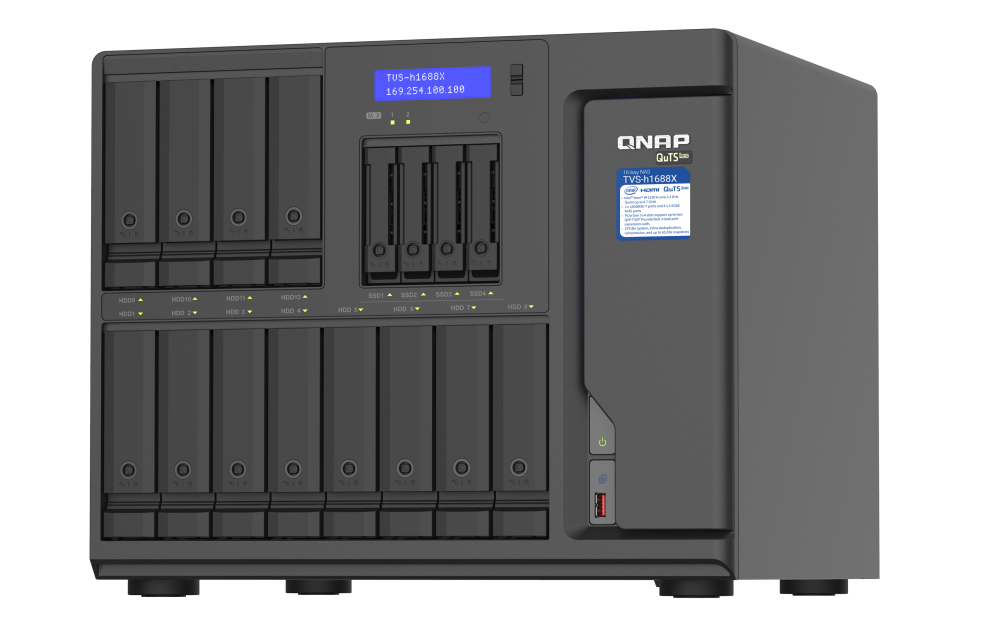
QNAP lists twelve 3.5-inch SATA positions plus four smaller 2.5-inch SATA SSD-only positions. Two M.2 NVMe slots are additional internal connectors, not native front bays; the M.2 drives are not listed as hot-swappable. The manufacturer says the NAS ships without HDDs. Check exact drive models and firmware in QNAP's compatibility list before projecting capacity.
Explore this need in the finder →Does the exact profile have a built-in single port rated at least 10 Gbps?
Yes. QNAP lists two built-in 10GBASE-T ports, so one individual port meets a 10-Gbps link-rating minimum. A 10.5-Gbps floor is above the fastest built-in port. The two 10GbE links do not add into one 20-Gbps client port; optional 25GbE needs an adapter, and neither link rate nor port aggregation is a measured transfer result.
Explore this need in the finder →Can this exact profile be configured for two-drive redundancy?
The exact U.S. selector lists RAID 1 in both its QTS and QuTS hero profiles. Choose one OS, select two compatible SATA drives—such as in two of the 3.5-inch positions—and create the pool yourself. Neither the selector nor the package guide lists a preconfigured array or supplied data drives. A mirror helps with a supported member-drive failure but is not an independent backup.
Explore this need in the finder →The QNAP TVS-h1688X-W1250-32G-US is a large desktop NAS for a buyer who has a specific reason to use sixteen native SATA positions, ECC memory and built-in 10GbE. QNAP's U.S. product page describes it as a QuTS hero system for high-speed media and virtualization work; the current hardware selector also presents a QTS profile. The published U.S. selector lists the W-1250/32G profile, while QNAP's Official Store card and product identity use the exact -US suffix. This is a document-based assessment, not a hands-on test.
Sixteen SATA positions, divided into two physical groups
Its headline count is unusually easy to misread. QNAP's hardware table lists twelve 3.5-inch SATA positions and four 2.5-inch SATA positions. The twelve larger bays accept the SATA media types listed in the hardware table: 3.5-inch HDDs, 2.5-inch HDDs or 2.5-inch SSDs. The four smaller front bays are specified for 2.5-inch SATA SSDs. That makes a useful hybrid layout for a team that wants HDD capacity plus a dedicated bank of SATA SSDs, but not sixteen interchangeable trays. QNAP separately lists two M.2 2280/22110 NVMe Gen 3 x4 slots; those are optional internal SSD positions, not extra front bays, and QNAP does not list them as hot-swappable.
The manufacturer hardware table says the NAS ships without hard drives, and the TVS-hx88X model guide's package list contains screws and heatsinks rather than data drives. Buyers therefore need to budget and select the drive set themselves. I did not verify a model-and-firmware compatibility row for any particular disk. Check QNAP's current compatibility list for every intended HDD, SSD and NVMe device before planning a pool; a broad interface match alone is not a compatibility confirmation.
Wired networking is fast, but the path still matters
The profile has two 10GBASE-T ports and four 2.5GbE ports. For a requirement phrased as “at least one built-in port rated 10 Gbps,” it clears the threshold without a separate network card. QNAP's product page describes port trunking, failover and up to 20 Gb/s combined bandwidth for the two 10GbE links, but that is not a single 20-Gbps client connection or an independent throughput result. The switch, client NIC, cable, protocol, storage arrangement and workload all affect observed transfer rates.
The exact model selector also lists optional 25GbE adapters, but these are expansion purchases, not native ports. A single 10GbE port is already fitted through the preinstalled dual-port adapter in PCIe slot 1. Two other slots are listed as Gen 3 x4, so a buyer planning Thunderbolt or faster network expansion should check card dimensions, bandwidth and coexistence with QNAP before assuming the options can all be added together. QNAP describes installing two optional QXP-T32P cards to provide four Thunderbolt 3 ports; neither the cards nor four Thunderbolt ports are part of the base configuration.
ECC memory and alternative software profiles
QNAP specifies 32 GB of ECC DDR4 UDIMM memory in the W1250-32G profile, with four memory slots and a stated 128 GB maximum. That is a distinct configuration from the TVS-h877AX-R5-16G-US, which has a different CPU, a smaller DDR5 base-memory profile and six SATA plus two separate U.2 positions. The h1688X is the more natural fit when sixteen SATA locations and a four-bay SSD bank matter; the h877AX makes more sense when eight mixed SATA/U.2 positions are enough and its U.2 path is specifically useful. Neither count implies that media is included or that advertised lab performance will match a buyer's workload.
There is a software-version detail worth checking: QNAP's marketing page and TVS-hx88X user guide emphasize QuTS hero, while the current U.S. selector exposes separate QTS and QuTS hero profiles and RAID tables. Both profiles list a RAID 1 option for the eight-bay-and-larger class. Treat these as alternatives, not simultaneous storage modes. The administrator chooses the operating system, inserts compatible disks and creates the storage pool; this package is not a preconfigured mirror.
When a two-drive mirror is part of the plan
A straightforward supported arrangement is two compatible SATA drives in a pair of the twelve 3.5-inch positions, configured as RAID 1 under one chosen OS. QNAP's setup guidance describes selecting disks and a RAID type while creating the pool. The other positions remain available for a separately designed layout, but mixing unlike drive types or sizes in one RAID group can constrain the group, so decide the intended groups before filling trays. RAID 1 can help maintain access after one member failure; it does not protect against deletion, ransomware, site loss or every controller/system failure. Keep a separate backup and test restores.
Large, expandable, and still a tower
This is a substantial tower rather than a rackmount chassis. QNAP's exact W1250-32G hardware sheet lists a 294.3 × 369.89 × 319.8 mm (H × W × D) body without its foot pad; the pad may add up to 30 mm, depending on the model. The older TVS-hx88X guide instead lists 303.84 × 369.89 × 319.8 mm and 13.41 kg, while the exact-profile sheet lists 14.49 kg net. Keep that documented conflict in mind: if shelf depth, lifting weight or airflow clearance is tight, confirm the delivered unit rather than treating either nominal figure as working clearance. Plan cable bend, ventilation and access to the tray locks.
The trade-off is that this design asks for more up-front planning than a smaller desktop NAS. Sixteen positions do not set usable capacity, RAID layout or rebuild exposure; those depend on the drives and grouping selected. The four 2.5-inch SSD-only slots and optional M.2 devices add useful choices but also multiply compatibility checks. Expansion cards consume the available PCIe options, while the installed 10GbE adapter already occupies one slot. For an ordinary home file share, a simpler two- or four-bay NAS may be easier to populate and cool. For a media or virtualization team that can use the larger SATA bank, built-in multigigabit ports and ECC memory, the h1688X is a more coherent match on paper.
Checks before choosing this exact package
Confirm the exact TVS-h1688X-W1250-32G-US identifier and the seller's actual package; the Store title establishes the model suffix, not current availability or any seller-added components. Verify the intended drive models and firmware in QNAP's compatibility list, distinguish 3.5-inch SATA media from the four 2.5-inch SSD-only bays, and decide whether QTS/EXT4 or QuTS hero/ZFS suits the intended setup. Check whether a two-drive RAID 1 group fits the capacity and backup plan, and map the 10GbE link end to end. If optional Thunderbolt, M.2 or 25GbE cards are part of the design, verify slot and card compatibility for the exact configuration. Finally, reconcile the manual-versus-selector dimensional discrepancy and confirm the exact manufacturer's warranty terms. These checks matter more than treating a sixteen-position label as a complete storage plan.
Key specifications
Key details at a glance
| Internal drive bays | 16 bays |
|---|---|
| Documented internal drive media | 3.5-inch SATA hard disk drives in the twelve 3.5-inch positions / 2.5-inch SATA hard disk drives in the twelve 3.5-inch positions / 2.5-inch SATA solid-state drives in the twelve 3.5-inch positions / 2.5-inch SATA solid-state drives in the four 2.5-inch positions / NVMe PCIe Gen 3 or later SSDs in two separate M.2 2280/22110 positions |
| Built-in Ethernet ports | 2 x built-in 10GBASE-T RJ45 / 4 x built-in 2.5GbE RJ45 |
| Fastest individual Ethernet port | 10 Gbps |
| Installed system memory | 32 GB |
| Maximum listed memory | 128 GB |
| Listed storage arrangements | QTS: for 8-bay-and-larger systems, RAID 1, 5, 6, 10, 50 and 60 are listed alongside other modes / QuTS hero: for 8-bay-and-larger systems, RAID 1, 5, 6, 10, 50, 60, Triple Mirror and Triple Parity are listed |
| Internal file systems | EXT4 (QTS alternative) / ZFS (QuTS hero alternative) |
| Dimensions (H × W × D) | 294.3 × 369.89 × 319.8 mm (H × W × D; excludes foot pad; foot pad may add up to 30 mm depending on model) |
| Weight | 14.49 kg |
| Hardware warranty | 3 years |
| Data drives included in listed package | No |
| Processor | Intel Xeon W-1250 |
| CPU cores | 6 |
| CPU threads | 12 |
| Installed memory type | 32 GB ECC UDIMM DDR4 (2 x 16 GB) |
Use the exact model’s instructions for operating limits, supplied equipment and version differences.
Sources for this review
Sources for this assessment
- TVS-h1688X — QNAP U.S. product page
- TVS-h1688X hardware/software selector — QNAP U.S.
- TVS-hx88X User Guide — QNAP
- TVS-h1688X-W1250-32G-US — QNAP Official Store identity page
- SMB Desktop category, page 1 — QNAP Official Store
- Getting started with NAS storage — QNAP
- TVS-h1688X official product image — QNAP U.S.
- Hardware Specs - TVS-h1688X-W1250-32G - QNAP

Check your setup before choosing a NAS
Use the finder to narrow documented desk/shelf or rack formats, internal-bay minimums, a single Ethernet-port rating and optional redundancy requirements.