
Your needs, this model
Does it fit your priorities?
How many internal drive positions does the TVS-AIh1688ATX-U7-32G-US profile provide, and are they interchangeable?
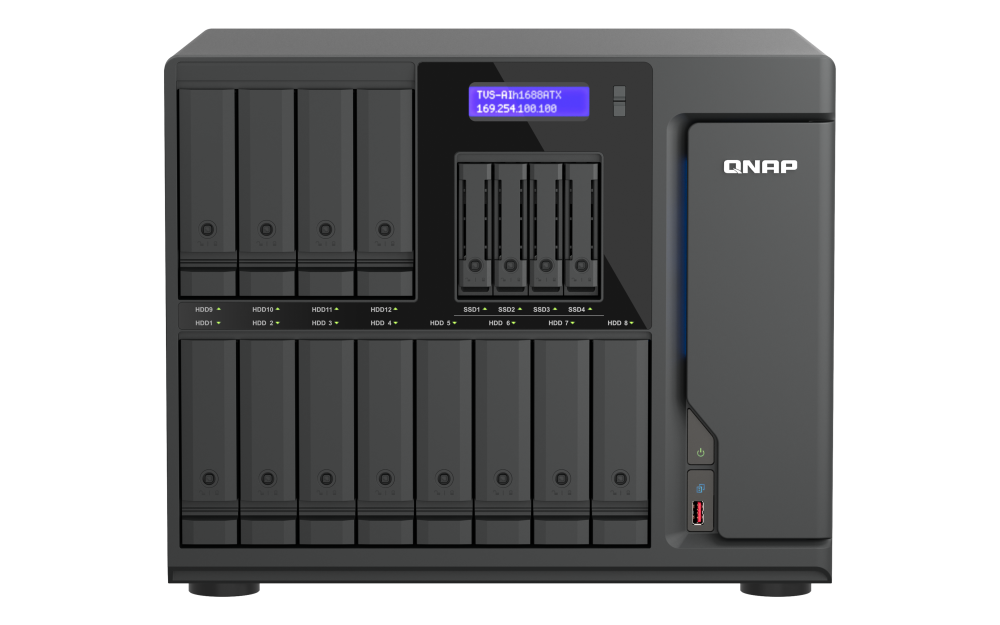
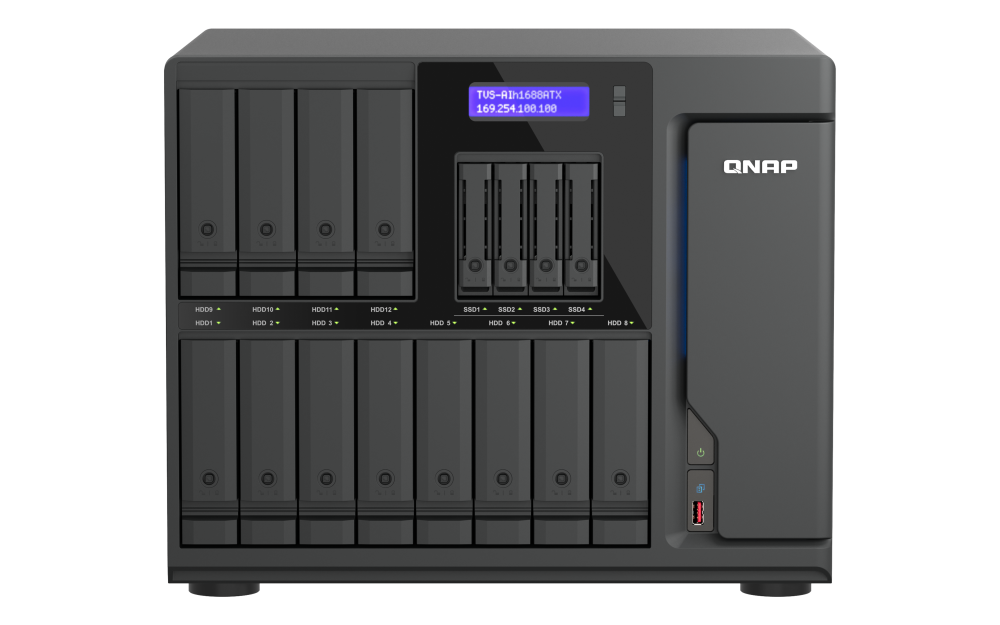
QNAP documents 16 total internal positions: 12 x 3.5-inch SATA HDD bays; 4 x 2.5-inch U.2 NVMe/SATA SSD positions. Their drive formats differ as described in the exact media compatibility note. This count is not a usable-capacity or all-HDD claim. Check exact disk/firmware compatibility before purchasing.
Explore this need in the finder →What is the fastest individual built-in network port on this profile?
QNAP documents a single built-in Ethernet port rated up to 10 Gbps: 2 x 10GBASE-T RJ45, 2 x 2.5GbE RJ45. Port count does not make a single connection faster; the switch, cable, client and workload must also support the desired path. This is a link rating, not a throughput test.
Explore this need in the finder →Can this exact profile support two-drive redundancy, and are the drives included?
The current QNAP software selector lists RAID 1 for this profile/family. A buyer may choose two compatible drives in the suitable native positions, install one selected OS and create the mirror; no data drives or prebuilt pool are listed. A mirror can help if one drive fails but is not an independent backup.
Explore this need in the finder →What changes between the selected hardware configuration and its closest selector sibling?
Intel Core Ultra 7 (20-core/20-thread, up to 5.3 GHz); 20 cores/20 threads; 32GB installed memory. Published CPU and memory specifications do not prove a workload-speed advantage. This exact U.S. SKU is documented by the official Store; compare its complete suffix before buying.
Assessment basis: This is a research-based review of the exact U.S. Store configuration TVS-AIh1688ATX-U7-32G-US. QNAP's product page, rendered hardware/software/package selectors and official offer identity were checked. No independent testing, ownership, user experience, price or stock claim is made. The U9-32G profile is treated separately because its processor differs.
Sixteen physical positions in two different formats
The tower has a useful but easy-to-misread 12+4 arrangement: twelve 3.5-inch SATA HDD bays plus four 2.5-inch U.2 NVMe/SATA SSD positions. The four smaller SSD slots are not additional hard-drive trays. A buyer focused on large SATA disks should count twelve HDD positions, not sixteen. A mixed workload may value the SSD slots, but the exact drive protocol, form factor, thickness, firmware and QNAP compatibility list need checking before ordering. Neither QNAP's image nor the 16-position total proves a specific drive combination, usable capacity or response time.
QNAP lists two 10GBASE-T and two 2.5GbE network ports. The fastest individual built-in link is 10Gbps; two 10GbE ports do not equal one 20Gbps single-client link. Switches, client adapters, cables, selected disks, software and workload constrain throughput. Three PCIe Gen4 slots allow additional cards, but do not make every accessory compatible or leave unlimited space. The optional QXP-T52P Thunderbolt 5 card is separately sold; it is not part of the U7/32G Store package by default.
U7/32G configuration and AI claims
The U.S. profile carries an Intel Core Ultra 7 processor documented at twenty cores and twenty threads, up to 5.3GHz, with 32GB ECC DDR5. The current selector lists four DDR5 ECC UDIMM slots and up to 192GB. The U9 package installs 32GB as well, but moves to an Ultra 9 profile with 24 cores/threads and a higher stated maximum frequency. These specification differences may inform a buyer's service plan, yet they do not demonstrate which configuration will run a particular VM, inference job or file workflow better. QNAP's “up to 36 TOPS” and other performance language is vendor specification, not an independent result from this review.
QNAP exposes QTS and QuTS hero as alternatives and lists RAID 1 in its software selector. For a straightforward two-drive plan, a buyer can select two compatible 3.5-inch SATA disks from the twelve large bays and create a RAID 1 mirror under one chosen OS. The four smaller SSD slots remain a different media path. QNAP's standard package list does not include data drives or a configured pool. A mirror may help with one disk failure, but it is not a backup; maintain a separate copy and test recovery.
Buying checks for the tower
QNAP's package selector lists the chassis, one 10GBase-T cable, one power cord, drive screws, tray keys and quick-start material; it lists no data drives. Verify the exact U7 suffix and all seller-added contents. QNAP's current page states a five-year standard warranty; confirm the written terms for the offer and market. Plan the actual tower footprint, cooling, room noise and power before choosing a spot; the 750W supply is single, not a dual-redundant design. This model can fit a buyer who needs the split HDD/SSD topology, on-box graphics features and the U7/32G package, but it is not a simple 16-HDD shelf. Its official image shows the family tower and tray layout, not this CPU/RAM bundle, installed drives or optional Thunderbolt card. No setup, acoustic, thermal or throughput tests were performed.
Key specifications
Key details at a glance
| Internal drive bays | 16 bays |
|---|---|
| Documented internal drive media | 3.5-inch SATA HDD / 2.5-inch U.2 NVMe SSD / 2.5-inch SATA SSD |
| Built-in Ethernet ports | 2 x 10GBASE-T RJ45 / 2 x 2.5GbE RJ45 |
| Fastest individual Ethernet port | 10 Gbps |
| Installed system memory | 32 GB |
| Maximum listed memory | 192 GB |
| Listed storage arrangements | RAID 1 |
| Data drives included in listed package | No |
| Processor | Intel Core Ultra 7 (20-core/20-thread, up to 5.3 GHz) |
| CPU cores | 20 |
| CPU threads | 20 |
| Installed memory type | ECC DDR5 UDIMM |
Use the exact model’s instructions for operating limits, supplied equipment and version differences.
Sources for this review
Sources for this assessment
Check your setup before choosing a NAS
Use the finder to narrow documented desk/shelf or rack formats, internal-bay minimums, a single Ethernet-port rating and optional redundancy requirements.