
Your needs, this model
Does it fit your priorities?
How many compatible internal drive positions does the TS-h987XU-RP-E2334-16G-US profile provide?
QNAP documents 9 native positions: Four 3.5-inch positions accept listed 3.5-inch SATA HDD or 2.5-inch SATA SSD. Five separate 2.5-inch bays accept listed U.2/U.3 NVMe or SATA SSD media with a maximum 7 mm height; bays 1–3 use PCIe Gen3 x2 and bays 4–5 use Gen4 x4. The guide only lists hot-swap for the four 3.5-inch bays. Confirm exact drive and firmware compatibility. A count does not establish usable capacity or an exact compatible drive; check QNAP’s current list for each model and firmware.
Explore this need in the finder →Is the TS-h987XU-RP-E2334-16G-US profile the same CPU and memory configuration as its family siblings?
No. This exact profile lists Intel Xeon E-2334, 4 cores/8 threads and 16 GB ECC DDR4. The English guide specifies one 16 GB ECC DDR4 UDIMM in a four-slot system with a 128 GB maximum. Confirm full model suffix and installed modules; specifications do not predict application performance.
Can the listed configuration use a two-drive mirror, and is one preconfigured?
QNAP’s exact software selector lists RAID 1 for QTS and QuTS hero. These are alternatives; the buyer chooses one, purchases two exact compatible drives and creates the pool. QNAP’s package list does not include data drives or an initialized array. A two-member mirror can tolerate one member drive failure but is not an independent backup.
Explore this need in the finder →What should I confirm for this rack installation and package?
The chassis is 1U and the English U.S. guide lists 2 x 300 W redundant supplies; RAIL-B02 is a listed compatible rail family. Data drives and rails are not in the standard package listing. Check the latest QNAP drawing, rack-post depth, rail fit, cable bend, airflow, loaded weight and independent power feeds. Current product and Store wording says five years but the guide says three; verify written terms for the exact delivered configuration.
Explore this need in the finder →Assessment basis: This review covers QNAP’s TS-h987XU-RP-E2334-16G-US package, identified by the exact U.S. hardware selector, user-guide order code and Official Store page. It is a source-based assessment, not a hands-on test. QNAP’s U.S. page identifies the 1U family and its mixed four-HDD/five-SSD layout. Check the model page and hardware selector for current revisions; the manufacturer Store SKU does not establish a third-party package or offer.
Nine internal positions across three media paths
The documented count is four 3.5-inch SATA bays plus five 2.5-inch U.2/U.3 NVMe-or-SATA positions, nine positions in total. The five smaller trays accept drives no taller than 7 mm. The guide identifies the first three as PCIe Gen 3 x2 positions and the fourth and fifth as Gen 4 x4, so do not assume all five 2.5-inch slots share the same bus generation or every media combination is appropriate. QNAP lists the four 3.5-inch positions for 3.5-inch SATA hard drives or 2.5-inch SATA SSDs. The guide only identifies hot-swap support for 3.5-inch bays 1–4; this review does not extend that claim to the five U.2/U.3 positions.
This hybrid count matters more than the headline nine if the plan is to use hard disks: only four positions are the 3.5-inch SATA bays. The 2.5-inch slots target compatible SSD media and have a strict height limit. No exact drive model, firmware or combined configuration was checked against QNAP’s compatibility database, so none is recommended here. Confirm each specific part number before buying; SATA, U.2 and U.3 labels alone do not verify electrical, protocol, firmware or thermal fit.
A compact 1U rack plan with dual power
QNAP’s English guide describes a 1U chassis, dual 300 W supplies and four 40 mm fans. It lists RAIL-B02 as the compatible rail family, while the package list does not include the rails or data drives. A shallow 1U enclosure can save rack height, but the guide measurement is not a complete clearance plan. Confirm QNAP’s current drawing, rack post depth, rail adjustment range, cable bend behind the system, airflow, loaded weight and the rack’s power environment. Two supplies are only meaningfully redundant if they can use separate approved upstream feeds; two cords connected to one shared PDU do not isolate the system from that PDU’s failure.
The single PCIe Gen 4 x8 slot is an optional expansion point, not an included network adapter or storage card. QNAP lists two built-in 10GBASE-T and two 2.5GbE RJ45 ports; 10Gbps is the fastest rating of one built-in link. Two 10GbE ports are separate connectors, not one guaranteed 20Gbps connection. A high-speed transfer still requires compatible client and switching hardware, cabling, storage, software configuration and workload. No independent throughput, noise or power result is claimed.
The E2334-16G configuration
This exact U.S. package uses the Intel Xeon E-2334 with four cores and eight threads, 16 GB ECC DDR4 memory and four memory slots. QNAP lists 128 GB maximum. The 2024 user guide identifies a single 16 GB module in the base configuration; use the current QNAP memory recommendations and exact revision before upgrading. These figures describe the package, not a guarantee that every application has enough resources or that an upgrade will work without compatibility checks. Unlike a memory number, the processor’s core count does not tell you the workload’s end performance.
RAID 1 requires owner setup and a deliberate OS decision
The current QNAP software selector exposes QTS and QuTS hero profiles for this model, while the guide’s introductory description emphasizes QuTS hero. The current model selectors list RAID 1 in each eight-bay-and-larger profile, but QTS and QuTS hero are alternative operating systems and storage implementations. QNAP warns that changing from QuTS hero to QTS requires removing drives. Decide which OS you need before initializing a pool and confirm the setup path for the exact package.
A buyer can create a two-drive mirror from compatible data drives as one operating plan; QNAP’s package materials list no data drives or preconfigured array. The mirror uses two of nine native positions, but because the bays are mixed format, it is not automatically an appropriate plan for arbitrary disks. RAID 1 can help with a single member failure while the other remains healthy; it does not protect against deletion, malware, theft, fire or losing the entire chassis. Keep a separate recoverable backup and rehearse a restore. The five 2.5-inch bays’ speed generations and 7 mm height limit make exact media selection particularly important.
Before you select it
The TS-h987XU-RP-E2334-16G-US suits an installation that specifically values nine mixed-format native positions in 1U, native 10GbE and dual supply modules. It is a poor fit for someone who expects nine ordinary 3.5-inch hard-drive trays or does not want to verify U.2/U.3 SSD support. The 2.5-inch positions are not five extra large HDD slots, and the four 3.5-inch positions should be evaluated separately from the SSD path. Confirm compatible storage models, software and RAID design, the rail kit, rack service access, cable routing, power sources and the exact box contents.
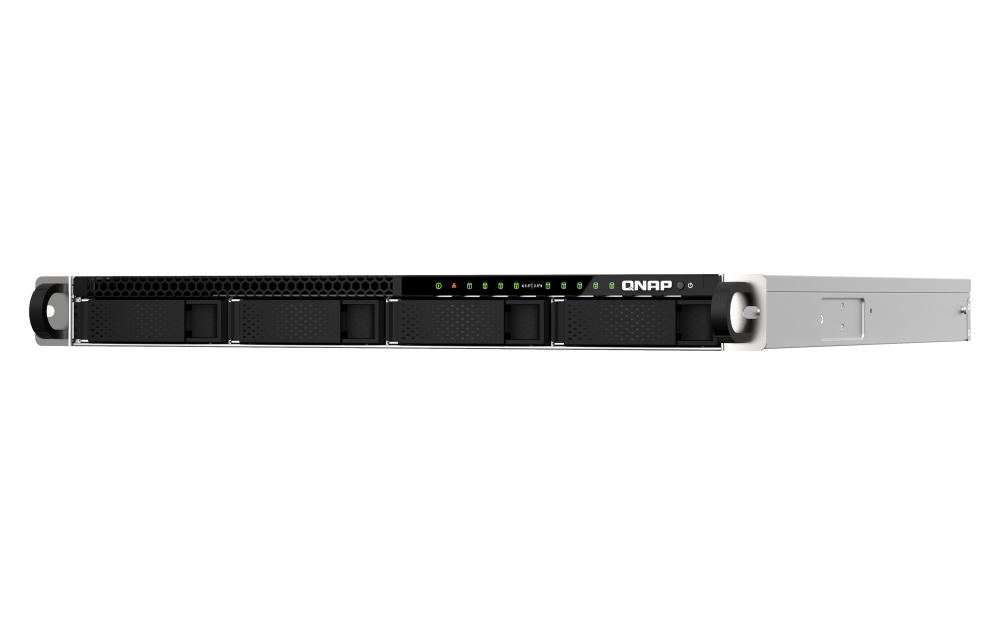
The guide says three-year limited warranty while the current product page and Store wording indicate five-year standard coverage. This review does not reconcile that difference or apply either term to a particular seller. The official QNAP image shows the family’s 1U chassis front with four large tray faces; it cannot visually establish the five small SSD positions, installed drives, CPU/memory package or accessories. Do not confuse that picture with proof of a selected assembly. No price, stock, seller-added parts, benchmark, customer experience, measurement or personal ownership is claimed.
Key specifications
Key details at a glance
| Internal drive bays | 9 bays |
|---|---|
| Documented internal drive media | 3.5-inch SATA HDD / 2.5-inch SATA SSD / 2.5-inch U.2 NVMe SSD / 2.5-inch U.3 NVMe SSD |
| Built-in Ethernet ports | 2 x 10GBASE-T RJ45 data ports / 2 x 2.5GbE RJ45 data ports |
| Fastest individual Ethernet port | 10 Gbps |
| Installed system memory | 16 GB |
| Maximum listed memory | 128 GB |
| Listed storage arrangements | RAID 1 |
| Data drives included in listed package | No |
| Processor | Intel Xeon E-2334 |
| CPU cores | 4 |
| CPU threads | 8 |
| Installed memory type | ECC DDR4 UDIMM |
Use the exact model’s instructions for operating limits, supplied equipment and version differences.
Sources for this review
Sources for this assessment
- QNAP U.S. TS-h987XU-RP product page
- QNAP U.S. rendered TS-h987XU-RP hardware selector
- QNAP U.S. rendered TS-h987XU-RP software selector
- QNAP U.S. rendered TS-h987XU-RP package selector
- QNAP TS-h987XU-RP User Guide, English (U.S.)
- QNAP U.S. Official Store TS-h987XU-RP-E2334-16G-US identity page
- QNAP TS-h987XU-RP family image

Check your setup before choosing a NAS
Use the finder to narrow documented desk/shelf or rack formats, internal-bay minimums, a single Ethernet-port rating and optional redundancy requirements.