
Your needs, this model
Does it fit your priorities?
Does the TS-h973AX-32G-US have nine native drive positions?
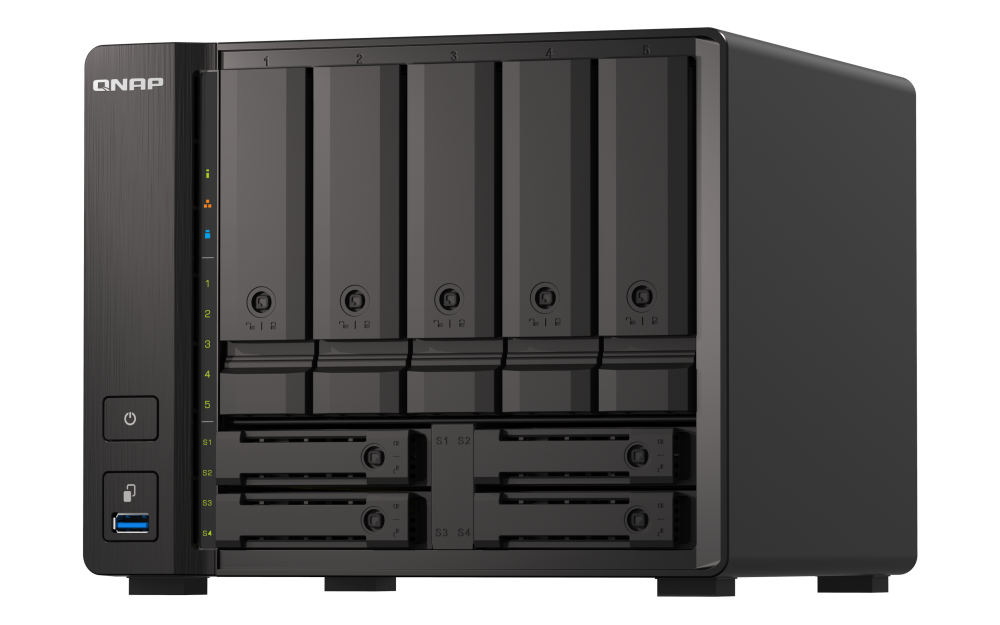
QNAP lists five 3.5-inch SATA positions plus four 2.5-inch positions. The 2.5-inch bays 1 and 2 accept U.2 NVMe or SATA SSDs, while U.2 drives must not go in the other positions. The current 32G selector additionally lists 2.5-inch SATA HDDs, but exact drive model and firmware compatibility still require a current check. No data drives are included in the NAS specification.
Explore this need in the finder →Is there one built-in 10GbE port on the 32G package?
Yes. QNAP lists one 10GBASE-T port that can negotiate 10, 5, 2.5, 1 or 0.1Gbps, alongside two separate 2.5GbE ports. This is an individual port rating, not a tested file-transfer rate; the network path still matters.
Explore this need in the finder →Can the 32G profile support a two-drive mirror?
The TS-h973AX QuTS hero guide describes RAID 1 with two member drives and one-member failure support. You choose compatible drives and create the pool; QNAP says the NAS ships without HDD/SSD, and the package is not a preconfigured mirror. Maintain an independent backup for risks RAID cannot cover.
Explore this need in the finder →QNAP · 32GB nine-position hybrid tower NAS · source-based assessment
The TS-h973AX-32G-US is a separately identified 32GB configuration of QNAP’s TS-h973AX tower NAS. Its distinctive selling point in the documented record is not a different chassis, bay layout or Ethernet arrangement from the 8G package: it arrives with 32GB installed, while the 8G profile is listed at 8GB. That difference matters because QNAP ties several named memory-intensive applications to a 16GB minimum. This is a source-based assessment only. We have not bought, tested, measured, installed or owned this NAS, and do not claim live availability, a current price, seller-added components or firsthand experience.
A hybrid nine-position layout with a model-specific caveat
The chassis provides five native 3.5-inch SATA positions and four native 2.5-inch positions. For the current 32G selector, QNAP lists 3.5-inch SATA hard drives, 2.5-inch SATA HDDs and SSDs, plus U.2 NVMe drives in only the first two small bays. The 8G selector omits the 2.5-inch SATA HDD entry, while the older User Guide v2 lists this media more broadly. Do not erase that difference by assuming one configuration’s media list automatically proves the other’s. Match the full drive model, firmware and intended slot against QNAP’s current compatibility material for the exact SKU and revision.
Nine native positions may be useful if a project genuinely needs both larger SATA disks and a smaller-media layer, but it does not translate directly into a guaranteed capacity number. The positions accept different drive classes, U.2 NVMe is limited to bays 1 and 2, and any additional adapter or expansion unit is a separate purchase/configuration, not an extra native bay. QNAP specifies the appliance without HDD/SSD. The manual’s standard package list includes the NAS, AC adapter, cord, one Cat6a cable, tray keys and screws and a quick guide; it is not proof of a retailer’s actual box contents.
Thirty-two gigabytes addresses a stated workload threshold—not every workload
The rendered U.S. selector identifies the TS-h973AX-32G profile as 32GB DDR4 non-ECC SODIMM memory across two slots. The exact QNAP Store item corroborates the 32G package identity. QNAP calls out several memory-intensive applications, including Virtualization Station, Q’center, Qsirch, QVR Center, Qsync and Boxafe, and states that they need at least 16GB. It specifically points to the 32G profile or upgrading the 8G version to at least 16GB. On the manufacturer’s stated threshold alone, the 32GB package clears that minimum as supplied. This is not evidence that any specific workload, number of virtual machines, camera count or indexing task will run at a particular speed; we do not turn QNAP’s performance marketing into a test result.
Memory expansion guidance is not perfectly aligned across the source set. The current selector lists 64GB maximum as two 32GB modules, while the English-U.S. User Guide v2 says 32GB maximum as two 16GB modules. The 32G package itself agrees with the older guide’s stated ceiling, but that does not resolve support for a future upgrade on every hardware revision. If future memory growth is a purchase requirement, ask QNAP to confirm the exact board, firmware and supported module before relying on the 64GB selector figure.
The 10GbE link is individual; path design still determines results
Both configurations have one built-in 10GBASE-T RJ45 port and two separate 2.5GbE RJ45 ports. The single-port questionnaire field therefore records a maximum listed link speed of 10Gbps; it does not add the three port rates together or promise file throughput. A 10.5Gbps single-port floor is above the listed port. For a 10GbE workflow, check that the client and switch can negotiate 10GBASE-T, that the cabling and topology are appropriate, and that the storage and workload can use the link. None of those checks can be replaced by the product label. The finder can screen for the same nine-bay and 10Gbps single-port minimums.
QuTS hero RAID 1 is buyer-created, and QTS is an alternative
The model guide describes QuTS hero/ZFS and also allows QTS as a distinct operating system alternative. They are not two filesystems running together. OS installation or switching can erase the drives, so choose the supported system before loading data and follow QNAP’s current instructions. QNAP’s model-specific RAID table and QuTS hero documentation describe a two-drive RAID 1 arrangement with one member-drive failure tolerance. The buyer must procure compatible disks and create the pool; the diskless NAS is not delivered with a prepared mirror. RAID helps with one specified drive-failure scenario, not accidental deletion, malware, fire, theft or loss of the whole unit. Keep a separately recoverable backup.
With nine bays, the buyer can allocate two positions to the mirror and still has other positions available, but the mirror does not make those unallocated positions a configured pool. Apply those same nine-bay, 10GbE and required-mirror finder answers to review matching arrangements, then read the exact model notes before choosing drives or operating system.
Check the actual revision, size and offer
QNAP’s current selector lists 6.95 × 8.84 × 8.82 inches and 9.57 pounds, with a foot-pad qualification. User Guide v2 gives 7.19 × 8.84 × 8.82 inches and 7.76 pounds. Neither value is an in-hand measurement. Verify the offered revision, ventilation and service clearance, and actual carrying weight. The manual does not guarantee a reseller’s accessories or warranty. Confirm the exact TS-h973AX-32G-US label and seller BOM; QNAP’s product page, U.S. selector, model guide and QuTS hero RAID reference describe the platform, not an individual seller offer or its current compatibility state.
Key specifications
Key details at a glance
| Internal drive bays | 9 bays |
|---|---|
| Documented internal drive media | 3.5-inch SATA HDD / 2.5-inch SATA HDD / 2.5-inch SATA SSD / 2.5-inch U.2 NVMe PCIe Gen3 x4 SSD in 2.5-inch bay 1 or 2 |
| Built-in Ethernet ports | 1 x built-in 10GBASE-T RJ45 individual multi-gig port (10/5/2.5/1/0.1 Gbps) / 2 x built-in individual 2.5GbE RJ45 ports |
| Fastest individual Ethernet port | 10 Gbps |
| Installed system memory | 32 GB |
| Listed storage arrangements | QuTS hero: RAID 1 (two owner-selected compatible drives; owner-created) |
| Internal file systems | QuTS hero: ZFS / QTS: EXT4 (alternative OS; not combined with QuTS hero in one setup) |
| Data drives included in listed package | No |
| System drives included (not data-bay drives) | |
| Processor | AMD Ryzen Embedded V1500B |
| CPU cores | 4 |
| CPU threads | 8 |
| Installed memory type | 32GB DDR4 non-ECC SODIMM (2 x 16GB) as listed for the TS-h973AX-32G ordering profile |
Use the exact model’s instructions for operating limits, supplied equipment and version differences.
Sources for this review
Sources for this assessment
- TS-h973AX U.S. product page — QNAP
- Rendered TS-h973AX U.S. software selector — QNAP
- TS-h973AX User Guide v2, English U.S. — QNAP
- QNAP-branded 9–16 Bay desktop NAS collection — QNAP Store
- TS-h973AX-32G-US exact QNAP Store item
- RAID types — QuTS hero h5.2.x, QNAP documentation
- TS-h973AX official QNAP Store gallery image

Check your setup before choosing a NAS
Use the finder to narrow documented desk/shelf or rack formats, internal-bay minimums, a single Ethernet-port rating and optional redundancy requirements.