
Your needs, this model
Does it fit your priorities?
How many internal drive positions does the TS-h3077AFU-R7-64G-US profile provide, and are they interchangeable?
QNAP documents 30 total internal positions: 30 x 2.5-inch SATA SSD positions. Their drive formats differ as described in the exact media compatibility note. This count is not a usable-capacity or all-HDD claim. Check exact disk/firmware compatibility before purchasing.
Explore this need in the finder →What is the fastest individual built-in network port on this profile?
QNAP documents a single built-in Ethernet port rated up to 10 Gbps: 2 x 10GBASE-T RJ45, 2 x 2.5GbE RJ45. Port count does not make a single connection faster; the switch, cable, client and workload must also support the desired path. This is a link rating, not a throughput test.
Explore this need in the finder →Can this exact profile support two-drive redundancy, and are the drives included?
The current QNAP software selector lists RAID 1 for this profile/family. A buyer may choose two compatible drives in the suitable native positions, install one selected OS and create the mirror; no data drives or prebuilt pool are listed. A mirror can help if one drive fails but is not an independent backup.
Explore this need in the finder →What changes between the selected hardware configuration and its closest selector sibling?
AMD Ryzen 7 7000 series; 8 cores/16 threads; 64GB installed memory. Published CPU and memory specifications do not prove a workload-speed advantage. This exact U.S. SKU is documented by the official Store; compare its complete suffix before buying.
Assessment basis: This review evaluates the exact QNAP TS-h3077AFU-R7-64G-US configuration from QNAP's U.S. Store identity page and English U.S. guide. It is not a physical test or a report of ownership. The R5-32G sibling is separately assessed because its processor and installed memory differ. Current pricing, seller inventory and seller-added contents are not treated as durable product facts.
An SSD-only 30-bay rack platform
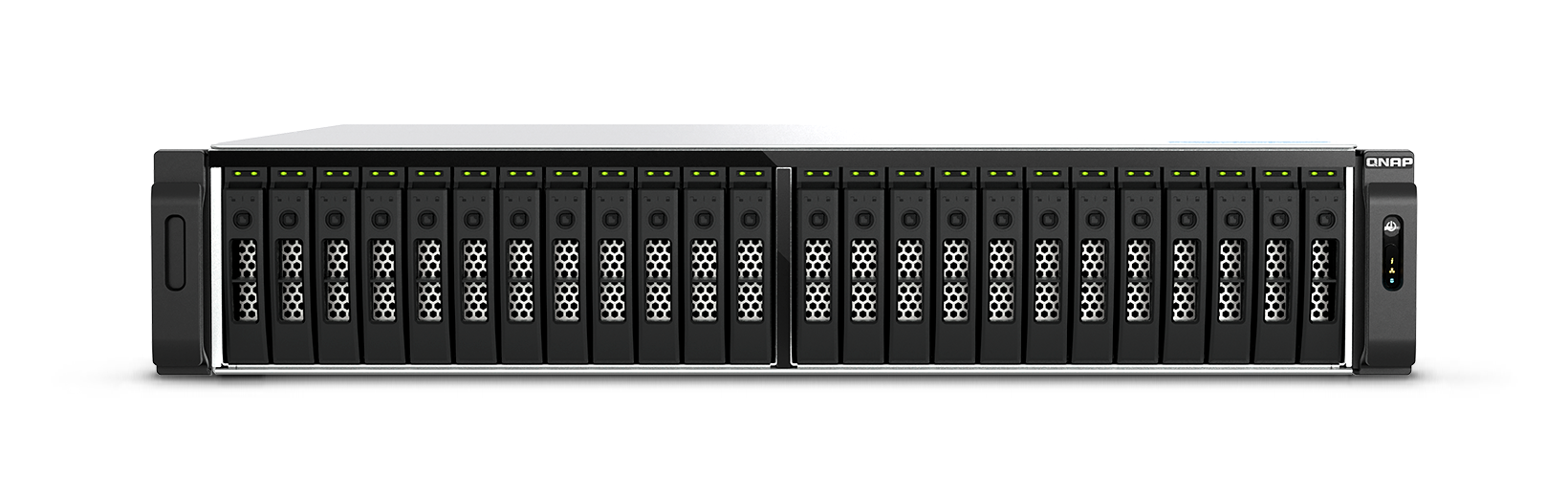
QNAP documents thirty 2.5-inch SATA 6Gb/s positions and specifies compatible 2.5-inch SATA SSDs. That is the central purchase constraint. This chassis does not turn into a 3.5-inch hard-drive system just because it has many bays. Before treating thirty drives as usable capacity, check every SSD's model code, firmware, endurance suitability and support status; the tray count does not promise a particular array, usable total or performance result. The manufacturer lists hot swap except for SSD cache drives.
For networking, the guide lists two 10GBASE-T ports and two 2.5GbE ports. Its fastest individual built-in link is 10Gbps. Two separate 10GbE ports do not create a guaranteed 20Gbps workstation link, and link speed is not file-transfer speed. A compatible client NIC, switch and cabling are still needed. QNAP lists three PCIe Gen4 slots, but expansion consumes finite slots and may compete with the storage or networking cards a deployment expects.
The R7/64G difference is a hardware choice, not a benchmark
This SKU uses an AMD Ryzen 7 7000-series processor listed at eight cores and sixteen threads, with 64GB DDR5 UDIMM installed. The R5-32G package uses a six-core/twelve-thread Ryzen 5 and 32GB. The family guide supports four DDR5 UDIMMs, up to 192GB and ECC modules. That is useful evidence for planning services and memory headroom, but it does not establish that the R7 package will deliver a fixed percentage improvement in your workload. Do not buy the higher configuration solely from core counts or assume a VM/database/AI workload will be faster without a workload-specific benchmark and compatible storage design.
QNAP lists QTS and QuTS hero as software alternatives and RAID 1 in the current selector. A reasonable plan is to choose one filesystem, purchase two compatible 2.5-inch SATA SSDs and configure the mirror after setup; the device is not supplied with a populated array. QNAP warns that switching from QuTS hero to QTS requires removing the drives. A two-drive mirror may help through one member failure, but separate backup and restore planning remain necessary. Neither the OS choice nor the RAID layout should be assumed from the marketing photo.
Deployment, kit and purchase limitations
The system is 2U and the guide names the RAIL-A03-57 rail kit, purchased separately. It lists 88.3 × 482 × 549.7mm and 12.73kg net. Confirm latest dimensions, rack depth, post compatibility, cable room, ventilation and safe loaded rail capacity with QNAP and the rack supplier. The standard guide package lists two power cords, one Cat6A cable and 120 screws; it does not list SSDs or rails. Dual 550W supplies need appropriately independent upstream feeds if power-path redundancy matters.
The official QNAP product and Store pages advertise five-year standard warranty coverage, but the English U.S. guide says three-year limited warranty. The conflict needs written confirmation for the exact regional item. This profile is most defensible when a planned deployment really needs a dense 2U all-flash chassis and the R7/64G CPU/memory package fits the workload and budget. It is difficult to justify for ordinary HDD storage or a small office that would leave most expensive SSD-only positions unused. The official photo is a family-level chassis image; it does not identify the R7 package, installed SSDs or rails. No hands-on operation, lab measurement, benchmark, acoustic test or ownership is claimed.
Key specifications
Key details at a glance
| Internal drive bays | 30 bays |
|---|---|
| Documented internal drive media | 2.5-inch SATA SSD |
| Built-in Ethernet ports | 2 x 10GBASE-T RJ45 / 2 x 2.5GbE RJ45 |
| Fastest individual Ethernet port | 10 Gbps |
| Installed system memory | 64 GB |
| Maximum listed memory | 192 GB |
| Listed storage arrangements | RAID 1 |
| Data drives included in listed package | No |
| Processor | AMD Ryzen 7 7000 series |
| CPU cores | 8 |
| CPU threads | 16 |
| Installed memory type | ECC DDR5 UDIMM |
Use the exact model’s instructions for operating limits, supplied equipment and version differences.
Sources for this review
Sources for this assessment

Check your setup before choosing a NAS
Use the finder to narrow documented desk/shelf or rack formats, internal-bay minimums, a single Ethernet-port rating and optional redundancy requirements.