
Your needs, this model
Does it fit your priorities?
Does the reviewed 128G configuration meet a 24-bay, 25GbE and two-drive RAID 1 screen?
Yes, at the documentation level: the U.S. hardware table and guide identify 24 native U.2 NVMe positions and four 25GbE SFP28 ports for the 7302P-128G. QuTS hero documents a two-disk RAID 1 plan. The base system is diskless, the mirror is not preconfigured, and no exact compatible SSD SKU was verified; confirm the network path and keep an independent backup.
Explore this need in the finder →Are 24 NVMe drives included, and which SSD should I order?
No. QNAP says the system ships without SSDs. Its current U.S. hardware table and the User Guide v3 differ in whether they mention U.3/Gen4 drives, so verify each exact model, capacity and firmware on the live TS-h2490FU compatibility list before ordering; this research confirms no specific compatible SSD row.
Explore this need in the finder →How do the five CPU and memory choices differ?
QNAP’s current U.S. comparison lists 7302P-256G, 7302P-128G, 7302P-64G, 7232P-64G and 7232P-32G. The 7302P is a 16-core/32-thread CPU listed up to 3.3 GHz; 7232P/7252 is 8-core/16-thread up to 3.2 GHz. The v3 guide only details the 7232P-64G, 7302P-128G and 7302P-256G configurations, and the official U.S. Store category identifies exact US suffixes for those three only. Match the complete part number on a written quote.
Explore this need in the finder →What should be checked before fitting this chassis in a rack?
The guide lists a 2U chassis 510.2 mm deep, dual 1100 W supplies and separately sold RAIL-A03-57 rails. Its package list includes the NAS and two power cords but does not list data SSDs or rails. The guide’s 15.2 kg net weight conflicts with the current U.S. table’s 36.97 lb figure; verify the exact hardware revision and site loading rather than relying on either number without confirmation.
Explore this need in the finder →Assessment scope
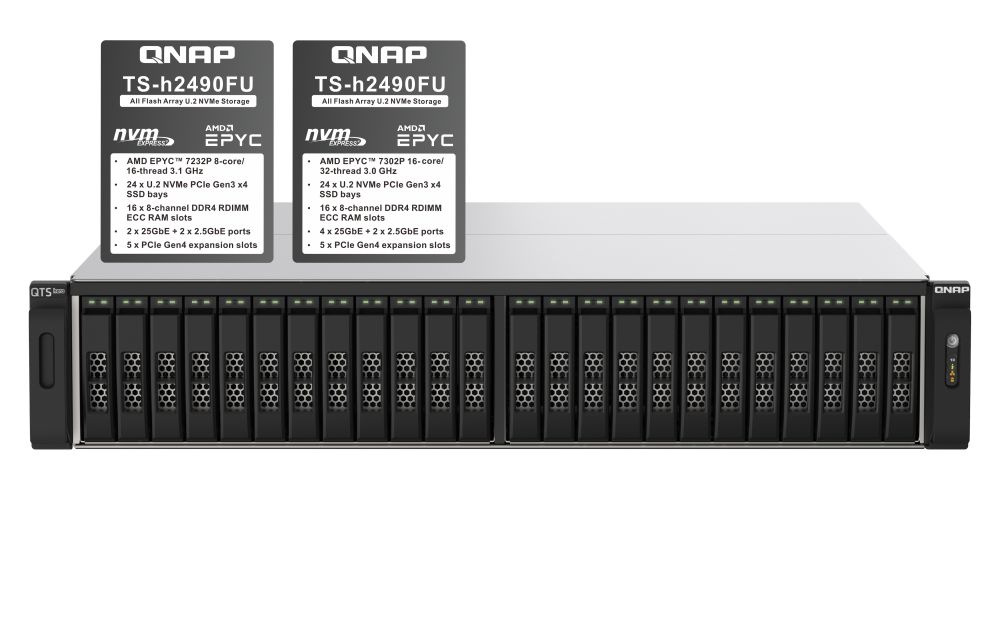
This research-based assessment covers the U.S. configuration identified by QNAP's Store as TS-h2490FU-7302P-128G-US: an AMD EPYC 7302P system with 128 GB ECC RDIMM. It is not a hands-on test, installation report, or independent benchmark. The official image identifies the TS-h2490FU chassis and labels two CPU/network variants, but it cannot establish which memory package or drives are in a seller's box.
The purchase question is whether this all-flash rack NAS fits a specific U.2 NVMe project—not whether “24 bays” is automatically better. The reviewed variant combines 24 front positions, a 25GbE interface and a 16-core processor, but uses a specialized drive format and a 2U installation. A smaller SATA NAS is usually a more sensible starting point for ordinary file sharing, while an enterprise team must still verify exact SSDs, network components, rack fit, software deployment and recovery operations.
One chassis, five manufacturer-listed configurations
QNAP's current U.S. comparison page exposes five TS-h2490FU hardware choices. The 7302P-128G reviewed here has an AMD EPYC 7302P (16 cores/32 threads, up to 3.3 GHz) and 128 GB DDR4 ECC RDIMM. The comparison lists 7302P-256G and 7302P-64G variants with the same processor and different memory totals. The 7232P-64G and 7232P-32G choices use an EPYC 7232P/7252 8-core/16-thread processor, listed up to 3.2 GHz. QNAP's English guide version 3 details only the 7232P-64G, 7302P-128G and 7302P-256G configurations, while its current comparison and hardware selector list all five. I retain that documentation-version difference rather than assuming every current selector choice has the same manual coverage.
The exact U.S. Store evidence identifies three configurations: 7302P-128G-US, 7302P-256G-US and 7232P-64G-US. It does not establish a seller suffix for the selector's 7302P-64G or 7232P-32G options. Ask the seller to put the full configuration identifier, CPU and memory on a written quote; do not infer a -US suffix from the hardware comparison. The alternative CPU and starting-memory packages are meaningful hardware distinctions, even though all five options share the same documented bay count and the currently documented port classes.
Twenty-four NVMe positions are not a generic drive shelf
The system is a 2U rack chassis with 24 hot-swappable 2.5-inch U.2 PCIe NVMe front positions. QNAP's U.S. hardware table specifies U.2 NVMe Gen 3 x4 SSDs; the English guide's broader compatibility table also names U.2/U.3 NVMe Gen 4/Gen 3 x4 drives and says Gen 4 drives operate at Gen 3 speeds. Treat that difference as a reason to verify the precise drive model on QNAP's live compatibility list, not as permission to buy any U.2 or U.3 drive. The manufacturer's base specification says the system ships without SSDs. I found no exact compatible drive model/firmware row to recommend, and the 24 positions do not imply 24 supplied drives or a particular usable capacity.
QNAP describes a ZFS-based QuTS hero system with compression, deduplication, snapshots and file services. These are platform capabilities, not a promise that every workload benefits equally or that they replace a tested recovery design. For a documented mirror example, a QuTS hero RAID 1 plan uses two separately selected compatible NVMe SSDs. QNAP's OS help describes RAID 1 as two disks holding identical copies and tolerating one disk failure while healthy. The NAS does not arrive with a populated mirror, and redundancy does not protect against deletion, malware, a failed NAS or a site-level event. Keep an independent backup and verify restoration.
Network and expansion depend on the selected configuration
The reviewed 7302P-128G has four built-in 25GbE SFP28 ports and two 2.5GbE RJ45 ports. QNAP's guide documents only two 25GbE ports on the 7232P-64G variant; the other 2.5GbE ports are listed for the model. The high-speed port rating is a single-port link capability, not expected file-transfer speed. The switch, client adapter, optics or DAC, cable, protocol, SSD set and workload all matter. Two 25GbE ports do not automatically provide a 50Gbps connection to one client.
The official page lists five PCIe Gen 4 slots, but the 7302P-128G's two dual-port 25GbE cards are preinstalled in slots 4 and 5. Do not plan an add-in card as though all slots were vacant; card width, lane sharing and compatibility matter. QNAP's published benchmark is not an independent test: the stated test used a 7302P-128G with QuTS hero 5.0.0, 24 WD NVMe SSDs in RAID 50, three additional dual-port 25GbE cards and six client PCs. Its reported throughput and IOPS cannot be treated as a typical result for a different SSD, network, memory or application.
Rack, power, package and evidence checks
The English guide lists dimensions of 88.3 × 481 × 510.2 mm (about 3.48 × 18.93 × 20.09 inches, H × W × D), two 1100 W power supplies and RAIL-A03-57 as a compatible, separately purchased rail kit. Its package list contains the NAS, two power cords, one Cat5e cable, drive screws and a quick installation guide; it does not list data SSDs or rails. Check cabinet depth and clearances, lift/service access, rack loading, cooling, power feeds, SFP28 connectivity and the seller's actual bill of materials before treating the chassis as deployable.
The manufacturer sources conflict on net weight: the version 3 guide says 15.2 kg (33.51 lb), while the current U.S. hardware table reports 36.97 lb. Both are manufacturer-published values, so I leave the net weight unresolved rather than selecting one. QNAP lists a five-year standard warranty; confirm the applicable terms and seller coverage for the exact offer. The U.S. product page and Store excerpts support model/configuration identity, but a current product page or catalog listing is not proof of your seller's package, inventory or delivery terms.
Who should shortlist it?
This is a reasonable candidate for a storage team that needs 24 native U.2 NVMe positions, plans an all-flash workload, can use QuTS hero and 25GbE, and has staff or an integrator to check the drive matrix, pool layout, software, network, rack and recovery plan. The 128 GB reviewed configuration may be a better fit than a higher-memory sibling when the workload and deployment design justify its specific CPU/RAM balance; this review does not claim a performance ranking among the options.
It is a poor default for a home NAS, a SATA-only rack, or a project whose requirements are simply capacity or a 10GbE link. The interface is specialized, drives and rails are separate checks, and a 2U enterprise appliance brings network, electrical, cooling and service needs that a bay count alone cannot reveal. Verify the full model name on the quote, the exact supported SSDs and firmware, chosen RAID layout, single-port network path, site requirements and independent backup target before buying.
Primary references
- QNAP U.S. TS-h2490FU product page and current U.S. configuration comparison
- QNAP U.S. hardware specifications and the TS-hx90FU User Guide, version 3
- QNAP U.S. Store TS-h2490FU configuration category and 7302P-128G-US identity page
- QNAP QuTS hero RAID reference and QNAP compatibility lookup
Key specifications
Key details at a glance
| Internal drive bays | 24 bays |
|---|---|
| Documented internal drive media | 2.5-inch U.2 NVMe PCIe Gen3 x4 SSD / 2.5-inch U.2/U.3 NVMe PCIe Gen4/Gen3 x4 SSD (guide v3; Gen4 operates at Gen3 speed) |
| Built-in Ethernet ports | 4 x built-in 25GbE SFP28 SmartNIC / 2 x built-in 2.5GbE RJ45 |
| Fastest individual Ethernet port | 25 Gbps |
| Installed system memory | 128 GB |
| Maximum listed memory | 4096 GB |
| Listed storage arrangements | RAID 1 / RAID 5 / RAID 6 / RAID 10 / RAID 50 / RAID 60 |
| USB 3.2 Gen 1 ports | 2 |
| Dimensions (H × W × D) | {'height': 88.3, 'width': 481, 'depth': 510.2} |
| Hardware warranty | 5 years |
| Data drives included in listed package | No |
| Processor | AMD EPYC 7302P |
| CPU cores | 16 |
| CPU threads | 32 |
| Installed memory type | DDR4 ECC RDIMM (guide v3: 8 x 16 GB) |
Use the exact model’s instructions for operating limits, supplied equipment and version differences.
Sources for this review
Sources for this assessment
- QNAP U.S. Tower / SMB product grid observation
- QNAP U.S. TS-h2490FU product page
- QNAP U.S. TS-h2490FU hardware selector and specification table
- QNAP current U.S. TS-h2490FU configuration comparison
- QNAP TS-hx90FU User Guide, version 3
- QNAP U.S. Store TS-h2490FU configuration category
- QNAP U.S. Store exact 7302P-128G-US identity page
- QNAP QuTS hero h5.2 User Guide: RAID types
- QNAP compatibility list and model-specific drive lookup
- QNAP official TS-h2490FU labelled product image
Check your setup before choosing a NAS
Use the finder to narrow documented desk/shelf or rack formats, internal-bay minimums, a single Ethernet-port rating and optional redundancy requirements.