
Your needs, this model
Does it fit your priorities?
How many compatible internal drive positions does the TS-h2287XU-RP-E2336-32G-US profile provide?
QNAP documents 22 native positions: The exact guide lists sixteen 3.5-inch and six 2.5-inch SATA positions. 3.5-inch trays support 3.5-inch SATA HDD or 2.5-inch SATA SSD; the 2.5-inch trays list SATA SSDs. Do not treat all positions as HDD slots. The guide lists hot-swap for all family positions. Check exact drive/firmware support. A count does not establish usable capacity or an exact compatible drive; check QNAP’s current list for each model and firmware.
Explore this need in the finder →Is the TS-h2287XU-RP-E2336-32G-US profile the same CPU and memory configuration as its family siblings?
No. This exact profile lists Intel Xeon E-2336, 6 cores/12 threads and 32 GB ECC DDR4. The U.S. selector and English guide both list 32 GB ECC DDR4; the guide lists 2 x 16 GB across four UDIMM slots. The family maximum is 128 GB. Confirm full model suffix and installed modules; specifications do not predict application performance.
Can the listed configuration use a two-drive mirror, and is one preconfigured?
QNAP’s exact software selector lists RAID 1 for QTS and QuTS hero. These are alternatives; the buyer chooses one, purchases two exact compatible drives and creates the pool. QNAP’s package list does not include data drives or an initialized array. A two-member mirror can tolerate one member drive failure but is not an independent backup.
Explore this need in the finder →What should I confirm for this rack installation and package?
The chassis is 3U and the English U.S. guide lists 2 x 550 W redundant supplies; RAIL-B02 is a listed compatible rail family. Data drives and rails are not in the standard package listing. Check the latest QNAP drawing, rack-post depth, rail fit, cable bend, airflow, loaded weight and independent power feeds. Current product and Store wording says five years but the guide says three; verify written terms for the exact delivered configuration.
Explore this need in the finder →Assessment basis: This is a document-based review of the exact QNAP TS-h2287XU-RP-E2336-32G-US profile, not a hands-on test or an offer-level guarantee. QNAP’s current U.S. model selector lists the six-core E-2336 and 32 GB ECC memory; its English-U.S. guide lists the same configuration and a 22-position hybrid layout. The exact U.S. Store route identifies the -US model suffix, but does not prove a third-party seller’s contents, current stock or price. QNAP’s product page and current hardware selector are the primary references.
A 22-position 3U chassis with two kinds of SATA tray
The important count is 22 native SATA positions, not 22 interchangeable hard-drive trays. QNAP and the model guide split that total into sixteen 3.5-inch positions and six 2.5-inch positions. The larger trays accept 3.5-inch SATA hard drives or 2.5-inch SATA solid-state drives; the smaller trays are listed for 2.5-inch SATA SSDs. A 2.5-inch hard drive is not claimed for the 2.5-inch-only slots. The guide says the drives are hot-swappable, but that does not make a specific disk compatible: verify each intended model and firmware on QNAP’s current compatibility list before purchasing. The 22-bay count is a physical starting point, not usable capacity or a supported maximum-drive-size claim.
The frame is a 3U rack NAS. The English-U.S. guide describes its 3U form and RAIL-B02 compatibility, while current rendered selector dimensions do not agree with the guide’s drawing. Do not treat either dimension set as rack clearance. Check the current chassis drawing, four-post rack geometry, rail adjustment range, rear cable bend, airflow and loaded rack capacity with QNAP and the rack vendor before buying. QNAP lists dual 550 W supplies; redundancy only helps if the two cords reach appropriately independent approved upstream power paths. Two sockets on one shared power strip do not provide independent supply.
What the E2336-32G package actually changes
The exact E2336 package uses an Intel Xeon E-2336, listed as six cores and twelve threads, with 32 GB ECC DDR4. The family selector lists a maximum of 128 GB across four UDIMM slots; the older guide describes the 32 GB as two 16 GB modules. For a memory upgrade, check QNAP’s current module recommendation and the exact hardware revision rather than assuming a convenient third-party kit will be supported. This configuration is distinct from the E2378-64G-US sibling: that option has an eight-core/sixteen-thread E-2378 and 64 GB installed memory. CPU core and RAM differences are meaningful selectors, but published specifications do not demonstrate a real workload advantage or predict VM, database, media or backup speed. Choose the E2336-32G only after checking the installed memory, expected services and future expansion needs.
Three PCIe Gen 4 positions provide a path for compatible network or storage expansion, but they are finite shared resources. QNAP’s exact profile already has two 10GBASE-T ports and two 2.5GbE ports. The fastest individual built-in Ethernet link is 10 Gbps; the other 10GbE connector does not make a single workstation connection 20 Gbps. A real transfer also depends on the client, switch, cabling, selected storage, filesystem, workload and any configured path aggregation. This is a link-rating comparison, not a throughput result.
Choose one operating system and build the array yourself
The current QNAP software selector exposes QTS and QuTS hero alternatives, with RAID 1 listed for this 8-bay-and-larger model. The English guide explains a two-member mirror’s one-disk-failure tolerance. QTS and QuTS hero are separate installation/storage plans, not software that should be assumed to run concurrently. QNAP warns that moving from QuTS hero to QTS requires removing the drives, so settle the OS choice before placing data. If a QTS-first or QuTS hero/ZFS workflow matters, confirm the exact delivered state and setup route with QNAP.
The manufacturer package description and guide do not list data drives or a preconfigured pool. A buyer could select two compatible SATA drives, install one chosen OS, then create a RAID 1 mirror that occupies two of the 22 native positions. The other trays remain open; their existence does not establish which expansion, volume or migration plan will suit the workload. Mirroring can help maintain access after one member disk fails while the other is healthy, but it is not backup against deletion, malware, theft, fire or loss of the whole NAS. Keep a separate recoverable copy and test restoration. No drive model is endorsed here because no exact approved model/firmware row was selected in this research.
Installation, package and warranty checks
QNAP’s guide lists the RAIL-B02 for this family, but the standard chassis package list does not include rails or data drives. Confirm whether the exact seller package contains the rail kit, power cords and any cards or drives you expect; do not infer add-ons from a model photo or a neighboring configuration. The guide’s three-year limited-warranty text conflicts with the current product page’s five-year standard-warranty wording. The discrepancy is unresolved here; read the written terms for the exact region and delivered configuration rather than treating either number as a seller-specific promise.
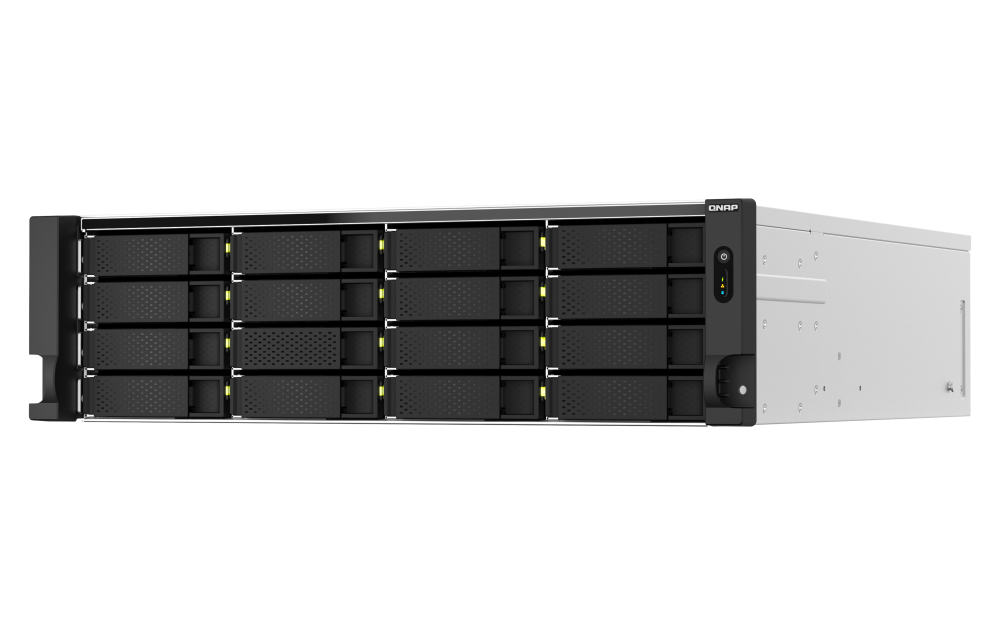
This profile is a plausible candidate when a deployment needs many internal positions, native 10GbE and a buyer-planned rack system with 3U available. It is less compelling if 22 mixed-media positions and three expansion slots exceed the real requirement, or if the design depends on unverified disks, a rail fit that has not been checked, or a presumed performance benchmark. The official image shows the TS-h2287XU-RP family’s 3U exterior, not the E2336 CPU/RAM variant, installed drives, rails or seller package. No independent measurements, acoustic or thermal testing, installation experience, ownership, or customer feedback are claimed.
Key specifications
Key details at a glance
| Internal drive bays | 22 bays |
|---|---|
| Documented internal drive media | 3.5-inch SATA HDD / 2.5-inch SATA SSD |
| Built-in Ethernet ports | 2 x 10GBASE-T RJ45 data ports / 2 x 2.5GbE RJ45 data ports |
| Fastest individual Ethernet port | 10 Gbps |
| Installed system memory | 32 GB |
| Maximum listed memory | 128 GB |
| Listed storage arrangements | RAID 1 |
| Data drives included in listed package | No |
| Processor | Intel Xeon E-2336 |
| CPU cores | 6 |
| CPU threads | 12 |
| Installed memory type | ECC DDR4 UDIMM |
Use the exact model’s instructions for operating limits, supplied equipment and version differences.
Sources for this review
Sources for this assessment
- QNAP U.S. TS-h2287XU-RP product page
- QNAP U.S. rendered TS-h2287XU-RP hardware selector
- QNAP U.S. rendered TS-h2287XU-RP software selector
- QNAP U.S. rendered TS-h2287XU-RP package selector
- QNAP TS-hx87XU-RP User Guide, English (U.S.)
- QNAP U.S. Official Store TS-h2287XU-RP-E2336-32G-US identity page
- QNAP TS-h2287XU-RP family image

Check your setup before choosing a NAS
Use the finder to narrow documented desk/shelf or rack formats, internal-bay minimums, a single Ethernet-port rating and optional redundancy requirements.