
Your needs, this model
Does it fit your priorities?
How many compatible internal drive positions does the TS-h1887XU-RP-E2336-16G profile provide?
QNAP documents 18 native positions: The exact guide lists twelve 3.5-inch and six 2.5-inch SATA positions. 3.5-inch trays support 3.5-inch SATA HDD or 2.5-inch SATA SSD; the 2.5-inch trays list SATA SSDs. Do not treat all positions as HDD slots. The guide lists hot-swap for all family positions. Check exact drive/firmware support. A count does not establish usable capacity or an exact compatible drive; check QNAP’s current list for each model and firmware.
Explore this need in the finder →Is the TS-h1887XU-RP-E2336-16G profile the same CPU and memory configuration as its family siblings?
No. This exact profile lists Intel Xeon E-2336, 6 cores/12 threads and 16 GB ECC DDR4. Current U.S. rendered hardware selector lists the E2336-16G profile with 16 GB ECC DDR4. The family guide lists four UDIMM slots and a 128 GB maximum but does not contain this order code; installed module layout and a U.S. retail suffix are not established. Confirm full model suffix and installed modules; specifications do not predict application performance.
Can the listed configuration use a two-drive mirror, and is one preconfigured?
QNAP’s exact software selector lists RAID 1 for QTS and QuTS hero. These are alternatives; the buyer chooses one, purchases two exact compatible drives and creates the pool. QNAP’s package list does not include data drives or an initialized array. A two-member mirror can tolerate one member drive failure but is not an independent backup.
Explore this need in the finder →What should I confirm for this rack installation and package?
The chassis is 2U and the English U.S. guide lists 2 x 550 W redundant supplies; RAIL-B02 is a listed compatible rail family. Data drives and rails are not in the standard package listing. Check the latest QNAP drawing, rack-post depth, rail fit, cable bend, airflow, loaded weight and independent power feeds. Current product and Store wording says five years but the guide says three; verify written terms for the exact delivered configuration.
Explore this need in the finder →Configuration scope: QNAP’s current U.S. rendered hardware and package selectors expose a TS-h1887XU-RP E2336-16G profile: Xeon E-2336 with 16 GB ECC DDR4. However, the English-U.S. guide’s order-code table and the captured U.S. Store category list E2334-16G-US and E2336-32G-US, not a corroborated E2336-16G-US retail SKU. This assessment preserves the selector profile without inventing a U.S. suffix or claiming an established sellable package. A listing or seller should be treated as the exact configuration only if its written specification identifies E-2336 and 16 GB. This is source-based, not hands-on research. See QNAP’s family page and its current hardware selector.
Same 18-position chassis, same mixed-media caveat
For this selector profile, the chassis is QNAP’s TS-h1887XU-RP with twelve 3.5-inch SATA positions and six 2.5-inch SATA positions. The larger trays are listed for 3.5-inch SATA HDDs or 2.5-inch SATA SSDs; the smaller trays are listed for 2.5-inch SATA SSDs. Count eighteen native positions but do not treat all as standard hard-drive trays. QNAP’s English guide says the family supports hot-swapping. That does not prove a particular drive model or firmware is suitable; check QNAP’s current model list before ordering storage.
The frame is 2U with dual 550 W power supplies and four 60 mm fans documented in the guide. The rail compatibility table lists RAIL-B02, but the standard package list does not include data drives or rails. QNAP’s current rendered dimensions do not match the 2024 guide, so use the current installation drawing and verify rack depth, post spacing, rear cable space, ventilation and loaded weight with the rack manufacturer. Two supplies need properly independent upstream paths if continuity is the goal; a shared feed remains a single point of failure.
The processor profile matches E2336-32G, but memory does not
The current selector identifies a six-core/twelve-thread Intel Xeon E-2336 and 16 GB ECC DDR4. That CPU identity matches the 32 GB E2336 selector/store configuration, but its installed memory amount is half as much. The E2334-16G profile differs in both CPU and memory: its CPU is an E-2334 with four cores/eight threads, while the E2336 16G and 32G profiles use six cores/twelve threads. These distinctions should remain separate when checking an offer. A model-page selector entry is not evidence that all retailers carry every configuration.
The family guide lists four UDIMM slots and a 128 GB maximum, but its package table does not contain this 16 GB E2336 order code. Do not transfer the guide’s E2336-32G module layout to this 16 GB selector profile. Verify module population, supported upgrades and the exact order/revision with QNAP before changing memory. No workload performance can be derived from processor identity, core count or a stated maximum. Compare the software stack’s actual RAM and CPU requirements with the manufacturer-supported package.
Ports and buyer-configured storage
The current selector lists two 10GBASE-T and two 2.5GbE RJ45 ports. The fastest individual built-in link is 10 Gbps; a second connector is not a 20Gbps workstation interface. End-to-end file transfers depend on a compatible client, switch, cable, storage pool and workload, and no speeds are independently measured here. QNAP lists three PCIe Gen 4 positions for optional cards, but any add-on must be checked for exact compatibility and may compete with other expansion plans.
QNAP exposes QTS and QuTS hero alternatives for this family and lists RAID 1 under both exact model software profiles. Choose one operating system; QNAP warns that switching from QuTS hero to QTS requires drive removal. An owner-created two-disk RAID 1 plan uses compatible SATA drives in two native positions. The package list does not promise data drives or an initialized array, and no specific drive/firmware pairing is verified in this review. A mirror can help after one member failure but is not an independent backup against deletion, malware, site loss or damage to the NAS. Keep a separate backup and test recovery.
Practical buying decision
Do not substitute the E2336-16G selector entry for an E2334-16G-US or E2336-32G-US offer just because the chassis names match. Ask for a full model/suffix and a written CPU/RAM description; if the source cannot establish this profile as a U.S. package, treat it as a research reference rather than an exact retail match. The system’s 2U form, 18 mixed SATA positions, four Ethernet ports and option to configure RAID 1 may fit a rack plan, but it remains a diskless, buyer-configured system. Verify RAIL-B02 fit, current clearances, memory support, network compatibility and specific drive models.
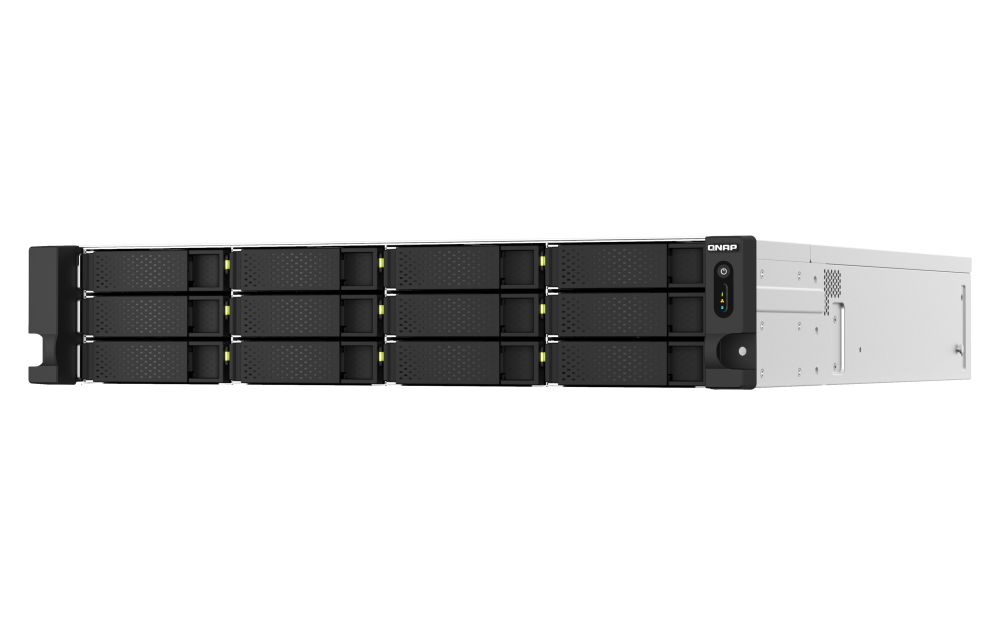
Warranty wording also differs by source: the model page currently says five years, while the English family guide says three years. Neither statement resolves the written terms attached to an unidentified seller offer. The official product-family image shows the 2U exterior and does not establish the E2336-16G memory package, installed disks, U.S. SKU, rails or box contents. No price, inventory, seller package, benchmark, measured power/noise, ownership or installation experience is asserted. The only evidence gap stated here is the uncorroborated U.S. retail identity of this exact selector configuration; the hardware profile itself remains a visible QNAP U.S. selector entry.
Key specifications
Key details at a glance
| Internal drive bays | 18 bays |
|---|---|
| Documented internal drive media | 3.5-inch SATA HDD / 2.5-inch SATA SSD |
| Built-in Ethernet ports | 2 x 10GBASE-T RJ45 data ports / 2 x 2.5GbE RJ45 data ports |
| Fastest individual Ethernet port | 10 Gbps |
| Installed system memory | 16 GB |
| Maximum listed memory | 128 GB |
| Listed storage arrangements | RAID 1 |
| Data drives included in listed package | No |
| Processor | Intel Xeon E-2336 |
| CPU cores | 6 |
| CPU threads | 12 |
| Installed memory type | ECC DDR4 UDIMM |
Use the exact model’s instructions for operating limits, supplied equipment and version differences.
Sources for this review
Sources for this assessment

Check your setup before choosing a NAS
Use the finder to narrow documented desk/shelf or rack formats, internal-bay minimums, a single Ethernet-port rating and optional redundancy requirements.