
Your needs, this model
Does it fit your priorities?
Do sixteen internal bays mean that the TS-h1677AXU-RP includes sixteen drives or a particular usable capacity?
No. The exact R7-32G selector lists sixteen 3.5-inch SATA positions, but the package list does not include data drives; usable space depends on the selected drives and storage layout. The two M.2 NVMe sockets are separate and do not increase native SATA bay count. Check exact drive models, capacity and firmware against QNAP's current compatibility list.
Explore this need in the finder →Does this package provide a single built-in 10-Gbps Ethernet port, and does that promise 10-Gbps file copies?
The exact hardware profile lists two individual 10GBASE-T ports, so it clears a 10-Gbps single-port line-rate floor but not the next allowed 10.5-Gbps step. That is not a file-transfer guarantee: the peer, switch, cable, storage, protocol and workload also matter, and the two connectors do not form one 20-Gbps client link.
Explore this need in the finder →Can I use a two-drive mirror on the TS-h1677AXU-RP-R7-32G-US?
The exact QTS and QuTS hero profiles each list RAID 1, and the guide describes a two-drive group that can tolerate one failed member. The diskless package does not include a preconfigured mirror; choose two individually compatible SATA drives, select one operating system and configure the array. Keep a separate backup.
Explore this need in the finder →Is the 192-GB memory ceiling and rail kit settled for every listing with this family name?
No. The current exact h1677 R7-32G selector says 192 GB maximum, but the older guide has a general 128-GB overview line and leaves the h1677 maximum blank in its detailed table. The guide names RAIL-B02 as compatible but says rails are not included. Confirm approved modules, exact SKU, current chassis drawing and kit fit for the delivered unit.
Explore this need in the finder →The QNAP TS-h1677AXU-RP-R7-32G-US is a diskless 3U rack NAS built around sixteen native 3.5-inch SATA positions, a Ryzen 7 7000-series processor and 32 GB of DDR5 memory. Its useful distinction is straightforward: it brings 16 bays and built-in 10GbE to a single chassis without moving to the 24-bay TS-h2477AXU-RP or the 30-position TS-h3087XU-RP. That makes the h1677 worth considering when an existing rack needs a middle ground in bay count—not a compact, quiet or ready-to-use box. This is a source-based assessment of the listed R7-32G-US configuration, not a hands-on test.
Sixteen native bays, plus separate M.2 sockets
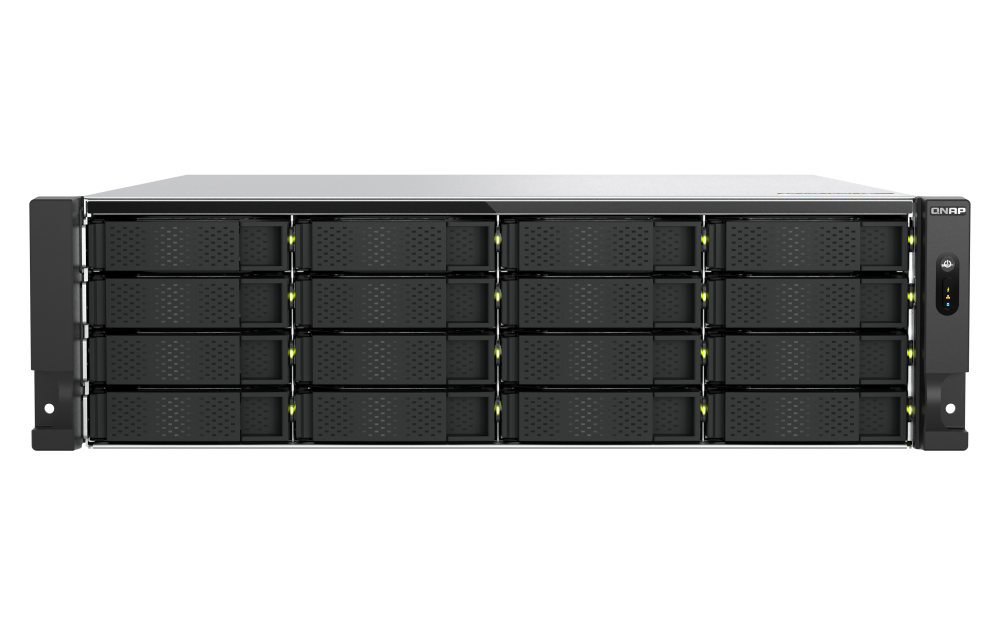
The exact hardware selector lists sixteen 3.5-inch SATA bays and 2.5-inch SATA SSD support. QNAP's manual describes the full 3U chassis, and the official front image shows sixteen empty tray faces. Neither the tray count nor the image means the package arrives with sixteen drives. QNAP's package list names the NAS, screws, a 10GBASE-T cable, two power cords and a quick-install guide; it does not list data drives.
There are also two M.2 2280 PCIe Gen 5 x2 NVMe sockets, but those are not extra SATA bays and the manual says the M.2 devices are not hot-swappable. Treat them as a separate storage or caching choice, after checking the exact SSD against QNAP's compatibility list and considering how it will be serviced. No individual compatible drive or SSD model is established in the sources reviewed here, so I would not buy media from connector type alone.
One 10GbE port is not a 10-Gbps file-copy promise
The U.S. hardware table lists two 10GBASE-T ports and two 2.5GbE ports. A single built-in 10GbE port satisfies a 10-Gbps link-rating requirement; the additional port does not turn that into one 20-Gbps client connection. Real file-copy speed depends on the client interface, switch, cabling, storage drives, protocol and workload. The h1677's three PCIe Gen 4 slots offer room to consider other adapters, but add-in capacity is not part of the built-in-port comparison and each card still needs a lane, fit and compatibility check.
QNAP identifies the exact R7-32G profile with an eight-core, sixteen-thread Ryzen 7 7000-series processor, 32 GB DDR5 UDIMM and four memory sockets. The current selector says the platform can support up to 192 GB (four 48-GB modules) and lists optional ECC support. An older guide's overview paragraph says 128 GB, while its detailed table assigns that 128-GB value to the smaller h1277 column and leaves the h1677 ceiling blank. The current exact selector is the more specific evidence for this configuration, but I would verify the approved memory kit and delivered revision before budgeting an upgrade. Optional ECC support is not proof that the standard 32-GB module is ECC.
RAID 1 is an option that still needs drives and setup
QNAP's model-specific software profiles list RAID 1 in both the QTS and QuTS hero eight-bay-and-larger tiers. Those are alternatives: QTS uses EXT4 and QuTS hero uses ZFS. The user guide describes a two-drive RAID 1 group that can continue in a degraded state after one member fails. A buyer must choose two compatible SATA drives, decide which operating system to initialize, and configure and monitor the array; the diskless package is not a prebuilt mirror. The two drives use two of the sixteen positions. A mirror can reduce interruption from one drive failure, but it is not an independent backup and does not protect against deletion, malware, theft, controller or enclosure loss, or other shared failures.
Rack planning is part of the purchase
This is a 3U rack appliance with two 550-W power supplies. The English-U.S. guide lists a 131 x 482 x 551 mm chassis, a net weight of 34.48 lb and three 60-mm fans. Those are manufacturer specifications, not my measurements; check the current drawing for overall depth, rail travel, rear cable clearance and loaded weight before assigning a cabinet position. The family guide says rails are not included and identifies RAIL-B02 as compatible, so do not mistake that rail reference for an included accessory or assume every rack uses the same fit kit.
The exact-model package listing says nothing about drives or rails, and a seller may offer a different bundle. QNAP's U.S. profile currently states a five-year standard warranty; confirm written warranty terms for the exact delivered SKU and channel. I would also check available rack power, cooling and service access: a rack NAS with spinning drives can create operational needs that the bare chassis specification does not answer.
Who should shortlist the h1677?
It is a reasonable fit to investigate for a rack deployment that genuinely needs sixteen internal positions, a built-in copper 10GbE path and a planned drive layout that benefits from a 3U platform. It offers more bay headroom than a 12-bay TS-h1277AXU-RP while staying below the 24-bay TS-h2477AXU-RP and 30-position TS-h3087XU-RP. Those are different chassis families and configurations, not interchangeable memory variants; compare each exact seller SKU, bay media, network needs, rack depth and loaded weight before deciding.
Skip it if your goal is an all-in-one ready-to-run purchase with drives, a confirmed rail kit and an already-created redundant array: the base configuration does not establish any of those. It is also a poor match for a desktop office with no rack, for a buyer who only needs a handful of bays, or for anyone expecting dual 10GbE to guarantee 20-Gbps transfers. The potentially large memory ceiling and PCIe slots are expansion options to validate, not reasons by themselves to overbuy.
Checks before ordering
- Match the listing to TS-h1677AXU-RP-R7-32G-US rather than relying on the family name or a different RAM/CPU suffix.
- Confirm the seller's full box contents, whether drives are actually included, and the exact RAIL-B02 kit and rack compatibility.
- Check every intended SATA drive and NVMe SSD model, capacity and firmware in QNAP's current compatibility list; do not assume M.2 is hot-swappable.
- Choose QTS or QuTS hero before setup, then configure and test the RAID 1 pair; plan a separate backup and a recovery procedure.
- Confirm the intended network peer, switch ports and Cat6A-class cabling path for 10GBASE-T, without treating the link label as a throughput estimate.
- Verify current dimensions, clearances, rail travel, loaded weight, cooling, memory kit and written warranty for the delivered revision.
The h1677 is most compelling as a well-specified 16-bay building block for an existing rack and a deliberately planned storage design. Its trade-offs are not hidden: the drive and rail purchases, system setup, compatibility research and network path remain the buyer's work.
Key specifications
Key details at a glance
| Internal drive bays | 16 bays |
|---|---|
| Documented internal drive media | 3.5-inch SATA hard drives / 2.5-inch SATA SSDs in supported 3.5-inch trays |
| Built-in Ethernet ports | 2 x built-in 10GBASE-T RJ45 / 2 x built-in 2.5GbE RJ45 |
| Fastest individual Ethernet port | 10 Gbps |
| Installed system memory | 32 GB |
| Maximum listed memory | 192 GB |
| Listed storage arrangements | QTS 8-bay-and-larger profile: RAID 1 / QuTS hero 8-bay-and-larger profile: RAID 1 |
| Hardware warranty | 5 years |
| Data drives included in listed package | No |
| M.2 NVMe slots | 2 |
| Processor | AMD Ryzen 7 7000 series |
| CPU cores | 8 |
| CPU threads | 16 |
| Installed memory type | 32 GB DDR5 UDIMM in exact R7-32G hardware-selector profile; optional ECC support is listed but the base module's ECC status is not asserted |
Use the exact model’s instructions for operating limits, supplied equipment and version differences.
Sources for this review
Sources for this assessment
- QNAP U.S. TS-h1677AXU-RP product page
- QNAP exact TS-h1677AXU-RP-R7-32G U.S. hardware selector, rendered observation
- QNAP exact-model U.S. QTS and QuTS hero profiles, rendered observation
- QNAP exact-model R7-32G U.S. package selector, rendered observation
- QNAP TS-hx77AXU-RP User Guide, English (U.S.)
- QNAP U.S. Official Store exact TS-h1677AXU-RP-R7-32G-US offer
- QNAP TS-h1677AXU-RP official U.S. model-family product image

Check your setup before choosing a NAS
Use the finder to narrow documented desk/shelf or rack formats, internal-bay minimums, a single Ethernet-port rating and optional redundancy requirements.