
Your needs, this model
Does it fit your priorities?
What is actually different between the three listed TS-h1290FX packages?
The U.S. model selector and Official Store list a 7232P-64G, a 7302P-128G and a 7302P-256G package. The first has an eight-core/16-thread CPU and 64 GB ECC memory; the two 7302P versions have 16 cores/32 threads, with 128 or 256 GB. The reviewed 128G package is not interchangeable with either suffix; check the complete part number and delivered configuration.
Does the 25GbE marking mean a workstation will copy files at 25Gb/s?
No. QNAP lists two 25GbE SFP28 interfaces, but the number is an individual-port link rating. The switch, client NIC, optics or DAC, cable, storage layout and concurrent workload all affect the end-to-end path; the two ports do not become a single 50GbE workstation link by default.
Explore this need in the finder →Can two bays be set up as RAID 1 without buying a separate mirror-ready bundle?
QNAP lists RAID 1 for both the QTS and QuTS hero eight-bay-and-larger software profiles, and its setup guidance describes selecting two drives. The NAS is listed without data drives, so select two compatible drives and configure the array yourself; a mirror can help with one drive failure but does not replace a separate backup.
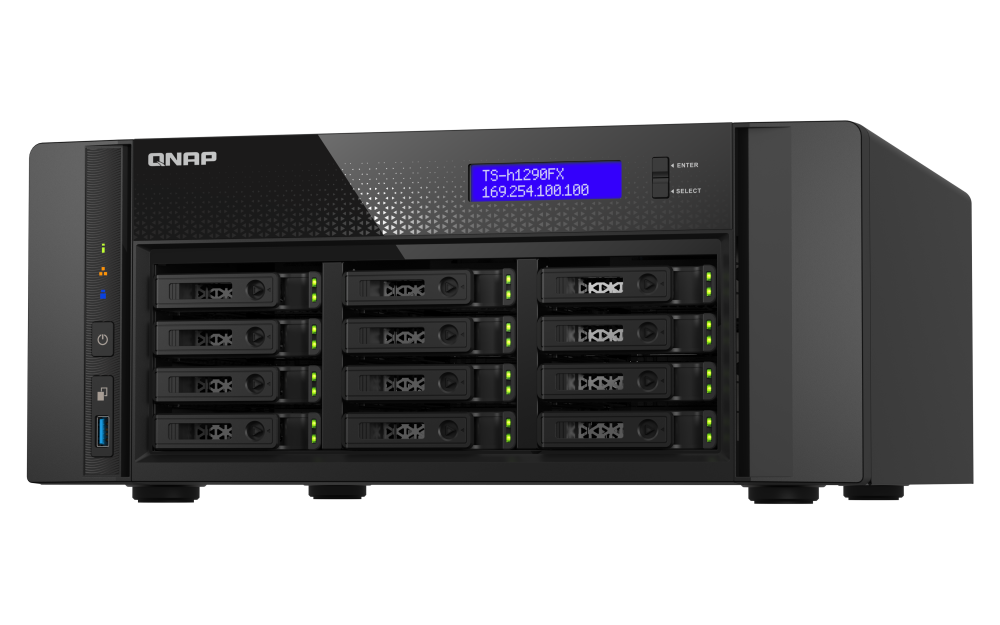
Explore this need in the finder →This assessment is for the exact U.S. package TS-h1290FX-7302P-128G-US, not a generic promise that every TS-h1290FX has the same processor and memory. QNAP's model page presents a 12-position tower NAS with U.2 NVMe/SATA support and built-in 25GbE; its U.S. store identity and model guide identify a 7302P processor with 128 GB ECC RDIMM. This is a document-based review, not a hands-on test. No performance run, noise measurement, installation or ownership experience is claimed.
Start with the package suffix, not just “TS-h1290FX”
The exact 128G configuration has an AMD EPYC 7302P, listed as 16 cores and 32 threads, with 128 GB of DDR4 ECC registered memory. QNAP also lists a TS-h1290FX-7232P-64G package with an eight-core/16-thread EPYC 7232P and 64 GB, and a TS-h1290FX-7302P-256G package with the 7302P and 256 GB. These are meaningful component differences even though the reviewed model guide keeps the same twelve drive positions and network layout across them. Verify the full part number on an offer and confirm the installed RAM before sizing a workload; a shared chassis name is not a memory or CPU guarantee.
The 128G SKU is a substantial memory configuration, but the evidence does not say what any particular application will achieve. It is better read as a platform for a team that already has a storage, compute and network plan than as a household upgrade chosen from the model name alone.
Twelve 2.5-inch positions, with a compatibility task attached
QNAP's English U.S. guide lists twelve 2.5-inch positions and supports U.2 NVMe PCIe Gen 4 SSDs, SATA SSDs and SATA hard drives. The model is marketed as an all-flash NAS, but the exact supported media and your workload should guide the array design. The manufacturer says the unit ships without data SSDs. Twelve empty positions are not storage capacity: usable space depends on the chosen drives, their capacities, the filesystem and the layout.
Before buying drives, check each complete model, capacity and firmware in QNAP's live TS-h1290FX compatibility lookup. Do not infer support from an M.2/U.2 connector or from the fact that another QNAP model accepts the same-looking drive. The U.2/SATA native bays are also distinct from optional PCIe cards or a separate adapter-based M.2 plan. A budget should include the drives, compatible trays or adapters if needed, network hardware, and the time to configure and verify the system.
QTS and QuTS hero are alternative operating plans
The current U.S. software table shows QTS and QuTS hero profiles separately. QTS uses EXT4; QuTS hero uses ZFS. The exact-model table lists RAID 1 in the eight-bay-and-larger tier under both profiles. That is evidence that two drives can be selected for an owner-configured mirror; it is not a preinstalled array, and the software options should not be combined into one supposed setup. Confirm which operating system the exact offered package will use and review current migration instructions before changing an existing volume.
A two-drive RAID 1 group mirrors data and can tolerate a member-drive failure while the group remains within its documented limits. It consumes the capacity of one member, requires two compatible drives, and does not protect against deletion, malware, theft, electrical damage or loss of the entire NAS. Keep a separately recoverable backup and test a restore. If you want more usable capacity or a different failure model, compare the other layouts in the chosen OS documentation rather than assuming the 12 bays automatically form a particular pool.
25GbE is a link capability, not a transfer promise
The reviewed configuration lists two built-in 25GbE SFP28 ports and two 2.5GbE RJ45 ports. For a single-port requirement, one SFP28 port meets a 25-Gbps link-rating threshold. It does not predict file-copy speed: the peer NIC, switch, transceiver or DAC, cabling, storage layout, filesystem, protocol and number of active clients all matter. Two ports do not automatically become one 50GbE connection for a workstation.
That makes the network a system purchase. Confirm that the host and switching fabric can use the intended SFP28 speed, that the right optics or direct-attach cable are compatible, and that the workstation storage and software can take advantage of the path. If the existing home or office network is gigabit or 2.5GbE, the 25GbE rating may add cost without changing that route.
Placement and setup are part of the decision
The product is a desktop tower, not a rackmount chassis. The model guide lists twelve trays, a 750 W, 100–240 V supply, two system fans and one CPU fan, plus four PCIe Gen 4 expansion slots. Those specifications help plan a location and expansion checklist; they are not a measurement of power draw, temperature, acoustic level or real workload performance. Leave ventilation and service space, and check card dimensions and power requirements before selecting any expansion board.
QNAP's listed package contents include the NAS, drive trays and keys, a power cord, drive screws and a quick-install guide. The hardware table says the system is shipped without SSDs. That is the manufacturer's stated package list, not a guarantee about every seller's bundle. Ask for the exact configuration, any installed drives, accessories, warranty and support terms in writing; this review does not certify a particular reseller package.
Where it sits beside other reviewed models
Within QNAP's reviewed all-flash choices, the TS-h1290FX occupies a middle ground in physical bay count between the ten-position TS-h1090FU and the 24-position TS-h2490FU, while using a tower enclosure rather than the rack chassis of those two. The separate QAI-h1290FX shares a similar name and twelve-position count but is a different product record with a different model page and its own compute/GPU-oriented proposition; do not transfer its configuration or package claims here. Compare exact model documentation, mounting, drive compatibility and network design rather than treating the names as a product family guarantee.
Bottom line: the TS-h1290FX-7302P-128G-US is a plausible shortlist entry when twelve internal 2.5-inch positions, a documented 25GbE port, ECC memory and either QTS or QuTS hero are actual requirements. It is a poor shortcut for someone expecting included SSDs, an already-built array, a simple household setup or tested transfer rates. Confirm the exact seller configuration, select compatible drives and an OS, design the complete network path, and maintain a separate backup before relying on the enclosure.
Primary references: QNAP U.S. TS-h1290FX product page; TS-h1290FX User Guide; QNAP software specification profiles; QNAP drive compatibility lookup; QTS RAID documentation and QuTS hero RAID documentation. Manufacturer marketing is not treated as independent testing.
Key specifications
Key details at a glance
| Internal drive bays | 12 bays |
|---|---|
| Documented internal drive media | 2.5-inch U.2 NVMe PCIe Gen 4 x4 SSD / 2.5-inch SATA SSD / 2.5-inch SATA HDD |
| Built-in Ethernet ports | 2 x built-in 25GbE SFP28 SmartNIC ports / 2 x built-in 2.5GbE RJ45 ports |
| Fastest individual Ethernet port | 25 Gbps |
| Installed system memory | 128 GB |
| Maximum listed memory | 1024 GB |
| Listed storage arrangements | QTS: 8-bay-and-larger options include RAID 1, 5, 6, 10, 50 and 60 / QuTS hero: 8-bay-and-larger options include RAID 1, 5, 6, 10, 50, 60, Triple Mirror and Triple Parity |
| USB 3.2 Gen 1 ports | 3 |
| Hardware warranty | 5 years |
| Data drives included in listed package | No |
| Processor | AMD EPYC 7302P |
| CPU cores | 16 |
| CPU threads | 32 |
| Installed memory type | 128 GB DDR4 ECC RDIMM (8 x 16 GB in the U.S. English model guide) |
Use the exact model’s instructions for operating limits, supplied equipment and version differences.
Sources for this review
Sources for this assessment
- QNAP U.S. TS-h1290FX product page
- QNAP U.S. TS-h1290FX hardware selector
- QNAP TS-h1290FX User Guide, English (U.S.)
- QNAP U.S. TS-h1290FX software profiles
- QNAP U.S. TS-h1290FX package contents
- QNAP U.S. Official Store TS-h1290FX-7302P-128G-US configuration page
- QNAP U.S. Official Store 12-bay Video Production category
- QTS 5.2.x RAID types
- QuTS hero h5.2.x RAID types
- QNAP Drive Compatibility entry point
- U.S. CPSC recall search scope
Check your setup before choosing a NAS
Use the finder to narrow documented desk/shelf or rack formats, internal-bay minimums, a single Ethernet-port rating and optional redundancy requirements.