
Your needs, this model
Does it fit your priorities?
Does TS-h1065eU mean ten native SATA bays?
No. The exact non-RP U.S. hardware profile lists eight front SATA positions. It also lists two separate rear NVMe positions; QNAP's product overview and exact table say two, while one later marketing passage says three. Neither those sockets nor a separately connected JBOD adds native SATA bays. Check exact SATA/NVMe model and firmware compatibility before ordering.
Explore this need in the finder →Can this non-RP package support a two-drive mirror?
Yes, as a buyer-created layout: QNAP's exact eight-bay QTS and QuTS hero tables each list RAID 1. Choose one OS, supply two compatible drives and initialize the pool yourself. The standard package does not include data drives or a prepared array, and a mirror is not a separate backup.
Explore this need in the finder →Can one built-in network port meet a 2.5-Gbps minimum?
Yes. Each of the two built-in Ethernet jacks is listed at 2.5GbE, so either individual port meets that link-rate floor. They are not one 5-Gbps client link; optional faster adapters require separate fit and network-path checks.
Explore this need in the finder →Does the non-RP suffix indicate redundant power supplies?
No. This exact hardware profile lists one 250 W supply and one power cord. The separately reviewed RP sibling lists two 300 W supplies. Confirm the exact SKU and upstream PDU/circuit design if power-path resilience matters.
Explore this need in the finder →Eight native trays, not ten
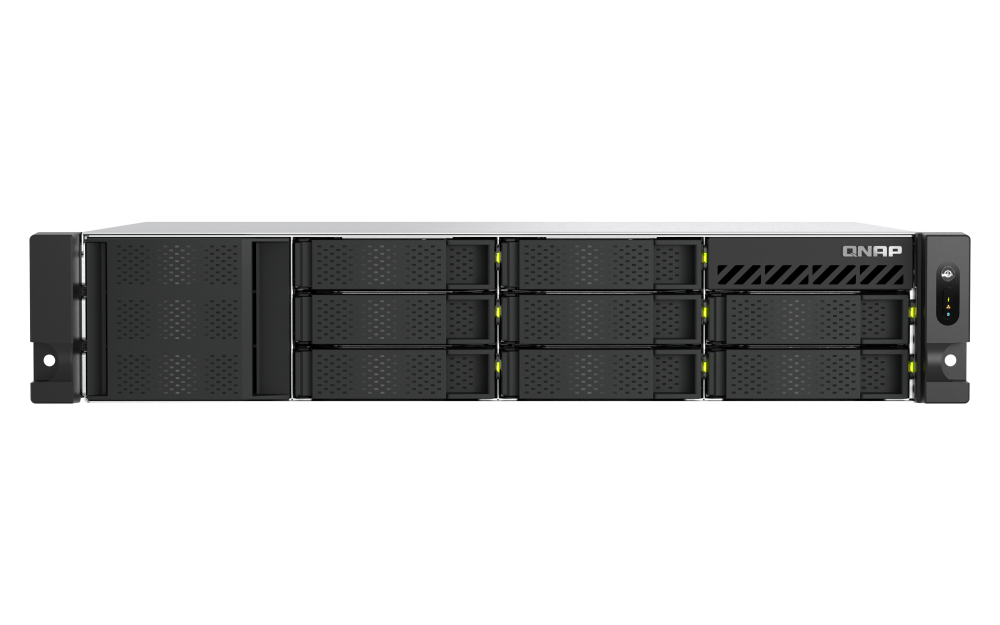
The exact U.S. configuration is listed as TS-h1065eU-8G-US by QNAP’s Official Store and as TS-h1065eU-8G in the U.S. hardware selector. Keep the absence of “RP” in that name: the separately assessed TS-h1065eU-RP-8G-US is not a spelling variant. The non-RP model is a two-unit short-depth rack NAS, not an external shelf or a desktop enclosure.
Its native count is eight front 3.5-inch SATA positions. QNAP lists compatibility there for 3.5-inch SATA hard drives and 2.5-inch SATA solid-state drives. The separate two rear E1.S/M.2 NVMe Gen3 x1 positions are not more front SATA trays; M.2 use is documented with a preinstalled QDA-E1SM2 adapter. One later product-page marketing paragraph says three NVMe slots, but the product overview and exact hardware table both say two. I use the specific table’s two-position count and would ask QNAP to resolve the discrepancy before buying a third NVMe device. A separately connected TL-R1200C-RP can add external storage, but it does not change this box’s eight-bay native count.
Choose a storage plan before loading the trays
The current QNAP software selector shows two alternative operating systems: QTS 6.1.0 with EXT4, or QuTS hero h6.1.0 with ZFS. Its exact eight-bay rows list RAID 1 under each system. That supports a buyer-created two-drive mirror, not a preinstalled array: select one OS, obtain drives whose exact model and firmware are on QNAP’s current compatibility list, initialize the storage pool and decide what the remaining six trays will do. A two-drive mirror reduces usable capacity compared with adding both drive capacities together. It can help with some single-drive failures; it is not protection from deletion, ransomware, theft, a failed NAS or an unusable backup. Keep a separate copy and test that it can be restored.
The model-specific software page lists a 250 TB maximum volume in its QTS table subject to at least 4 GB of memory, and separate, much larger ZFS pool/shared-folder figures in the QuTS hero table. Those are software limits, not drive-capacity promises. The selector starts this package with 8 GB of DDR5 SODIMM memory in one slot and lists a 16 GB maximum. That ceiling is worth considering if the planned services depend on memory-heavy deduplication or virtual machines. QNAP identifies an Intel four-core processor but does not name its exact SKU in this U.S. profile, so a processor brand and core count should not be mistaken for a workload benchmark.
Two 2.5GbE jacks are two separate paths
The hardware selector lists two built-in 2.5GbE ports. For a 2.5-Gbps minimum on one port, this configuration reaches that rated link speed. The ports do not become a single 5-Gbps connection to one client, and the rating is not a measured file-transfer result. A faster switch, client NIC, cabling, storage setup and workload all matter. QNAP's current model-specific compatibility data lists named 5GbE and 10GbE expansion cards, but the base model still has one PCIe Gen3 x2 slot; verify the exact card's bracket, link requirements and intended device arrangement rather than treating an add-on speed as built in.
There is also a small documentation mismatch for external-device planning. The hardware table lists one USB 3.2 Gen 2 Type-A port rated at 10 Gbps, while the Store short description calls the USB interface Gen 1 at 5 Gbps. I would not choose this unit for a tight USB speed requirement without asking QNAP to reconcile the exact port generation. The selector separately lists three USB 2.0 ports.
Non-RP means a different power tradeoff
The most consequential difference from the RP sibling is power hardware. This non-RP selector profile lists one 250-watt, 100–240-volt power supply and the package page lists one power cord. The separate RP profile has two 300-watt supplies. Do not apply the RP model’s supply count or wattage to this SKU. If a second supply is a hard requirement, compare the RP review instead; even a dual-supply NAS needs appropriately separate upstream circuits or PDUs to reduce a shared power failure.
QNAP lists the chassis as 2U short-depth and gives body dimensions of 3.49 × 17.01 × 11.71 inches (H × W × D), with 20.3 pounds net weight. Its marketing page describes the depth as about 12 inches. Neither dimension proves cabinet fit: rails, rack-post depth, front and rear service space, cable bends, ventilation and installed drive weight still matter. QNAP’s product-page fit note names RAIL-B02 and Rail-S01; the hardware accessory list and the current model-specific compatibility data name RAIL-B02 and RAIL-S02. The compatibility rows have no rail descriptions, so they do not settle the Rail-S01/S02 discrepancy or cabinet fit. Rails are not on the standard package list; verify the exact rail with QNAP rather than ordering from the model names alone.
What the package and lab pages do—and do not—settle
QNAP’s standard package list names the chassis, one Ethernet cable, one power cord, drive screws and a Quick Installation Guide. It does not list data drives, a preconfigured pool or rack rails. That is not a bill of materials for every seller bundle; check the written offer for the exact TS-h1065eU-8G-US suffix and any added components. The three-year standard warranty listed by QNAP is also a manufacturer specification, not confirmation of the seller’s terms for a particular unit.
QNAP publishes model-family lab material for the TS-h1065eU. Its current product page shows a QTS 5.2.6 test with eight 1 TB SATA SSDs in RAID 5 and an add-in 10GbE card; a separate model-performance page also contains older QTS 4.5/5.0 tests. These are vendor results for stated, expanded configurations—not independent measurements or a guaranteed speed. The test configuration is not the standard 8G-US package, and the result is not one built-in 2.5GbE-port throughput. This assessment uses manufacturer documentation, not personal ownership, installation or testing.
QNAP’s current TS-h1065eU compatibility data names exact models and firmware for its 3.5-inch HDD, SATA SSD, M.2 SSD and E1.S SSD rows. Compare the intended model, interface, capacity and firmware with the matching row before buying media; the response has no separate 2.5-inch HDD category, which does not prove either support or incompatibility. It also lists exact card and rail-kit names, but that is not proof of seller-included parts, rack clearance or a particular simultaneous expansion arrangement. Verify the written order for seller contents.
Key specifications
Key details at a glance
| Internal drive bays | 8 bays |
|---|---|
| Documented internal drive media | 3.5-inch SATA HDD / 2.5-inch SATA SSD / E1.S NVMe SSD / M.2 NVMe SSD with preinstalled QDA-E1SM2 adapter |
| Built-in Ethernet ports | 2 x built-in 2.5GbE RJ45 |
| Fastest individual Ethernet port | 2.5 Gbps |
| Installed system memory | 8 GB |
| Maximum listed memory | 16 GB |
| Listed storage arrangements | QTS 6.1.0 / EXT4: exact eight-bay software row lists RAID 1 / QuTS hero h6.1.0 / ZFS: exact eight-bay software row lists RAID 1 |
| Internal file systems | EXT4 (QTS 6.1.0 alternative) / ZFS (QuTS hero h6.1.0 alternative) |
| Dimensions (H × W × D) | 88.6 x 432.1 x 297.4 mm (converted from QNAP's listed inches) |
| Weight | 9.21 kg |
| Hardware warranty | 3 years |
| Data drives included in listed package | No |
| M.2 NVMe slots | 2 |
| M.2 SSD storage-pool support | Yes |
| Maximum total drive bays with listed expansion | 20 bays |
| Expansion-unit note | Eight native chassis bays plus one separately connected 12-bay JBOD is the manufacturer's described expansion arithmetic. The additional bays are external and do not make a 20-native-bay NAS. |
| Listed expansion unit | One external QNAP TL-R1200C-RP 12-bay JBOD expansion enclosure is described by QNAP |
| Processor | Intel four-core processor; exact SKU not identified in the inspected U.S. profile |
| CPU cores | 4 |
| Installed memory type | 8 GB DDR5 SODIMM; QNAP describes non-ECC memory with In-Band ECC support |
Use the exact model’s instructions for operating limits, supplied equipment and version differences.
Sources for this review
Sources for this assessment
- QNAP U.S. Tower / SMB finite product grid — TS-h1065eU card
- TS-h1065eU — QNAP U.S. product page
- TS-h1065eU-8G — QNAP U.S. hardware selector
- TS-h1065eU-8G — QNAP U.S. software selector
- TS-h1065eU — QNAP U.S. package contents
- QNAP U.S. Official Store short-depth category — exact SKU row
- QNAP U.S. Official Store 2U (8 Bay) category — exact SKU row
- TS-h1065eU-8G-US — QNAP U.S. Official Store item identity
- TS-h1065eU — QNAP model-specific performance configuration page
- TS-h1065eU official front chassis image — QNAP
- TS-h1065eU exact-family compatibility data — QNAP

Check your setup before choosing a NAS
Use the finder to narrow documented desk/shelf or rack formats, internal-bay minimums, a single Ethernet-port rating and optional redundancy requirements.