
Your needs, this model
Does it fit your priorities?
Does the RP-2600-8G meet an eight-bay, 10GbE and two-drive RAID 1 screen?
Yes at the specification level: QNAP lists eight SATA trays, two individual 10GbE SFP+ ports, QTS RAID 1 and the exact Ryzen 5 2600 / 8 GB profile. The drives and pool are not included or preconfigured; verify exact drive compatibility and maintain a separate backup.
Explore this need in the finder →How does it differ from the RP-1200-4G?
The reviewed 2600-8G configuration uses a six-core/twelve-thread Ryzen 5 2600 and 8 GB memory; RP-1200-4G uses a four-core/four-thread Ryzen 3 1200 and 4 GB. Both are eight-bay RP systems, but verify each full profile rather than transferring CPU or memory fields.
Explore this need in the finder →Are the rails and drives included?
The QNAP guide says drives are not included and identifies RAIL-B02 as compatible but sold separately. The exact seller’s written bill of materials still controls any offer-specific contents.
Explore this need in the finder →Scope: the 8 GB RP configuration
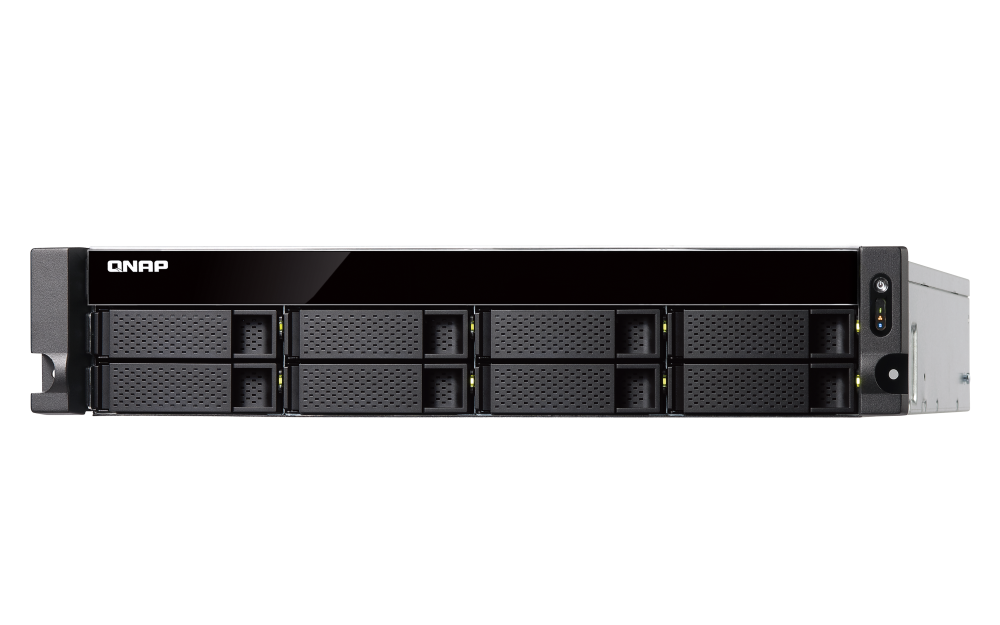
This review covers the QNAP TS-877XU-RP-2600-8G configuration linked from a U.S. Official Store card. The item path contains an “-US” suffix, but the descriptive card does not independently establish a full seller SKU or bill of materials; QNAP’s exact selector labels the hardware TS-877XU-RP-2600-8G. The profile has an AMD Ryzen 5 2600, 8 GB of DDR4 UDIMM memory and the RP chassis. QNAP marks the selector configuration Legacy. It is distinct from the RP-1200-4G and non-RP TS-877XU-1200-4G; CPU, memory and power hardware differ. This is not a hands-on test, workload benchmark or claim of current retail availability.
Eight conventional SATA trays and 10GbE
The 2U chassis has eight native 3.5-inch SATA bays and supports compatible 2.5-inch SATA HDDs or SSDs in the trays. QNAP’s guide says the NAS is shipped without disks. The family guide and current model selector agree on two 10GbE SFP+ SmartNIC ports plus two 1GbE RJ45 ports. The matcher’s 10Gbps figure describes one individual port, not combined interfaces or guaranteed transfer speed. The switch, client adapter, cabling, storage media and traffic pattern all constrain the full path.
QNAP’s hardware selector lists four PCIe slots—two Gen 3 x8 and two Gen 3 x4. Slot widths and intended card fit should be checked against the exact platform and existing add-ins; the printed slot count is not a guarantee that any desired expansion card will fit or work. If 10GbE is unfamiliar in the rack, resolve optics or DACs, switch compatibility and network segmentation before treating it as an advantage.
What the 2600/8G suffix buys
QNAP specifies a six-core/twelve-thread Ryzen 5 2600 with a burst rating up to 3.9 GHz and 8 GB installed memory. The model selector lists four UDIMM DDR4 slots and a 64 GB ceiling. That is a more substantial starting configuration than the RP-1200-4G sibling, which has a four-core Ryzen 3 1200 and 4 GB. It does not establish application performance for a particular VM, iSCSI load or concurrent-user count. If a workload requires a memory floor, verify the actual module configuration in the unit and the supported QNAP modules before assuming an upgrade.
An older family guide labels the memory slots “LDIMM,” while the exact hardware selector identifies UDIMM. Treat the current exact selector as the more specific profile, but confirm the correct module type with QNAP before a memory purchase. The model is Legacy, so an expansion decision should also include current firmware, parts and support checks.
RP power is a real difference, not a performance upgrade
The RP unit’s published power specification is two hot-swappable 300 W supplies, unlike the standard TS-877XU’s single 350 W supply. Redundant supplies can preserve power input after one supply fails when the system and feeds are correctly configured; they do not protect the NAS from storage failure, controller faults or a shared electrical outage. Separate the feeds if the installation design supports that, and verify the facility’s load, cooling and power requirements. The rack rails are not listed as included: QNAP names RAIL-B02 as compatible, so confirm the exact kit and post range.
A mirror is a buyer-created plan
QTS supports RAID 1 on this eight-bay family. A two-drive mirror can be built from two separately chosen compatible drives; the product is not described as arriving with a pool already created. With equal drives, the mirror’s usable capacity is roughly one drive before formatting and system overhead. It can withstand one member-drive failure in a healthy array but is not a separate backup. Keep independent copies and test restoring them. Check every intended drive’s exact model, capacity and firmware in QNAP’s compatibility list; this review does not approve a generic SATA drive SKU.
Fit and limits
Choose this profile only if eight SATA positions, a built-in single 10GbE link, the 2600/8G compute starting point and RP power hardware fit an actual deployment plan. At 2U and about 22 inches deep, the unit still needs careful rack-depth, service-clearance and loaded-weight checks. It is not a current-reference buy recommendation: QNAP’s selector labels the configuration Legacy, so confirm software support, replacement parts, warranty terms and the exact seller’s configuration before relying on it for new production storage. If the RP suffix is not required, compare it with the separate standard chassis rather than assuming the power design is interchangeable.
Primary references
- QNAP TS-877XU-RP U.S. page and exact configuration selector
- QNAP software selector
- QNAP TS-x77XU User Guide, English-U.S.
- QNAP drive compatibility lookup
Key specifications
Key details at a glance
| Internal drive bays | 8 bays |
|---|---|
| Documented internal drive media | 3.5-inch SATA HDD / 2.5-inch SATA HDD (maximum 9.5 mm tray height) / 2.5-inch SATA SSD (maximum 9.5 mm tray height) |
| Built-in Ethernet ports | 2 x 10GbE SFP+ SmartNIC / 2 x 1GbE RJ45 |
| Fastest individual Ethernet port | 10 Gbps |
| Installed system memory | 8 GB |
| Maximum listed memory | 64 GB |
| Listed storage arrangements | RAID 1 |
| Dimensions (H × W × D) | {'height': 88.3, 'width': 482, 'depth': 562} |
| Weight | 12.17 kg |
| Data drives included in listed package | No |
| Processor | AMD Ryzen 5 2600 |
| CPU cores | 6 |
| CPU threads | 12 |
| Installed memory type | DDR4 UDIMM; current QNAP selector lists four UDIMM slots. |
Use the exact model’s instructions for operating limits, supplied equipment and version differences.
Sources for this review
Sources for this assessment

Check your setup before choosing a NAS
Use the finder to narrow documented desk/shelf or rack formats, internal-bay minimums, a single Ethernet-port rating and optional redundancy requirements.